 AI History: 6 Times We Changed How We Teach Machines, From Hand-Written Rules to Reasoning AI
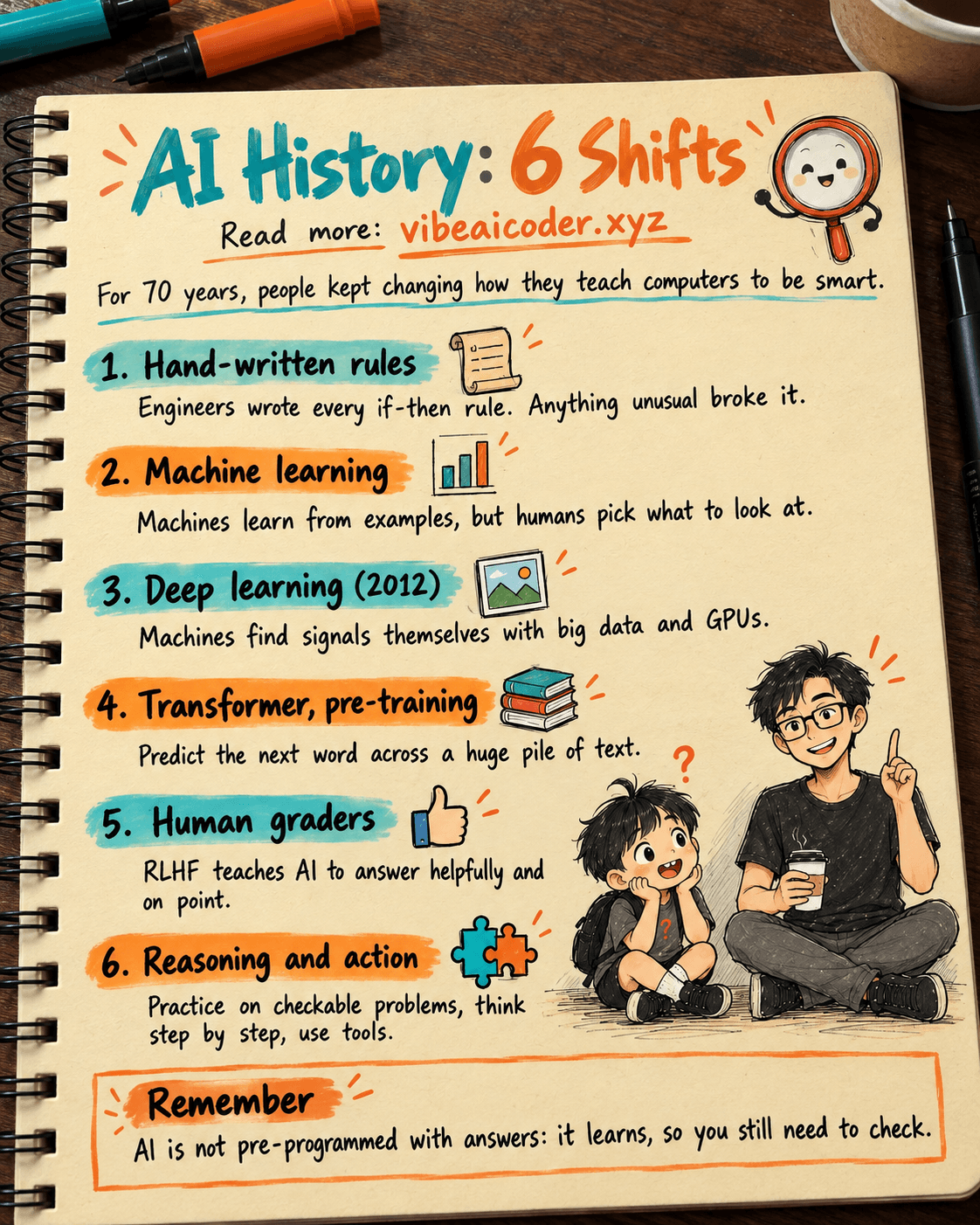
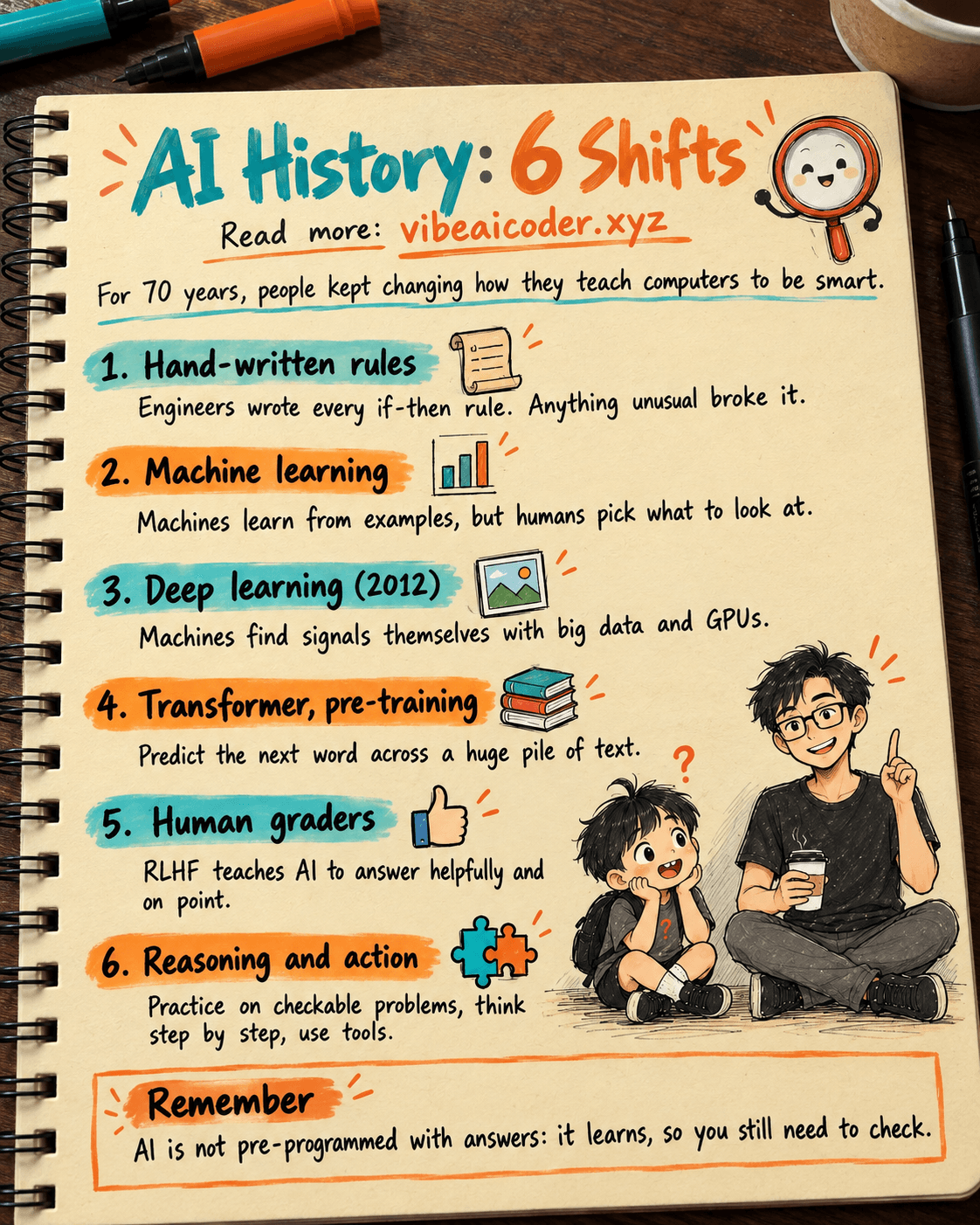
The history of AI is a 70-year story of people changing how they teach computers. At first, engineers wrote every rule by hand. Today, machines learn on their own from trillions of words, then get graded by people and practice until they can think step by step. Once you see this journey, you understand why ChatGPT and Claude are so capable, and why they still get things wrong.
If you are new to AI, start with What is AI, explained simply.
A quick everyday analogy
Imagine teaching an apprentice to cook noodle soup across six eras:
- Hand over a detailed rule book: "if the water boils, lower the heat; if it is salty, add water". Anything not in the book and the apprentice freezes.
- Let them taste many bowls, but you point out what to notice: how clear the broth is, how tender the meat is. They work out which bowls are good.
- Let them taste a huge number of bowls and point out nothing: they discover by themselves what makes a great bowl.
- Have them read every cookbook in the world before they ever enter the kitchen.
- Bring in a head chef to grade each bowl: customers love this one, that one needs work.
- Give them practice dishes with clear right answers, tell them "think it through step by step before you cook", and hand them tools like a scale and a thermometer.
Those six ways of teaching map almost exactly onto the six eras of building AI models.
 How the way we build AI has evolved
1. Writing rules by hand (1950s to 1980s)
In 1950, Alan Turing asked "can machines think?". In 1955, four scientists (John McCarthy, Marvin Minsky, Nathaniel Rochester and Claude Shannon) wrote a proposal for a summer workshop at Dartmouth College in 1956. That proposal is credited with introducing the term "artificial intelligence".
The method back then: engineers interviewed experts and turned their knowledge into hundreds or thousands of "if... then..." rules. These were called expert systems. MYCIN at Stanford (1970s), for example, identified bacteria behind blood infections and suggested antibiotics using about 600 rules.
The weakness: the world is full of exceptions. The more rules you add, the harder they are to fix, and anything unusual breaks them. When the hype did not pay off, funding dried up, a period researchers call the "AI winter".
Meanwhile, a less popular idea was growing: neural networks. In 1958 Frank Rosenblatt built the Perceptron, a machine that learned to classify from examples instead of rules. In 1986 David Rumelhart, Geoffrey Hinton and Ronald Williams popularized a way to train multi-layer networks to correct their own errors (backpropagation: when a guess is wrong, trace back which parts caused the error and adjust them). Good idea, but computers were too weak and data too scarce.
2. Learning from data, with humans choosing what to look at (1990s to 2000s)
Instead of writing rules, people gave machines lots of examples with known answers. This is machine learning. The machine works out how much each signal matters.
But humans still had to decide where the machine should look. Take a spam filter: engineers told it to count words like "free", the number of links, the amount of capital letters. Pick the right signals and it works well; pick the wrong ones and it struggles. Most spam filters and product recommendations of that era worked this way.
3. Deep learning: the machine finds what to look at (from 2012)
The turning point came in 2012. Hinton's group entered a large neural network called AlexNet into the ImageNet image recognition challenge (more than a million labeled training images). AlexNet's error rate was 15.3%, while the runner-up's was 26.2%. It was trained on two gaming graphics cards (GPUs) over five to six days.
What was new: nobody told AlexNet to "look for eyes and noses". Its early layers learned edges and colors on their own, later layers combined them into shapes, then objects. The winning formula was big networks + big data + GPUs. In 2016, DeepMind's AlphaGo beat Go champion Lee Sedol 4-1 by combining deep learning with millions of games played against itself.
The people behind this path were recognized: the 2018 Turing Award went to Hinton, Yann LeCun and Yoshua Bengio, and the 2024 Nobel Prize in Physics to John Hopfield and Geoffrey Hinton.
4. Transformers and pre-training on everything (2017 to 2020)
In 2017, Google published "Attention Is All You Need", introducing the Transformer. Put simply, the model reads the whole sentence at once, and each word "pays attention" to the words related to it. This runs very well in parallel on GPUs, so models could train on enormous amounts of text.
Add one clever trick: pre-training by predicting the next word. Text on the internet already contains its own answers, so nobody needs to label anything. The post What is a large language model (LLM) explains the mechanism.
Then researchers found that bigger models, more data and more compute made models better, in a predictable way. GPT-2 (2019) had 1.5 billion parameters; GPT-3 (2020) had 175 billion. Parameters are the internal "knobs" the model adjusts as it learns.
5. Teaching manners with human feedback (2022)
A model that only predicts words tends to ramble and miss what you actually asked. In 2022 OpenAI published InstructGPT, trained in three steps:
- People write example answers to requests, and the model learns to imitate them.
- People rank the model's answers from best to worst.
- The model keeps training to score highly by those rankings. This is RLHF (reinforcement learning from human feedback).
The surprising result: labelers preferred the 1.3 billion parameter InstructGPT over the 175 billion parameter GPT-3, despite it being more than 100 times smaller. ChatGPT launched at the end of that year. Anthropic, the company behind Claude, added an approach called Constitutional AI: a written set of principles the AI uses to critique and revise its own answers. For more on further training an existing model, see What is fine-tuning.
6. Teaching reasoning and action (2024 to today)
In September 2024, OpenAI released o1, a model trained to think step by step before answering. In January 2025, DeepSeek published R1 (later in the journal Nature): they let the model solve math problems and rewarded correct answers. Nobody taught it how to think, yet it picked up the habit of checking its work and correcting mistakes.
The key to this era is practice problems with verifiable answers: a math problem with a correct result, code that passes its tests. The machine can practice millions of times without a person grading each attempt. Models are also trained to use tools and carry out many steps in a row, which is the foundation of AI agents.
| Era | Who does the hardest part | Typical example |
|---|---|---|
| Hand-written rules | Engineers write every rule | MYCIN |
| Machine learning | Humans pick signals, the machine weighs them | Spam filters |
| Deep learning | The machine finds signals in labeled data | AlexNet, AlphaGo |
| Transformer + pre-training | The machine learns from unlabeled text | GPT-3 |
| Human feedback | People grade the answers | InstructGPT, ChatGPT |
| Reasoning + action | The machine practices on checkable problems | o1, DeepSeek R1 |
 What this means for you
- AI learns from data, it does not look things up. It answers with what sounds most plausible, so it can confidently make things up. Double-check numbers, names and quotes. More in What is AI hallucination.
- Models are trained to follow instructions, so the clearer your request, the closer the result. Instead of "write about coffee", try "write a 300-word introduction to a book cafe in Da Lat, friendly tone, ending with an invitation to visit".
- Long-thinking modes come from era 6. Turn them on for hard problems, multi-step analysis and fixing code. For simple questions, normal mode is faster and cheaper. See reasoning mode can cost 500 times more to choose well.
 Common misconceptions
- "AI only appeared with ChatGPT." Wrong. AI is over 70 years old. ChatGPT combines deep learning, Transformers, pre-training and human feedback.
- "People program every answer into the AI." Wrong, that was the 1970s approach. Today people design how the model learns and choose the data; the model generates each answer itself.
- "Just make the model bigger." Not quite. Size helps a lot, but InstructGPT was preferred while being 100 times smaller, and many recent leaps come from training after pre-training: human feedback, reasoning practice and tool use.
 FAQ
FAQ
When was AI born? The term "artificial intelligence" appeared in a 1955 proposal for the 1956 Dartmouth summer workshop, which is usually seen as the start of the field.
Why did deep learning only take off in 2012 when the idea was much older? It needed two things: large labeled datasets (like ImageNet) and GPUs fast enough to do the math. Once both existed, AlexNet won by a wide margin.
What is a Transformer, in short? An architecture that lets a model read a whole passage at once and lets each word focus on the words related to it. Almost every major chatbot today, including ChatGPT, Claude and Gemini, is built on it.
How is RLHF different from pre-training? Pre-training teaches the model knowledge and language by predicting the next word across a huge body of text. RLHF teaches it behavior: answering on point, helpfully and safely, based on scores from people.
Do "reasoning" models really think? They are trained to write out intermediate steps before answering, which makes them more accurate on hard problems. They can still be wrong, so check the results yourself when it matters.
More articles

AI Training vs Inference: What Is the Difference?

Gemini 4 Argon Reads a 500-Page Chemistry Patent in One Afternoon

Claude Opus 5.5 Codes a Real Money Trading Game in One Day

What Is a Token in AI? Why ChatGPT and Claude Charge by Tokens

What Is Chain of Thought? Why Asking AI to Think Step by Step Works Better

Claude Sonnet 5.5 vs GPT-6.1 Sol: Which AI Model Is Worth Using?