
What Is Chain of Thought? Why Asking AI to Think Step by Step Works Better
 What Is Chain of Thought? Why Asking AI to Think Step by Step Works Better
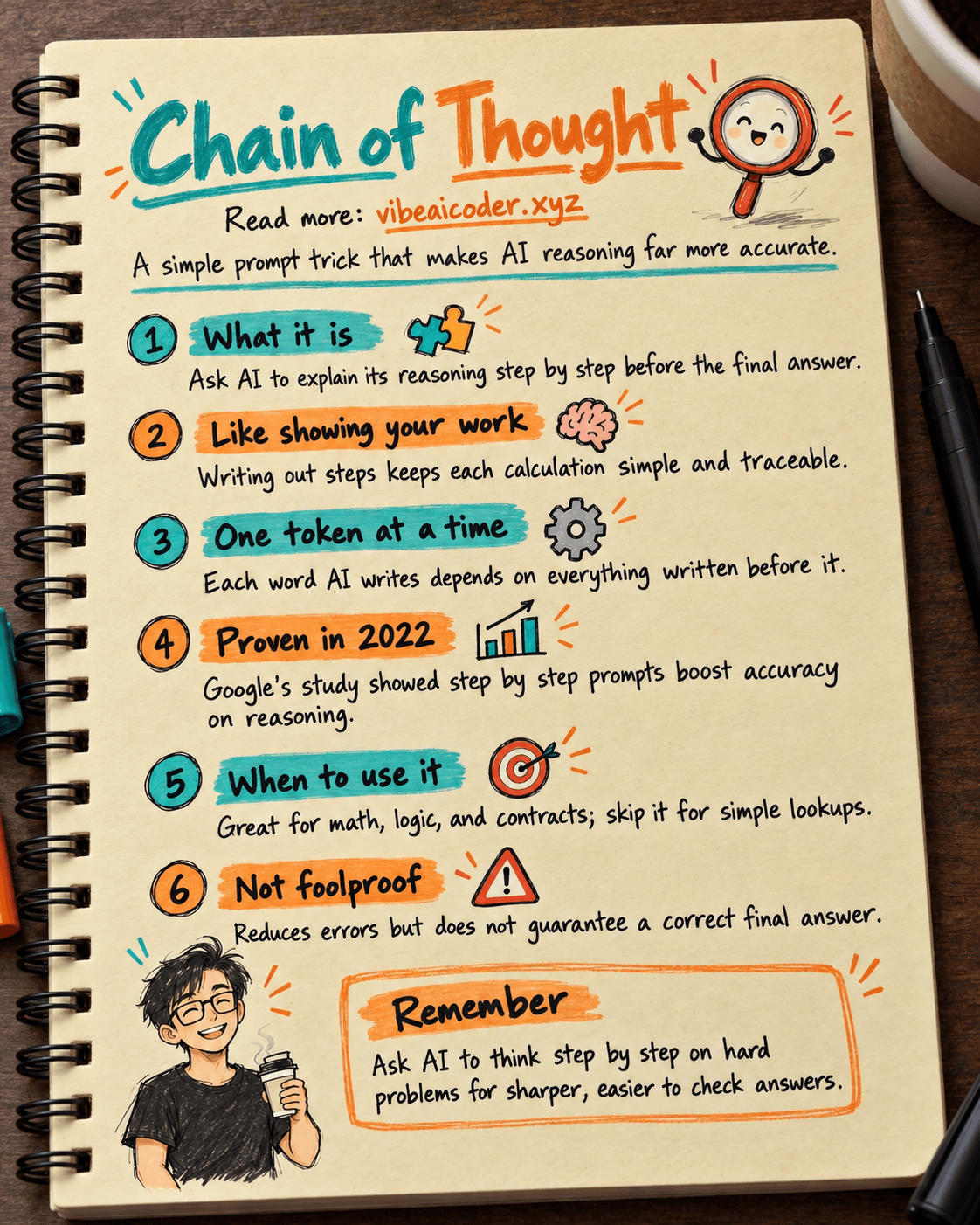
Chain of thought is a technique that asks an AI to lay out its reasoning step by step before giving a final answer, instead of jumping straight to the result. Just add a line like "please explain your reasoning step by step before concluding" to your prompt, and the AI is forced to write out its intermediate steps, and that act of writing things down helps it calculate more accurately on multi-step problems. This is a foundational technique published by a Google research team back in 2022, well before AI companies started building a built in "reasoning mode" into their products.
 A quick everyday example
Think back to school. Whenever you faced a hard problem, the teacher always made you "show your work," not just write down the final number. Strong students rarely solve a multi-step problem entirely in their head and blurt out the answer. Instead, they write it on paper: set up the calculation, work out an intermediate number, then use that number for the next step. Writing it down means the brain does not have to hold too much at once, each step only needs to focus on one small calculation, and if something goes wrong, it is easy to spot exactly which step failed.
AI runs into the same situation. If it is forced to answer a complex problem in one shot, it has to do the entire calculation "in its head" in a single pass, and it is easy to lose its way. If it is asked to lay out each step, the way a student does on a test, it gets a chance to "write it down" first, so the odds of staying on track go up significantly.
 How it works
- AI generates an answer by guessing one word at a time. Each word (more precisely, each token) is produced based on every word that came before it, including the words the AI itself has already written in its own answer so far.
- If forced to answer immediately, the AI has to compress the entire calculation into a single guess. For multi-step questions (say, a word problem or a decision that needs to weigh several factors), this makes it easy to miss something or miscalculate, similar to making a student blurt out an answer right after reading the question.
- When asked to lay out each step, every sentence the AI writes becomes a "hint" for the next one. The AI uses the intermediate result it just wrote to work out the following step, exactly like using the number calculated on one line to work out the line below it.
- As a result, one large problem gets broken down into several simpler calculations. Each small step is less likely to go wrong than one giant combined calculation, so the overall answer ends up more accurate.
- The study published in 2022 (the original Google paper titled "Chain-of-Thought Prompting Elicits Reasoning in Large Language Models") measured exactly this effect: for sufficiently large models, simply adding a request to show the reasoning step by step to the prompt noticeably raised the success rate on arithmetic and logical reasoning problems compared to asking for an immediate answer, even though the model itself was never retrained.
 What this means for you
Understanding chain of thought lets you tell the AI to "slow down and think carefully" exactly when it matters, instead of just hoping for the best:
- For math questions, logic puzzles, financial calculations, or reviewing a contract clause, add a line like: "Please explain your reasoning step by step first, then give your final conclusion." This simple sentence often improves accuracy noticeably.
- Having the AI write out each step also lets you check its work: if the final answer is wrong, you can trace through the steps to see exactly where the AI went off track, instead of just getting a flat answer with no clue why it is right or wrong.
- For apps that already have a built in "reasoning mode" or "Extended thinking" button (see also what is AI reasoning mode), you do not need to type the step by step request yourself, because turning on that button is essentially making the AI do chain of thought anyway, just built in, and it usually lets the AI "think" for longer before answering.
- For simple questions, like looking up a fact or translating a short sentence, there is no need to ask for step by step reasoning, since it only makes the answer longer and slower without adding any benefit.
 Common misconceptions
- "If the AI shows its steps, the result must be 100 percent correct." Not true. Chain of thought reduces errors, it does not eliminate them. The AI can still reason incorrectly at some step, and sometimes it writes steps that sound perfectly logical but still lead to a wrong conclusion. Always double check anything important, and do not trust an answer completely just because the AI "looks like" it reasoned logically.
- "You need a paid, premium app to use chain of thought." Not necessary. This is simply a way of phrasing your prompt, and it works on almost any chatbot, including free versions, as long as the model is large enough to benefit from it (see also what is a prompt and how to write an effective one).
- "The more steps you force the AI to think through, the better, for every single question." Not quite. For simple questions, asking for step by step reasoning just makes the answer longer, costs more time and tokens, and does not improve accuracy. It can even cause the AI to "ramble" off into unnecessary directions.
FAQ
How is chain of thought different from the "reasoning mode" in apps like Claude or ChatGPT? Chain of thought is the original technique: you type the "show your reasoning step by step" request into the prompt yourself. Reasoning mode is a packaged feature that AI companies built in, automatically making the model do this (and usually letting it think more and longer) with a single toggle, without you needing to write the request. The underlying mechanism is the same, the only difference is who gives the instruction.
Do I need to memorize the English term "chain of thought"? No, you just need to remember how to use it: whenever you hit a hard, multi-step question, add a line like "explain step by step before concluding" to your prompt. The AI will understand even if you type it in your own language.
Does asking the AI to show its steps cost extra tokens or money? Yes. Since the AI has to write out extra explanation before reaching its conclusion, the answer is longer and uses more tokens, and if you are using a paid, token billed API, the cost goes up accordingly. In exchange, for hard problems, that extra cost is usually worth it because it buys you noticeably higher accuracy.
Does chain of thought work for every type of question? It helps most clearly with tasks that require multi-step reasoning: math, logic, planning, data analysis, debugging code. For simple, single-step questions, like looking up a definition or translating a short sentence, it makes almost no difference.
How can I tell if the AI is reasoning correctly versus just writing steps that sound plausible but are wrong? Read through each step the AI writes instead of only looking at the final conclusion. If a step uses the wrong number or skips a logical connection, you can point directly at that step and ask the AI to redo it, instead of starting over from scratch.
More articles

Gemini 4 Argon Reads a 500-Page Chemistry Patent in One Afternoon

Claude Opus 5.5 Codes a Real Money Trading Game in One Day

What Is a Token in AI? Why ChatGPT and Claude Charge by Tokens

Claude Sonnet 5.5 vs GPT-6.1 Sol: Which AI Model Is Worth Using?

 Claude Opus 5.5 Launches: 30% Faster, 40% Cheaper, Blocks AI Brain Copying
How to Manage Your Claude Token Usage Limits Effectively