
Claude Opus 5.5 Codes a Real Money Trading Game in One Day
 A YouTuber let AI code an entire real money trading game
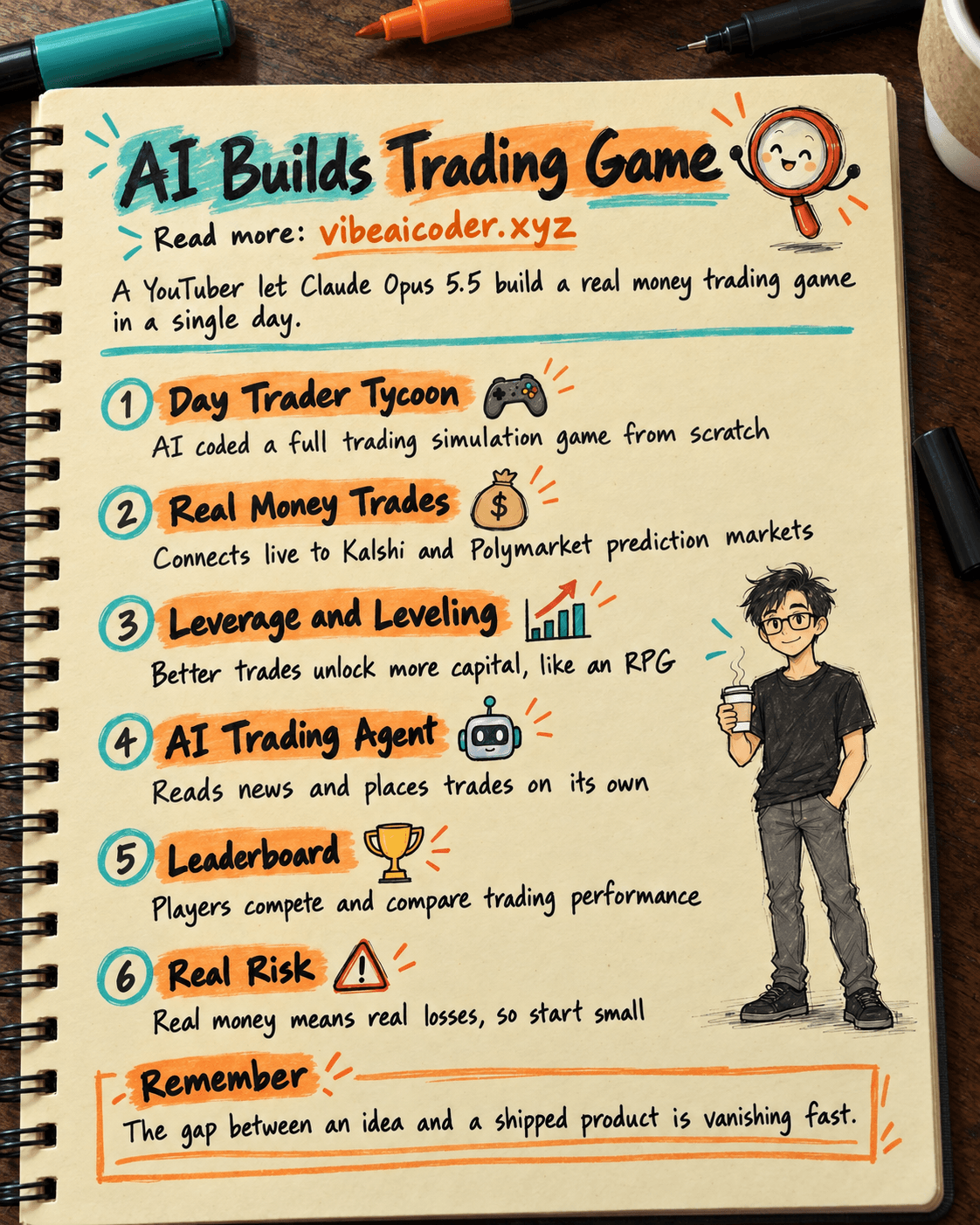
Would you believe someone could build a whole game without typing a single line of code themselves, then let that game trade with real money? The YouTube channel All About AI just did exactly that. They used Claude Opus 5.5 (Anthropic's newest coding focused AI model) to build "Day Trader Tycoon" from scratch, a game that simulates the life of a financial trader but can also place real trades on event prediction markets like Kalshi and Polymarket.
In plain terms: this is not a toy simulation anymore. Winning or losing in the game means winning or losing real money in the real world.
 How the game was built
According to the video, the entire build happened in a single sitting, just one filming session. The creator handed Opus 5.5 the job of writing all of the game's code, including:
- Creating a character and a trading desk for the player, like opening an "office" inside a virtual financial world.
- Leverage and leveling up mechanics: the better a player trades, the more capital they can use, much like leveling up in a role playing game.
- Business expansion: hiring virtual "employees" and combining their skills to boost trading performance.
- A leaderboard so players can compete against each other.
The most interesting part is that the game connects directly to Kalshi and Polymarket, two prediction market platforms (where people bet on whether a real world event will happen) that are widely used in the United States. Players can place real orders right inside the game interface, with no need to leave the app.
 It even built its own autonomous trading agent
The creator did not stop at the interface. They also had Opus 5.5 write an AI Trading Agent, essentially an automated assistant living inside the game. This agent can:
- Read the latest news and market data on its own.
- Decide when to place trades based on what it just read, with no button pressing from the player.
- Help test the game and rebalance its difficulty after every round.
This is the part that should catch the attention of anyone interested in AI: Opus 5.5 did not just produce a good looking interface, it created an AI "character" capable of thinking and acting on its own inside a system backed by real money. This mirrors the 6 permission modes in Claude Code, from asking at every step to letting AI decide on its own: the more you trust the AI, the more you let it act without confirming every single step.
 Why this matters even if you are not into trading
You do not need to care about financial trading to find this story interesting. What stands out is how fast the gap between an idea and a real product is shrinking. Building an app that combines a game interface with a real trading platform connection used to take a full team of engineers several weeks. Now one person, with help from an AI coding model, can get most of the way there in a single filming session.
It is also a live example of the trend where Claude Code now builds, tests, and fixes apps on its own, without you lifting a finger: you describe what you want, and the AI handles the rest, from writing the code to running tests to fixing bugs as they come up.
If you have ever thought "I do not know how to code so I cannot build an app," this is a good moment to rethink that. The idea behind all of this is vibe coding, meaning building software together with AI even if you cannot code: you just need to know what you want to build, and you let AI turn that idea into working software.
 Do not rush to copy this without understanding the risk
To be clear, trading with real money, whether through a game or a normal app, always carries the risk of losing money. An AI Trading Agent placing trades on its own does not mean it is always right. If you are curious about trying something similar, start with a small amount, understand how your chosen platform actually works, and treat AI as a decision support tool rather than a guaranteed money printer.
If you want to understand the basics first, see what Claude AI is and how beginners can start using it before attempting more complex AI projects like this one.
The Day Trader Tycoon story makes one thing clear: the line between "playing a game" and "shipping a real product" keeps getting thinner, as AI becomes good enough to turn almost any idea into working software in just a few hours.
More articles

Gemini 4 Argon Reads a 500-Page Chemistry Patent in One Afternoon

What Is a Token in AI? Why ChatGPT and Claude Charge by Tokens

What Is Chain of Thought? Why Asking AI to Think Step by Step Works Better

Claude Sonnet 5.5 vs GPT-6.1 Sol: Which AI Model Is Worth Using?

 Claude Opus 5.5 Launches: 30% Faster, 40% Cheaper, Blocks AI Brain Copying
How to Manage Your Claude Token Usage Limits Effectively