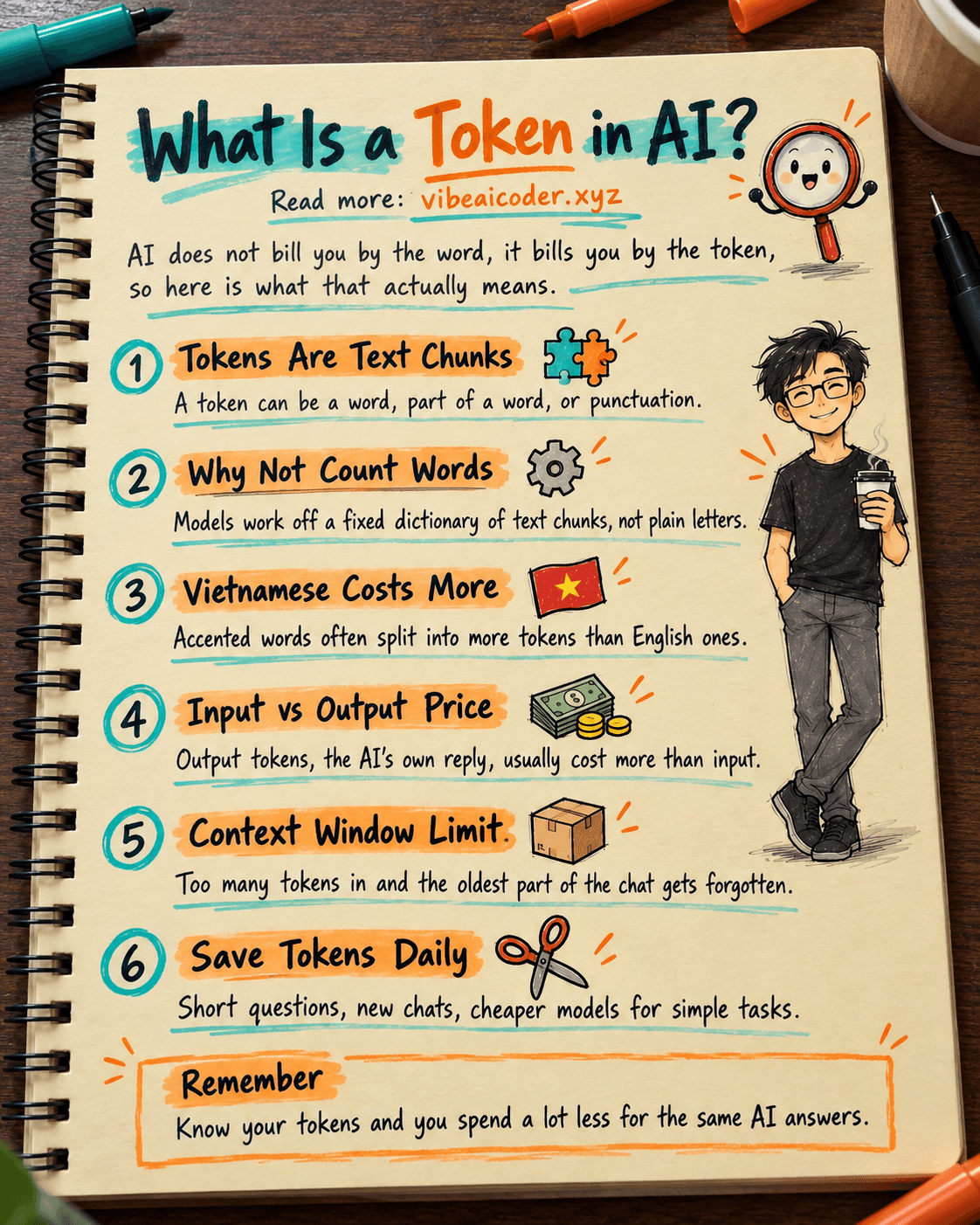

What Is a Token in AI? Why ChatGPT and Claude Charge by Tokens
A token is a small chunk of text, maybe a whole word, part of a word, or a punctuation mark, that AI uses to read and write language. ChatGPT, Claude, and every other chatbot do not charge you by the number of "words" you type, they charge by the number of tokens, so understanding what a token is can help you use AI more cheaply and more effectively. If you are still wondering what AI is in general and how it works, you can first read What Is AI, Artificial Intelligence Explained Simply for Beginners.
What a token is, in the simplest terms
When you type a sentence into Claude or ChatGPT, the machine does not read the whole sentence the way a person does. It slices that sentence into small pieces called tokens, then processes them one at a time. A token can be:
- A short, common word, such as "the," "and," or "is"
- Part of a longer word, for example "unhappiness" might get split into "un" and "happiness"
- A punctuation mark, a space, or a number
For English, a quick rule of thumb is that about 100 words come out to roughly 130 tokens, meaning each token averages close to 4 characters. That is why when you see an AI price listed as "$3 per million tokens," that figure is roughly equivalent to a few hundred thousand English words, not a million letters.
Why AI counts tokens instead of words
AI learns language by looking at billions of passages of text and memorizing how pieces of text relate to one another. To do this efficiently, companies like Anthropic and OpenAI build a fixed "dictionary," usually containing anywhere from tens of thousands to over a hundred thousand distinct chunks of text, known as a token set. Every time you send a message, the AI slices your sentence according to that exact dictionary, turns the text into numbers, and only then "thinks" using those numbers.
This is also how what Claude AI is works at its core: even though Claude's replies feel like a natural conversation, under the hood it is always working with a sequence of tokens, not a sequence of ordinary letters.
Why writing in Vietnamese costs more tokens than English
This is something many AI users outside English-speaking countries do not expect: the same sentence often costs noticeably more tokens in Vietnamese than in English. The reason comes down to tone marks and accented characters. The token dictionaries of most major AI models are built mainly from English data, so a short English word like "one" needs just a single token, while its Vietnamese equivalent, "một," can get chopped into as many as 5 tokens, because the accented letter does not exist in the dictionary as one whole unit.
The practical effect: if you write a long conversation in Vietnamese, the token count will run noticeably higher than writing the same content in English, even though the two read as roughly the same length out loud. With AI plans that bill by the token, this quietly means users writing in languages with heavy diacritics pay more for the same amount of information.
How tokens relate to what you pay
Most paid AI services, including Claude, bill in two directions: input tokens (what you send, including both your question and any attached documents) and output tokens (the reply the AI writes). Output tokens are usually more expensive than input tokens, because generating new text takes more computation than simply reading text that already exists.
For example, with the current Claude models, pricing differs quite a bit between versions, you can see the details in Haiku, Sonnet, or Opus, Which Claude Model to Pick So You Do Not Waste Money. The simple takeaway: the more capable the model, the higher the price per token, so if you are only asking simple questions, using a cheaper model saves a lot of money while keeping the answer quality perfectly fine.
Tokens and the context window, a storage box with a limit
The context window is the maximum total number of tokens an AI can "remember" in one conversation, including everything you have sent so far and everything the AI has written back. Think of it like a box with a fixed capacity, once too much new text gets pushed in, the oldest text at the start of the conversation gets pushed out and the AI "forgets" it.
This is also why an AI agent, a type of AI that can carry out many steps in a row instead of just answering one question, tends to burn through tokens very fast. If you are not clear on this concept yet, What Is an AI Agent, How Is It Different From a Chatbot explains the difference between an agent and an ordinary chatbot in more depth, and this is exactly when tokens get used up the fastest, since the agent has to re-read its entire history before taking its next step.
Tips for saving tokens in everyday AI use
A few simple habits can meaningfully cut down the number of tokens you pay for:
- Write short, clear questions and avoid repeating information you already said earlier in the same conversation.
- Start a new conversation once the topic has fully changed, instead of dragging out an old chat that already has a huge message history.
- Use a cheaper model for simple tasks, and only switch to a stronger model when the question truly needs deep reasoning.
- Summarize long documents before pasting them into AI, instead of pasting a dozen full pages when you only need one piece of information from them.
- If you work with AI often, learning how to write effective prompts also helps you avoid having to ask again, which cuts down the total tokens spent across the whole conversation.
One tip in particular is worth noting for non-English speakers: if you need AI to process a very long document and the reply does not have to be in your native language, try asking the AI to summarize in English first, since English usually costs fewer tokens for the same amount of content.
FAQ
Is a token the same as a word? Not exactly. A token can be shorter than a word (part of a longer word) or exactly equal to a short word, depending on whether that word is common enough to appear whole in the AI's dictionary.
How much text does 1,000 tokens equal? There is no fixed universal number, but since heavily accented languages typically cost more tokens than English for the same word, 1,000 tokens in a language like Vietnamese usually holds less text than 1,000 tokens in English.
Why does a longer AI reply cost more than a shorter one? Because AI bills for both input tokens and output tokens, and output tokens (the reply the AI writes itself) are usually priced higher than input tokens. The longer the reply, the more output tokens it uses.
What happens when the context window fills up? The AI can no longer remember the earlier parts of the conversation, so it is more likely to answer incorrectly or ask you again for information you already gave it. The usual fix is to start a new conversation or summarize the context so far.
Is there a way to see exactly how many tokens a piece of text costs? Most major AI providers offer a free token counter on their website, where you can paste in text to see the exact token count before you send it.
More articles

Gemini 4 Argon Reads a 500-Page Chemistry Patent in One Afternoon

Claude Opus 5.5 Codes a Real Money Trading Game in One Day

What Is Chain of Thought? Why Asking AI to Think Step by Step Works Better

Claude Sonnet 5.5 vs GPT-6.1 Sol: Which AI Model Is Worth Using?

 Claude Opus 5.5 Launches: 30% Faster, 40% Cheaper, Blocks AI Brain Copying
How to Manage Your Claude Token Usage Limits Effectively