What Is a Large Language Model (LLM)? How AI Predicts the Next Word
What Is a Large Language Model (LLM)? How AI Predicts the Next Word
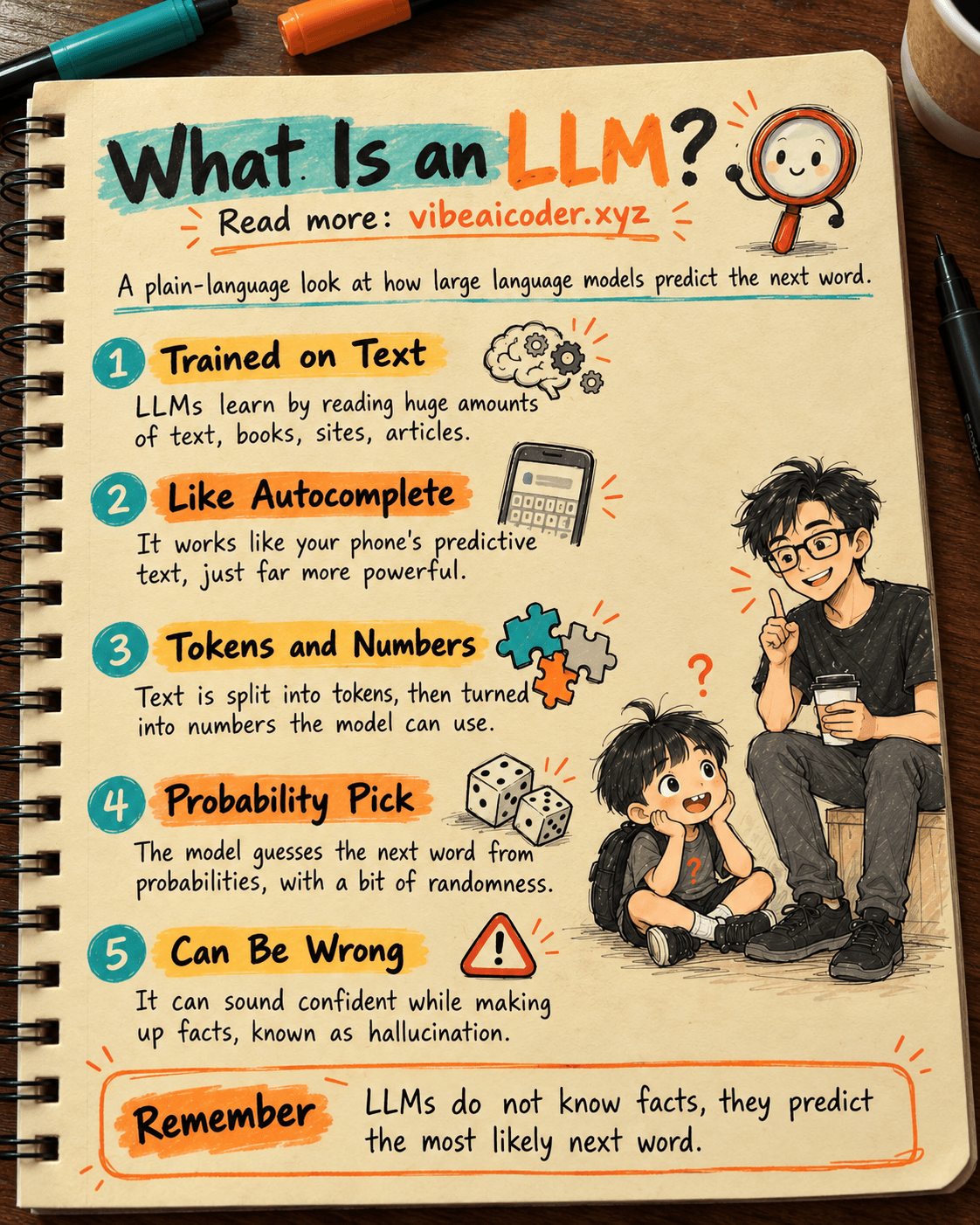
A large language model, or LLM, is an AI program trained by reading a massive amount of text so it learns to guess what word should come next in a sentence. That sounds simple, but when you repeat this "guess the next word" process billions of times on a big enough pile of data, you get what we know as ChatGPT, Claude, or Gemini. Once you understand this basic idea, you will be less surprised both by how smart AI answers can sound and by how confidently it sometimes gets things wrong.
Watch: LLMs explained
A Quick Everyday Example
Think about the predictive text suggestions on your phone's keyboard: you type "The weather today" and your phone suggests three possible next words, like "is", "looks", or "feels". The phone does not actually "understand" today's weather, it just remembers that across millions of messages people have typed, one particular word tends to follow that phrase most often.
An LLM works on the exact same principle, except it is trained on a vastly larger set of text than any phone keyboard, books, news articles, websites, documents, conversations. Instead of just suggesting a few short words, it can generate hundreds of words in a row, enough to write an email, a block of code, or a full answer to your question. You can check out what a prompt is to learn more about how to "instruct" this giant word guessing machine.
How It Actually Works
Here is a simplified breakdown of what happens inside an LLM:
- It splits the sentence into small pieces called tokens. The machine does not read letter by letter like a person does, it cuts the text into small chunks, which can be a whole word, part of a word, or a punctuation mark. You can read more in what is a token in AI if you want to go deeper on this part.
- It converts each token into a string of numbers. This is the step where the AI "translates" text into a language computers can work with, so it can calculate how related different words are to each other.
- It looks back at everything written so far, within its memory limit, to calculate probabilities. At each position, the model estimates, out of tens of thousands of possible next words, which one is most likely based on everything it learned during training. That "how far back it can look" limit is exactly what what is a context window explains, and it is why AI sometimes seems to "forget" partway through a long conversation.
- It picks a word based on that probability, then repeats. The model does not always pick the single most likely word, sometimes it picks randomly among a handful of top candidates so the output does not feel repetitive. That level of "risk taking" is controlled by temperature in AI.
- It repeats this whole process one token at a time until the response is complete. Each step only predicts one small piece, but repeated hundreds of times it adds up to a coherent passage of text.
The key thing to remember is that throughout this entire process, the model never looks anything up in a "book of facts". It is only predicting the most plausible next word based on what it read during training. That is also why it can write very fluently while sometimes making up information that is wrong, a phenomenon known as AI hallucination.
What This Means for You
Understanding the "predict the next word" principle helps you use AI more realistically, instead of treating it like an all knowing machine.
- Write clear prompts with enough context. Since AI only predicts based on what you give it, the vaguer your question is, the more it has to guess. Instead of asking "write me an email", try "write an email requesting two days of sick leave, addressed to my manager, polite tone, mentioning a routine health checkup." More context means a much higher chance the AI guesses what you actually want.
- Do not blindly trust numbers or citations the AI gives you. Since its core function is predicting plausible text rather than looking up facts, any numbers, book titles, or links it produces can be made up. Always double check before relying on them for anything important, especially for work or school.
- Provide source material when you need high accuracy. If you paste the actual text, data table, or document into the conversation, the AI predicts the next word based on that real material instead of its fuzzy memory from training, which makes the answer far more reliable.
Common Misconceptions
- "AI understands meaning the way humans do." In reality, the model does not "understand" in any conscious sense, it is calculating probabilities between tokens based on a huge amount of text it was trained on. The result can look exactly like an "understanding" answer, but the mechanism underneath is purely statistical.
- "A bigger LLM always gives more correct answers." Larger models, meaning more parameters and more training data, are usually better, but they can still guess wrong if the question is vague, the topic is rare in the training data, or the information has changed since training happened.
- "AI knows everything happening right now." A plain LLM only knows what was in its training data, it does not automatically update with current news unless it is connected to extra tools like web search or private documents, a technique known as RAG.
FAQ
How is an LLM different from AI in general? AI is a broad term for any computer system that mimics some form of intelligence. An LLM is just one branch of AI, focused specifically on processing and generating language, and it sits behind most of the chatbots you use today. You can read what is AI for a broader picture.
Why does AI give a different answer to the same question each time? Because the next word selection step does not always pick the single highest probability word, there is a controlled amount of randomness built in. That is also why asking the same question twice can get you two slightly different answers.
Does an LLM "think" before answering? Technically no, it generates text one word at a time in a predictive chain. However, newer "reasoning" models are trained to write out intermediate steps before producing a final answer, which makes them more accurate on complex problems.
Are ChatGPT, Claude, and Gemini all LLMs? Yes. They are all products built on top of one or more large language models, plus a chat interface, memory, and other supporting tools that turn the raw model into an assistant that is easy to use.
Why does an LLM sometimes make things up instead of saying "I don't know"? Because its core mechanism always tries to predict the most plausible next word, even when it is not certain, rather than being programmed to stop and admit uncertainty. This is the root cause of the AI hallucination phenomenon mentioned above.
More articles

Gemini 4 Argon Reads a 500-Page Chemistry Patent in One Afternoon

Claude Opus 5.5 Codes a Real Money Trading Game in One Day

What Is a Token in AI? Why ChatGPT and Claude Charge by Tokens

What Is Chain of Thought? Why Asking AI to Think Step by Step Works Better

Claude Sonnet 5.5 vs GPT-6.1 Sol: Which AI Model Is Worth Using?

 Claude Opus 5.5 Launches: 30% Faster, 40% Cheaper, Blocks AI Brain Copying