
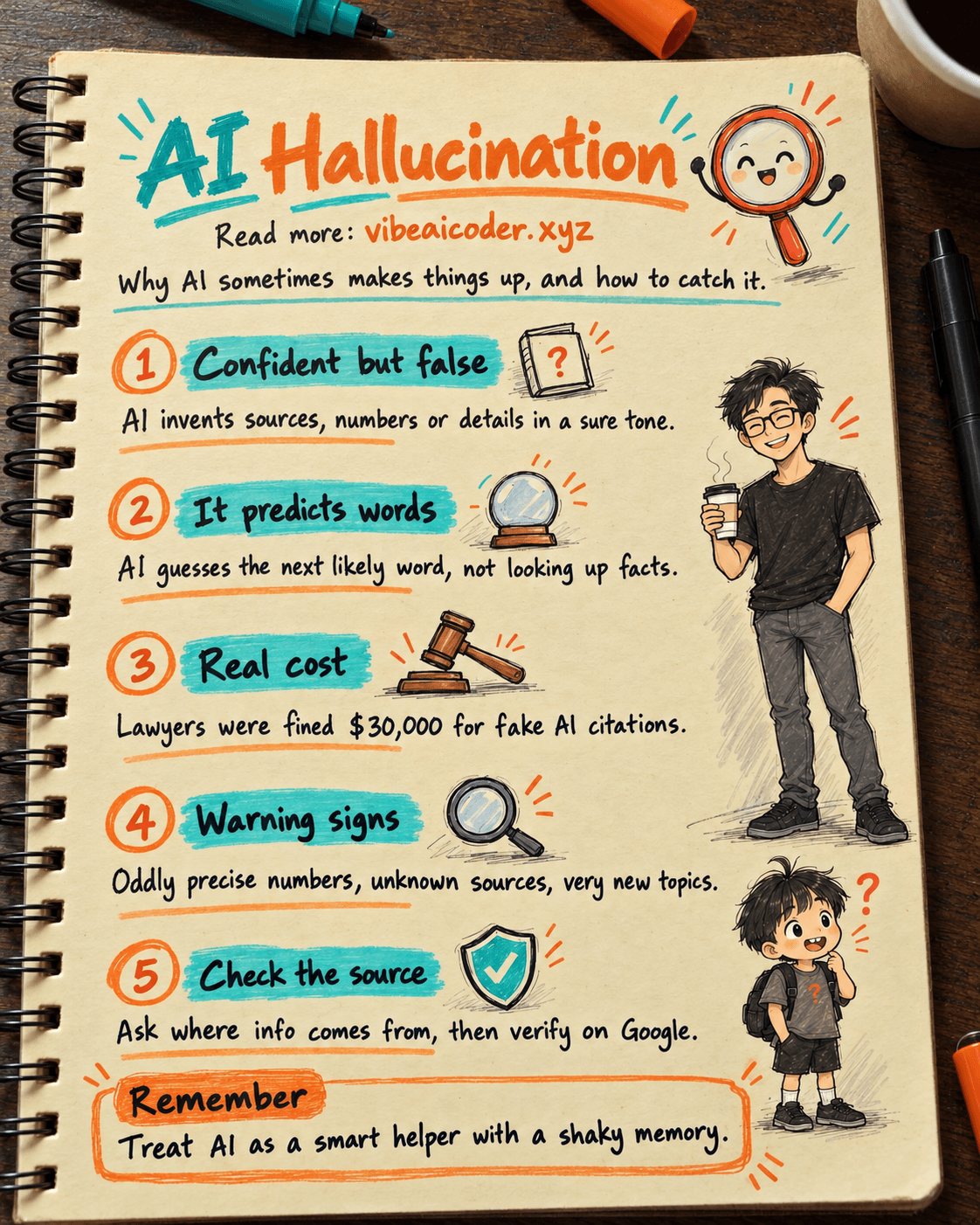
What Is AI Hallucination? Why ChatGPT and Claude Make Things Up
AI hallucination is when an AI gives you an answer that sounds completely confident, but the information is actually made up. It is not lying on purpose, it is more like a person guessing when they do not really remember, except the AI guesses in a tone so certain you believe it right away. If you have ever seen ChatGPT or Claude quote a study that does not exist, or hand you a suspiciously "precise" number, that is hallucination.
 What AI hallucination actually is
Hallucination is the term for when an AI produces an answer that is false, but presents it as if it were true. There are three common patterns:
- Fake sources: the AI cites a study, a court case, or a book that simply does not exist.
- Fake numbers: the AI gives a very specific-sounding figure ("up 37%") that is not based on any real data.
- Fake details: the AI adds invented names, dates, or events into a story that is otherwise real, quietly distorting it.
What all three have in common: the AI never says "I'm not sure." It answers in the exact same confident tone as when it is correct, which is why it is so hard for readers to tell the difference.
 Why AI makes things up
To understand why this happens, it helps to know how AI actually works. A model like ChatGPT or Claude does not "look up" facts in some built-in dictionary. It was trained to predict the next word, based on billions of pieces of text it read during training. When you ask a question, it is not retrieving an exact memory, it is calculating which words are most likely to come next in a plausible-sounding answer.
That is what lets AI write fluently and respond to almost any question. But it also has a weak spot: when the model does not actually "know" the answer, it still keeps guessing something that sounds reasonable, instead of stopping to say "I don't know." A few specific reasons hallucination happens:
- Not enough training data on the topic: for topics that are rare, very new, or very niche (a small company's name, a local event), the AI has little real information to draw on, so it fills the gap by guessing.
- Trick questions: if you ask about something that does not exist (like "tell me about book X by author Y" when that book was never written), many models will still try to "invent" an answer instead of simply refusing.
- Models are trained to answer, not to stay silent: during training, models are usually rewarded for giving a complete, confident answer, so they tend to guess rather than leave a blank.
 A real story: what happens when people trust AI blindly
This is not just a theoretical risk. In the US, the number of court filings containing AI-fabricated case citations has grown fast: from around 200 cases a year ago, to 719 by January, to more than 1,227 by mid-2026. In one Sixth Circuit appeals case (Whiting v. City of Athens), two attorneys filed a brief containing more than two dozen fabricated citations and were fined $30,000. In another case in Mississippi, both sides filed fake citations, forcing the judge to cancel the trial and suspend both lead attorneys from practicing in that district for two years.
These cases did not happen because the AI "meant to deceive." They happened because people copied the AI's answer straight into a legal filing without checking whether the cited case actually existed. The lesson applies to anyone, not just lawyers: the more blindly you trust AI, the more likely you are to run into trouble when it hallucinates.
 How to spot an answer that might be hallucinated
You do not need to be a technical expert to know when to be suspicious. A few warning signs:
- A number that is oddly round or oddly precise and you have never seen it anywhere else, especially growth percentages, revenue figures, or very specific dates.
- A source, book, or study name that sounds unfamiliar, and a quick Google search turns up nothing.
- The AI answers too fast, too neatly for a question that would normally take real research to answer accurately.
- The topic is very narrow or very recent, such as news from the last few days, internal company information, or obscure local data.
If you notice any of these, the safe rule is: don't use that answer for anything important (a report, a message to a client, a legal filing) until you have verified it against another source.
 How to reduce hallucination in everyday use
You cannot eliminate hallucination completely, since it is a natural limitation of how AI works, but a few habits go a long way:
- Always ask for the source: add "please tell me where this information comes from" to the end of your prompt. If the AI cannot name a specific source, treat the claim as unverified.
- Favor tools that actually search the web instead of relying only on the model's training memory. Many modern AI assistants, including AI agents that carry out multi-step tasks, can look up real documents before answering, which keeps answers grounded in real data instead of guesses.
- Cross-check anything important: for numbers you will use in a report, a contract, or a public post, take one extra minute to search the source name or figure on Google to confirm it is real.
- Break big questions into smaller ones: the more specific a question is, the easier it is to verify, and the less room the AI has to invent extra details.
- Treat AI like a smart assistant with a shaky memory, not an encyclopedia: that mindset naturally makes you double-check instead of trusting everything at face value.
 Does hallucination mean AI is "dumb"?
Not really. Hallucination is the flip side of the very thing that makes AI useful in the first place: its ability to reason, write fluently, and answer flexibly, even for questions it has never seen in exactly that form before. A paper dictionary never "hallucinates," but it also cannot hold a conversation, summarize a document, or draft an email for you. That tradeoff is exactly why AI companies keep working to reduce hallucination, even though they cannot eliminate it overnight.
Understanding this limit is not a reason to stop using AI. It is a reason to use it more wisely: enjoy the speed and convenience, but keep the habit of double-checking anything that actually matters before you trust it completely.
FAQ
Is AI hallucination a software bug? No. It is a natural limitation in how AI learns to predict language, not a technical bug that can simply be patched. AI companies can reduce how often it happens, but they cannot eliminate it entirely with today's technology.
Do newer, more expensive models still hallucinate? Yes, though usually less often. Newer models are typically trained more carefully and can look things up in real time, but no model is completely immune to hallucination.
How can I be sure a citation or number from an AI is real? The safest way is to look it up yourself, on Google, an official website, or an academic database. If you cannot find any trace of it, treat the information as unconfirmed.
Which hallucinates less, ChatGPT or Claude? There is no fixed answer, since both keep improving with every new version. What matters more is how you use them: ask specific questions, request sources, and always verify anything important, no matter which tool you use.
Does hallucination happen with AI agents that take multiple actions on their own? Yes, and the consequences can be bigger, because an agent acts on the information it generates itself, rather than stopping after one answer. That is why, for important tasks, it is worth letting the agent use real lookup tools instead of relying only on memory, and always reviewing its results before you act on them.
#AI #ChatGPT #Claude #AIHallucination #ArtificialIntelligence #VibeAICoder
More articles

AI Training vs Inference: What Is the Difference?

Gemini 4 Argon Reads a 500-Page Chemistry Patent in One Afternoon

Claude Opus 5.5 Codes a Real Money Trading Game in One Day

What Is a Token in AI? Why ChatGPT and Claude Charge by Tokens

What Is Chain of Thought? Why Asking AI to Think Step by Step Works Better

Claude Sonnet 5.5 vs GPT-6.1 Sol: Which AI Model Is Worth Using?