What Is RAG? AI Explained Simply for Beginners
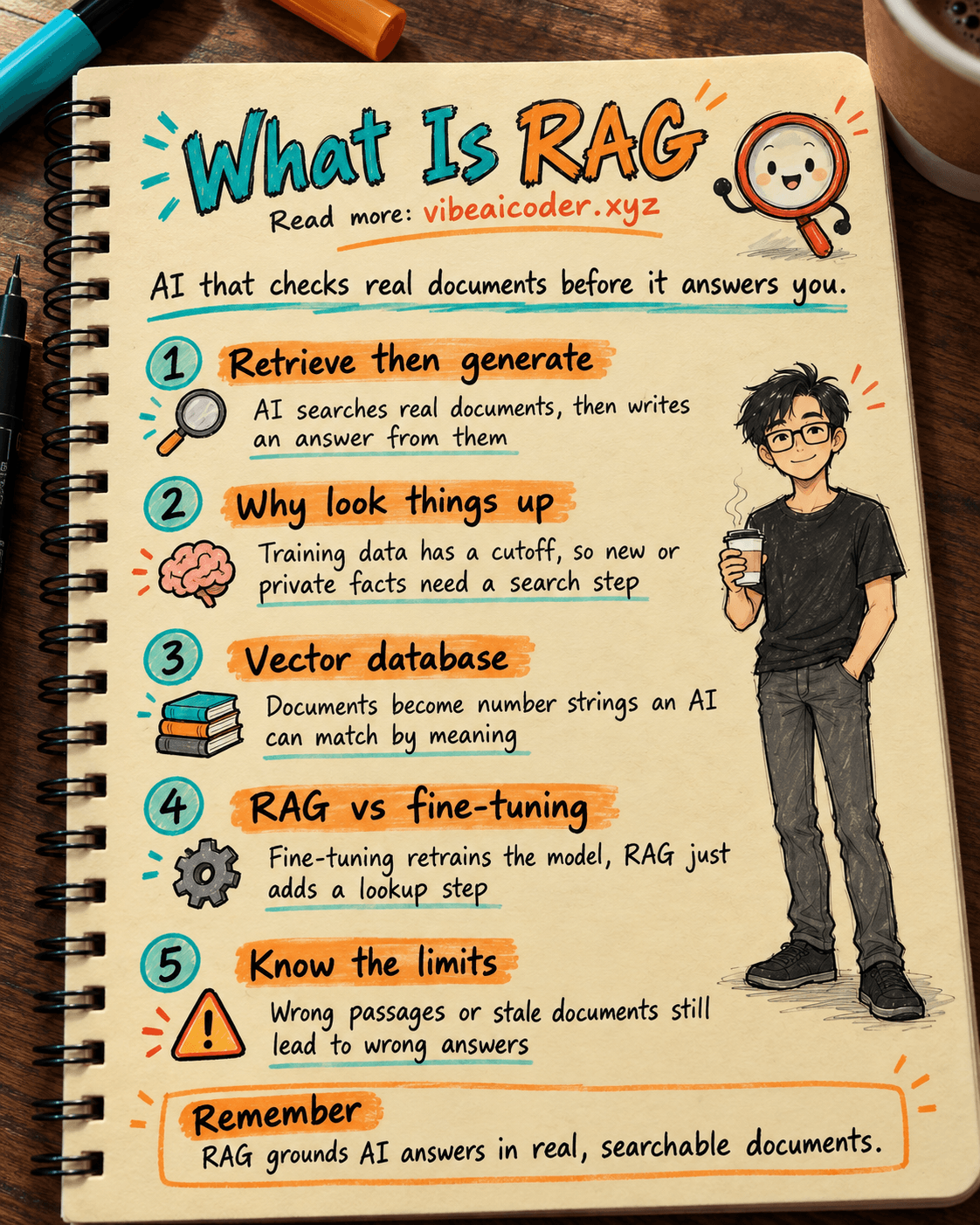
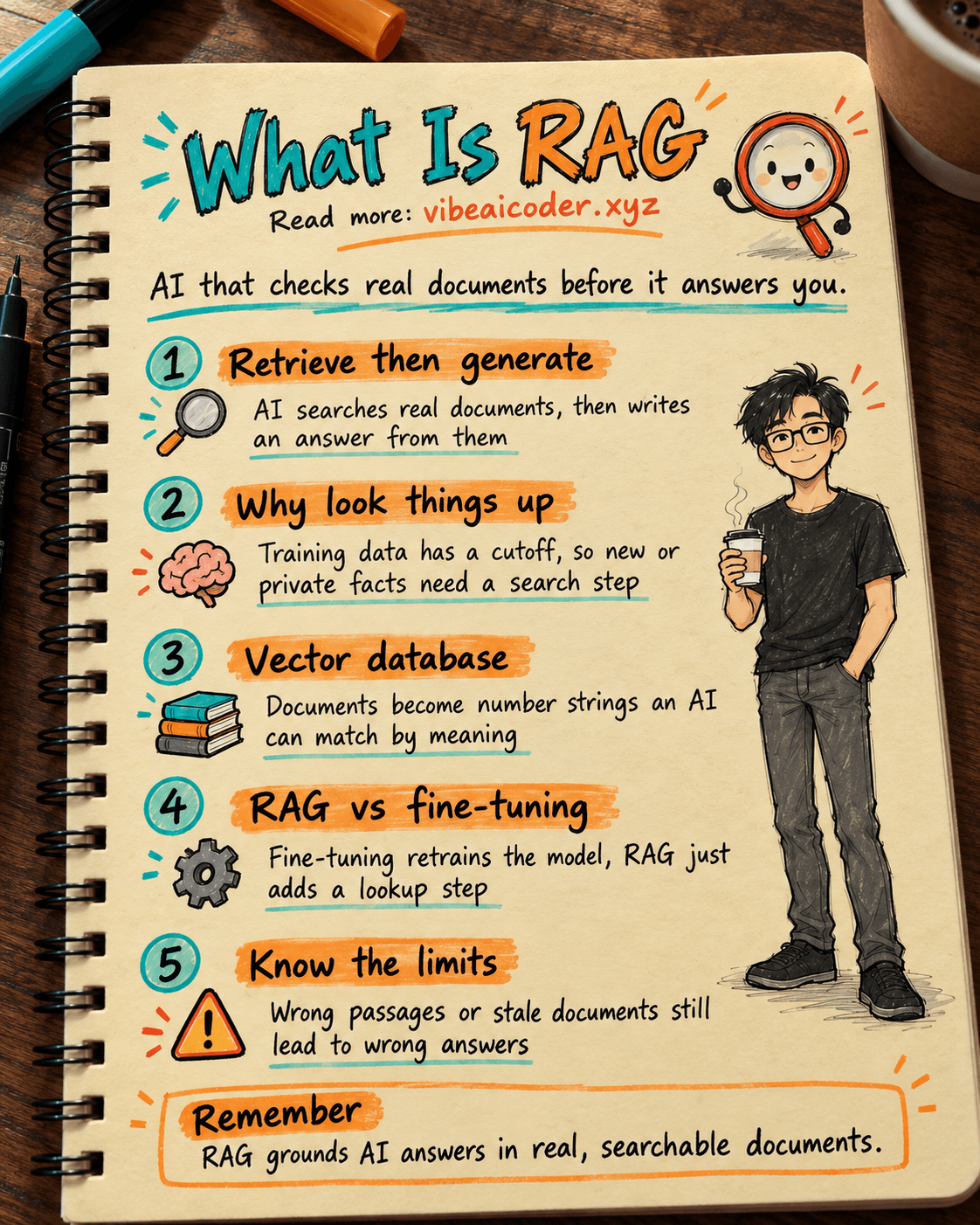
RAG (short for Retrieval Augmented Generation) is how an AI looks up real documents before answering, instead of relying only on what it memorized during training. That makes answers more accurate, more current, and often backed by citations you can check for yourself. If you have ever seen an AI answer correctly about very recent or very private information (like your company's internal documents), there is a good chance RAG is running behind the scenes. If you want to review the basics before diving into RAG, the post What is AI explains it in simple terms for beginners.
RAG in the simplest terms
Imagine asking a smart friend who hasn't read the news in a while. If you ask them a quick question, they answer from memory, which might be right or might be outdated. But if you hand them a few pages of the latest documents first and then ask, their answer will be far more accurate because they just "read up" before speaking.
RAG does exactly that for AI. Instead of letting the AI answer purely from what it learned during training (which could be months or years old), the system does three things:
- Takes your question.
- Retrieves the most relevant passages from a knowledge base, such as company files, articles, or web pages.
- Feeds those passages along with your question to the AI, which then generates an answer based on both.
Combine "retrieve" and "generate" and you get Retrieval Augmented Generation: generation that is strengthened by a lookup step.
Why does AI even need to look things up, didn't it learn everything already
A model like Claude or ChatGPT (see also What is Claude AI) is trained on a huge amount of data, but that data always has a cutoff point. After that point, there are three things the AI simply cannot know on its own:
- Fresh news and events: product launches, policy changes, new prices.
- Private data: your company's contracts, internal emails, project documents, anything that never appeared on the public internet for the AI to learn from.
- Constantly changing information: product stock, flight schedules, account balances.
Without RAG, the AI has to guess or rely on outdated knowledge, which leads to confidently stated made up answers, a phenomenon engineers call hallucination (when an AI produces a plausible sounding answer that is factually wrong). RAG sharply reduces this because the AI gets "primed" with real documents right before it answers, instead of relying only on memory.
How RAG works, in three steps
To make this concrete, picture RAG through an example: you ask your company's internal chatbot, "What changed in this year's leave policy?"
Step 1, turn documents into something the AI can search. Beforehand, all company documents (policies, emails, PDFs) are split into small chunks and converted into strings of numbers called embeddings (how AI turns text into numbers so it can compare how similar two pieces of meaning are). These number strings are stored in what's called a vector database, essentially a filing cabinet organized by meaning instead of alphabetically.
Step 2, find the relevant passages. When you ask your question, it also gets converted into a similar string of numbers, and the system compares it against the stored ones to find the handful of passages whose meaning is closest to your question, for example the exact passage about "2026 leave policy."
Step 3, the AI reads and answers. Those retrieved passages are sent to the AI together with your question. The AI reads both and writes an answer grounded in the real documents, often including a citation like "per section 4.2 of the leave policy."
This whole process happens in a few seconds. You just see a smooth answer, with no idea that a "library lookup" step just happened behind the scenes.
How is RAG different from retraining the AI
Many people confuse RAG with "re-teaching" the AI with new data, known as fine-tuning. The two solve different problems:
- Fine-tuning is like sending the AI back to school for a new course. It takes time, costs compute, and once it's done, that knowledge is "baked in" to the model. Updating it again means going through the whole training process from scratch.
- RAG is like handing the AI a notebook to check at the moment it answers, with no retraining required. To update the information, you just add or edit documents in the knowledge base, and the AI will automatically find the newest version the next time someone asks.
Because it's cheaper, faster, and much easier to keep current, RAG is the most common choice today when a business wants an AI to answer based on its own data, instead of training a custom model from scratch.
Where RAG shows up in everyday life and work
A few examples you may have already used without noticing:
- Customer support chatbots that answer correctly about a store's current return policy or latest prices, instead of giving generic answers.
- Document reading assistants: you upload a 50 page contract, ask "where is the penalty clause," and the AI finds the right passage and summarizes it for you.
- AI powered search such as search result summaries, where the AI reads a few of the latest web pages and puts together an answer with source links.
- AI agents doing teamwork or research (see also What is an AI agent) often use RAG to look up project documents before planning their next action.
When you don't need RAG
RAG isn't always the best choice. Andrej Karpathy, former AI director at Tesla, shared how he built a personal knowledge base using an LLM without RAG: when your document collection is small enough to fit entirely inside the AI's context window (the amount of text an AI can read in a single request), you can skip the retrieval step and just hand the AI the whole thing to read. This approach is much simpler than RAG, as long as the data isn't too large.
In other words, RAG really earns its keep when the knowledge base is too large to fit into a single request, say thousands of pages of documents or tens of thousands of emails.
Limitations worth knowing
RAG isn't magic. A few common issues:
- Retrieving the wrong passage: if the search step picks an irrelevant passage, the AI will answer based on wrong information, often still sounding very confident.
- Poor chunking: if a document gets split in the middle of an important point, the AI may only read half the story.
- Outdated source documents: RAG is only as good as the knowledge base it searches. If the documents haven't been updated, the answer will be wrong too.
So when you use a product that advertises "AI that answers based on your documents," it's still worth double checking important answers rather than trusting them blindly.
Where to go deeper
You don't need to know how to code to understand RAG, but if you want to try it yourself, the easiest step is to upload a document to an AI assistant like Claude or ChatGPT and ask it questions, that's effectively a simple, small scale form of RAG. If you work in a technical role and want to build a real RAG system for your company, it's worth learning how to write clear questions through the post What is a prompt, since the quality of a question directly affects whether the system retrieves the right documents.
FAQ
Is RAG its own type of AI? No. RAG is a technique combined with an existing AI model (like Claude or GPT), not a standalone AI. Think of it as a "helper" that looks things up for the AI before it answers.
Does RAG cost more than asking an AI normally? A little more, since it adds a document search step and sends more text for the AI to read. But this cost is usually far lower than retraining (fine-tuning) a model.
Do regular users need to understand RAG? Not necessarily, but understanding the concept helps explain why some AI tools answer very accurately about your own documents while others don't, so you can pick the right tool for your needs.
Does RAG completely eliminate wrong answers? Not completely. RAG sharply reduces made up answers because it has real documents to draw from, but if the search step retrieves the wrong document, the AI can still answer incorrectly.
How can you tell if an AI product uses RAG? The clearest sign is the AI citing specific sources (document pages, links, policy sections) directly in its answer, instead of giving a generic answer with no clear basis.
More articles

Gemini 4 Argon Reads a 500-Page Chemistry Patent in One Afternoon

Claude Opus 5.5 Codes a Real Money Trading Game in One Day

What Is a Token in AI? Why ChatGPT and Claude Charge by Tokens

What Is Chain of Thought? Why Asking AI to Think Step by Step Works Better

Claude Sonnet 5.5 vs GPT-6.1 Sol: Which AI Model Is Worth Using?

 Claude Opus 5.5 Launches: 30% Faster, 40% Cheaper, Blocks AI Brain Copying