Is Claude's Free Plan Enough? The Real Limits and How to Get the Most Out of It (2026)
 Is Claude's Free Plan Enough? The Real Limits and How to Get the Most Out of It (2026)
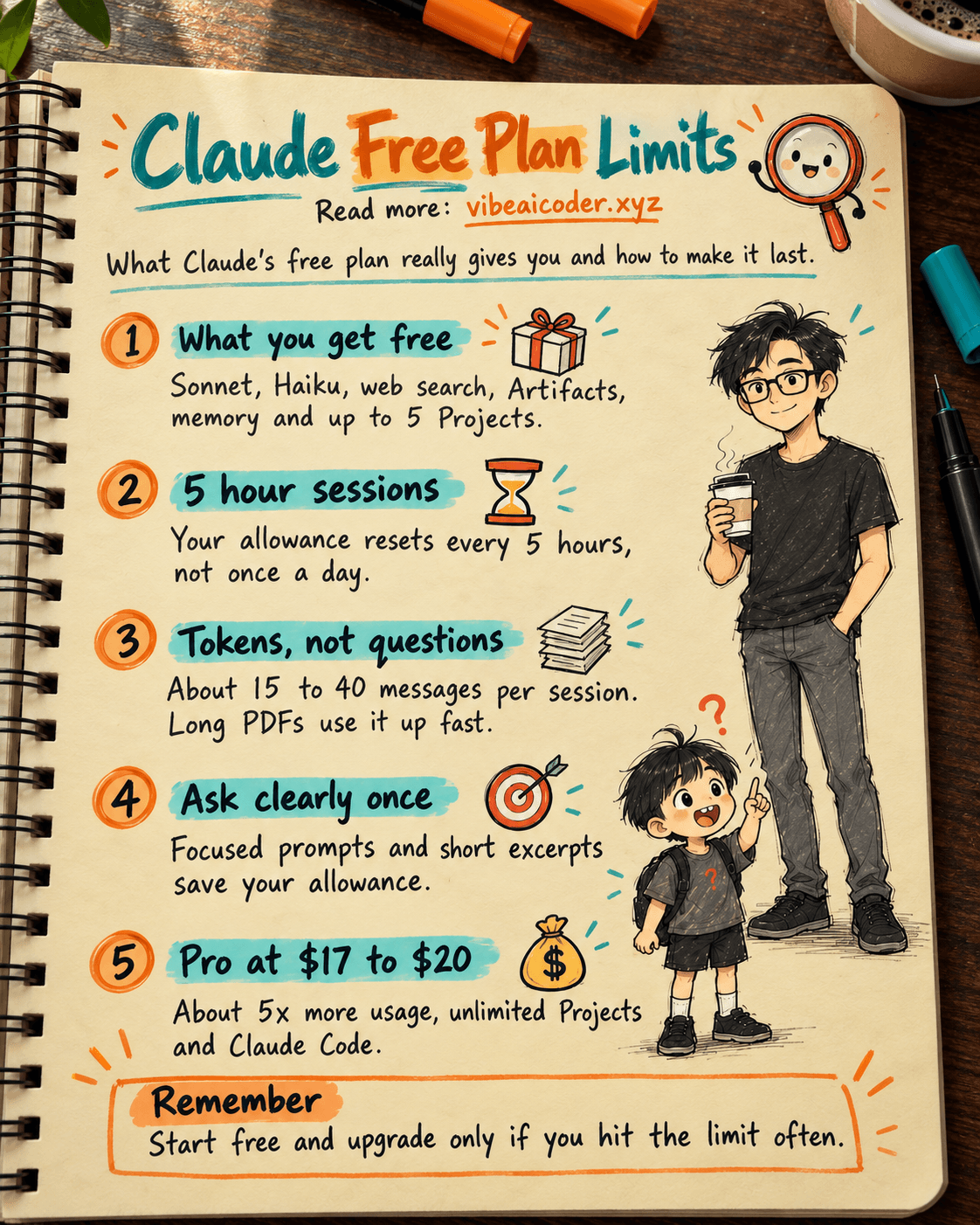
Yes, Claude's free plan is enough for most everyday needs: asking questions, writing, summarizing documents, searching the web. You'll only hit limits if you send many long messages in a short time, or need advanced features like Claude Code. This article explains the real limits of the free plan and how to use it without running out mid conversation.
 What the free Claude plan includes
If you're new to Claude, you can first read what Claude AI is. In short, Claude is a conversational AI assistant from the company Anthropic, available on web, phone and desktop apps.
With a free account, you get:
- Unlimited chatting by day, only limited by session (explained below).
- Sonnet and Haiku models, strong enough for writing, translation, explaining concepts, summarizing files, and basic coding.
- Web search right inside the conversation, so Claude can pull fresh information instead of relying only on older training data.
- Artifacts, a separate preview panel that shows a small web page, chart or code snippet Claude creates, so you can see the result visually instead of just reading text.
- Up to 5 Projects, each one grouping files and instructions so Claude remembers context when you come back to work.
- Memory across conversations, so you don't need to repeat old information every time you open a new chat.
What the free plan does not include: the Opus model (the strongest and most expensive one), Claude Code (the terminal based coding tool), and document tools like Claude Slides or Claude Docs.
 Where the real limit actually is
This is the part most people misunderstand. Anthropic does not publish a fixed number like "X messages per day." Instead, Claude works on a 5 hour session basis: you get a usage allowance for that 5 hour window, and once the session ends, the allowance resets automatically, no need to wait for the next calendar day.
Based on real world observation, this usually lands around 15 to 40 messages per 5 hour session, or roughly 30 to 100 messages a day if spread out. But this number varies a lot because Claude counts usage in tokens (the small units AI uses to measure text read and written), not in number of questions:
- A few short questions with short answers: you can use most of the session's higher range.
- One question with a 40 page PDF asking for a detailed summary: can use up the entire session in just 5 to 8 exchanges.
In other words, the limit isn't "number of questions" but "total amount of text" Claude has to read and write within that 5 hour window.
 How to make the most of the free plan
1. Write clear, focused questions from the start. Asking vaguely and then clarifying repeatedly burns through your allowance faster than asking correctly once. If you're not used to prompting AI yet, what is a prompt has concrete examples for writing short requests Claude still understands correctly.
2. Split big tasks across different sessions. Since the allowance resets every 5 hours, summarize a long document in the morning and handle something else in the afternoon, instead of cramming everything into one continuous chat.
3. Don't paste an entire long file if you don't need to. If you only need to ask about one specific section of a document, copy just that section instead of uploading the whole 40 page file for a short question.
4. Match the right tool to the right task. The free plan is great for everyday writing, learning, and lookups. If your work needs serious coding with Claude Code, or complex tasks that need the Opus model, that's when the cost difference of upgrading actually becomes worth it.
5. Watch for the low allowance warning. When you're close to running out, Claude usually warns you ahead of time how long until the allowance resets, so you can plan important work for when you have more allowance left.
 When it's worth upgrading to Pro
The Pro plan currently costs around $17 to $20 USD per month (depending on annual vs monthly billing), and in return you get:
- Roughly 5 times more usage than the free plan within each 5 hour session.
- Unlimited Projects, instead of the free plan's cap of 5.
- Access to Claude Code for coding directly in the terminal or a code editor.
- Advanced document tools like Claude Slides and Claude Docs.
If you only use Claude a few times a day for questions, emails, or summarizing news, the free plan is basically enough forever without paying anything. Only when you use Claude for daily work, need coding, or process many long documents continuously does Pro become worth considering.
 A note on accuracy
Whether you use the free or paid plan, Claude can still give wrong answers or "make up" information when a question goes beyond what it actually knows, a phenomenon called AI hallucination. What is AI hallucination explains why this happens and how to double check important information before fully trusting an AI's answer.
FAQ
Does Claude's free plan expire daily? No. The allowance resets every 5 hour session, not by calendar day. You can use up your allowance in the morning and use it again normally after 5 hours.
Does the free plan show ads? No, Claude doesn't insert ads into conversations. The only limit is the usage allowance per session.
Can I use Claude Code on the free plan? No. Claude Code is only available on Pro and above. The free plan only works through the web chat interface, phone app and desktop app.
Does the free account have a trial period with an expiration date? No, this isn't a trial with an expiration date. You can use it long term for free, only limited by the per session allowance described above.
Should I start with free Claude or pay right away? Start with the free plan first. Use it for a while to see if you actually hit the limits often, then decide whether to upgrade, instead of paying for features you may not actually need.
More articles

AI Training vs Inference: What Is the Difference?

Gemini 4 Argon Reads a 500-Page Chemistry Patent in One Afternoon

Claude Opus 5.5 Codes a Real Money Trading Game in One Day

What Is a Token in AI? Why ChatGPT and Claude Charge by Tokens

What Is Chain of Thought? Why Asking AI to Think Step by Step Works Better

Claude Sonnet 5.5 vs GPT-6.1 Sol: Which AI Model Is Worth Using?