DeepSeek Teaches AI to Forget Like Humans, Solving a Costly Memory Problem
DeepSeek Teaches AI to Forget Like Humans, Solving a Costly Memory Problem
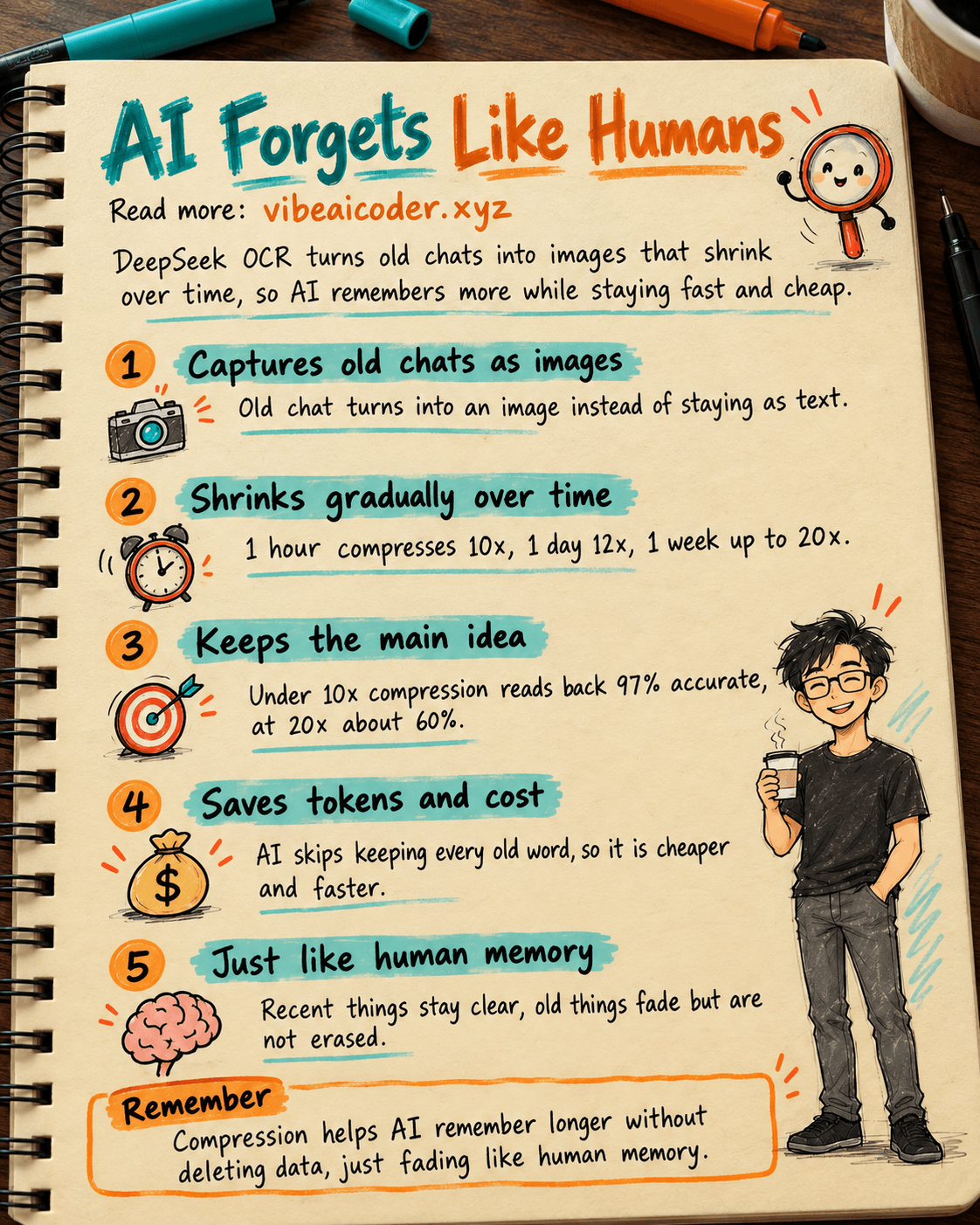
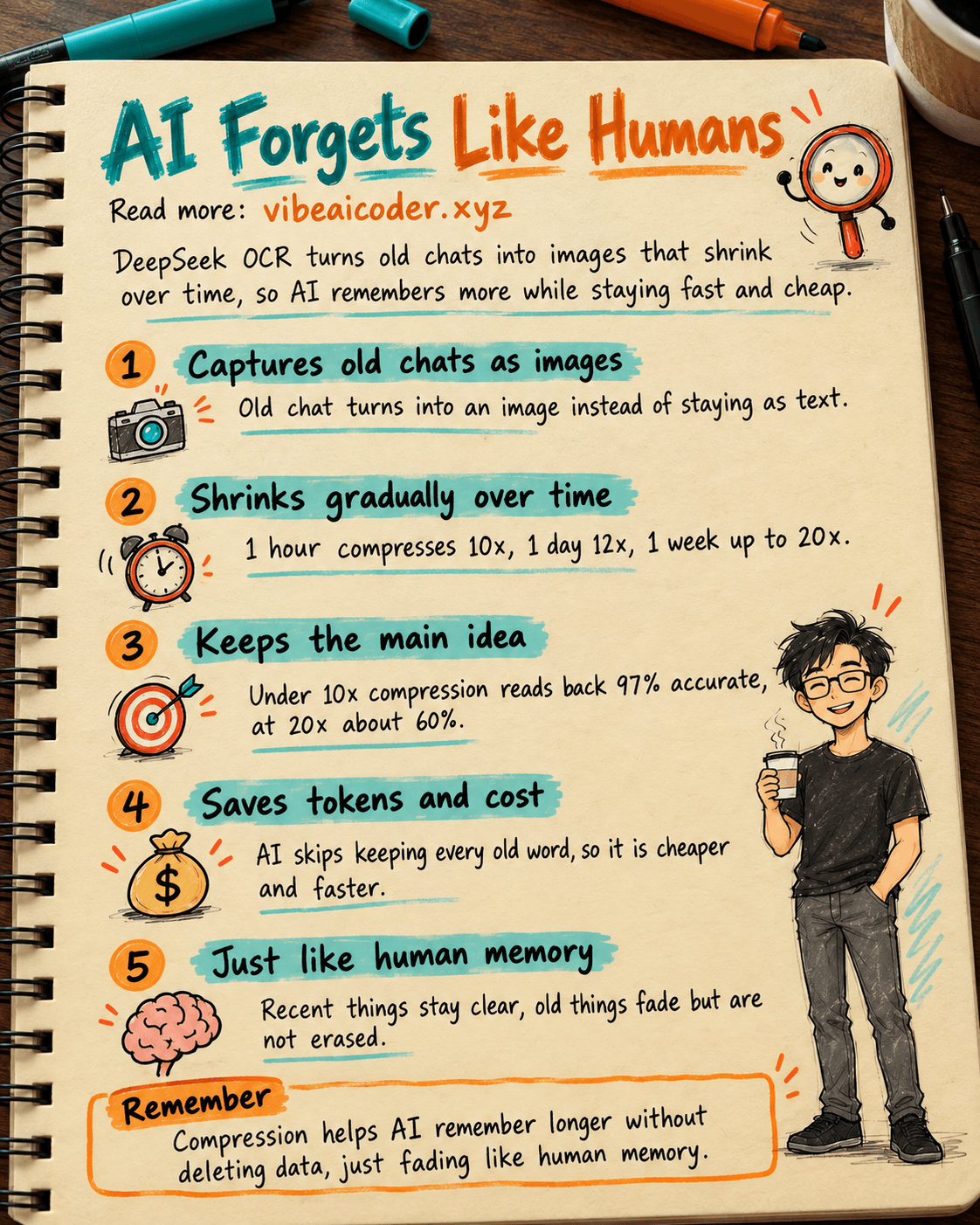
DeepSeek OCR is a new technique that turns old parts of a conversation into images, then shrinks those images over time, the same way human memory fades. This lets an AI keep track of very long conversations without having to remember every word at full resolution, saving a huge amount of tokens (the units AI uses to count text and bill you) and compute cost. The idea was recently highlighted again by the popular science channel Two Minute Papers, based on DeepSeek's Contexts Optical Compression research. To understand the basics first, see our guide on AI là gì.
 A simple everyday example
Imagine you take a screenshot of every conversation instead of retyping the whole text. A sharp screenshot of a page looks almost exactly like the original, but if you shrink that image again and again, the text blurs, and you can only make out the main idea instead of every comma. DeepSeek OCR does exactly this with old parts of an AI conversation: it turns text into an image, then keeps shrinking that image as time passes, just like you remember yesterday clearly but only vaguely recall something from last year.
 How it actually works
- The most recent part of the conversation stays as full, high resolution text so the AI can answer accurately.
- A part of the conversation from about one hour ago gets "captured" as an image at a medium resolution, compressed around 10 times compared to the original text.
- Conversation from about one day ago gets compressed further, around 12 times.
- Conversation from a week or more ago gets compressed the hardest, 15 to 20 times, the text nearly blurs out but the main idea survives.
- Internally, DeepSeek OCR uses two parts: an image reader and a small decoder. The image reader can turn an entire document page into only about 100 image tokens, far fewer than the thousands of text tokens that used to be needed. The research team measured that under a 10x compression ratio, read-back accuracy stays at 97 percent, while at 20x compression accuracy drops to around 60 percent, still enough to capture the main point.
To go deeper into why AI sometimes seems to "forget" mid conversation, read our posts on Context Window là gì and Token là gì trong AI.
 What this means for you
- Longer conversations without losing the thread: if this technique makes it into mainstream AI assistants, you could ask follow up questions through a very long session and the AI would still remember the gist of what was said at the start.
- Cheaper AI usage: since the AI no longer has to keep every single token of an old conversation, costs can drop, similar to how a Python library once helped AI agents save up to 80 percent of context window tokens, just with a different approach built around images.
- Uses beyond chat: the research team says this technology can also scan large batches of documents, generating over 200,000 pages of training data per day using a single A100 GPU, with PDF processing speed around 2,500 tokens per second.
 Common misconceptions
- "AI forgetting means the old data is deleted." Reality: this is lossy compression, old information is still there but blurred, like a shrunken photo, not an erased one.
- "This feature already exists in ChatGPT or Claude." Reality: this is DeepSeek's open source research, currently used mainly for document reading (OCR). No major AI company has announced bringing this gradual forgetting mechanism into mainstream chatbots yet.
- "Compressing text into images to save tokens is a brand new idea." Reality: summarizing old conversations to save memory space already existed before, DeepSeek OCR simply introduces an image based approach that compresses far more effectively than earlier methods.
FAQ
Is DeepSeek OCR a new chatbot? No. It is a model focused on reading documents and images (OCR), now extended with an optical context compression mechanism, not a chatbot you talk to directly like ChatGPT or Claude.
Can image based compression make the AI answer with wrong old information? It can, if you ask about a very small detail from a conversation long ago, accuracy drops, around 60 percent at the highest compression level. But for recent content or moderate compression, accuracy stays above 97 percent.
When will this show up in everyday AI apps? DeepSeek has open sourced the code and model for developers to experiment with, but mainstream chatbots like ChatGPT, Claude, and Gemini have not announced adopting this forgetting mechanism yet.
Why not just keep all the text, why compress at all? Keeping every word of a very long conversation uses a huge number of tokens, which drives up compute cost and slows down responses. Compression lets the AI remember more while staying fast and affordable.
Do I need to know how to code to understand this? No. All you need to know is that this is a clever way to help AI remember longer conversations without using up too many resources, similar to how the human brain prioritizes remembering recent events clearly while older ones fade.
More articles

Gemini 4 Argon Reads a 500-Page Chemistry Patent in One Afternoon

Claude Opus 5.5 Codes a Real Money Trading Game in One Day

What Is a Token in AI? Why ChatGPT and Claude Charge by Tokens

What Is Chain of Thought? Why Asking AI to Think Step by Step Works Better

Claude Sonnet 5.5 vs GPT-6.1 Sol: Which AI Model Is Worth Using?

 Claude Opus 5.5 Launches: 30% Faster, 40% Cheaper, Blocks AI Brain Copying