CLM-35B Is Coming: The AI That Picks an Action by Looking at Your Screen
CLM-35B Is Coming: The AI That Picks an Action by Looking at Your Screen, Not Reading a Description
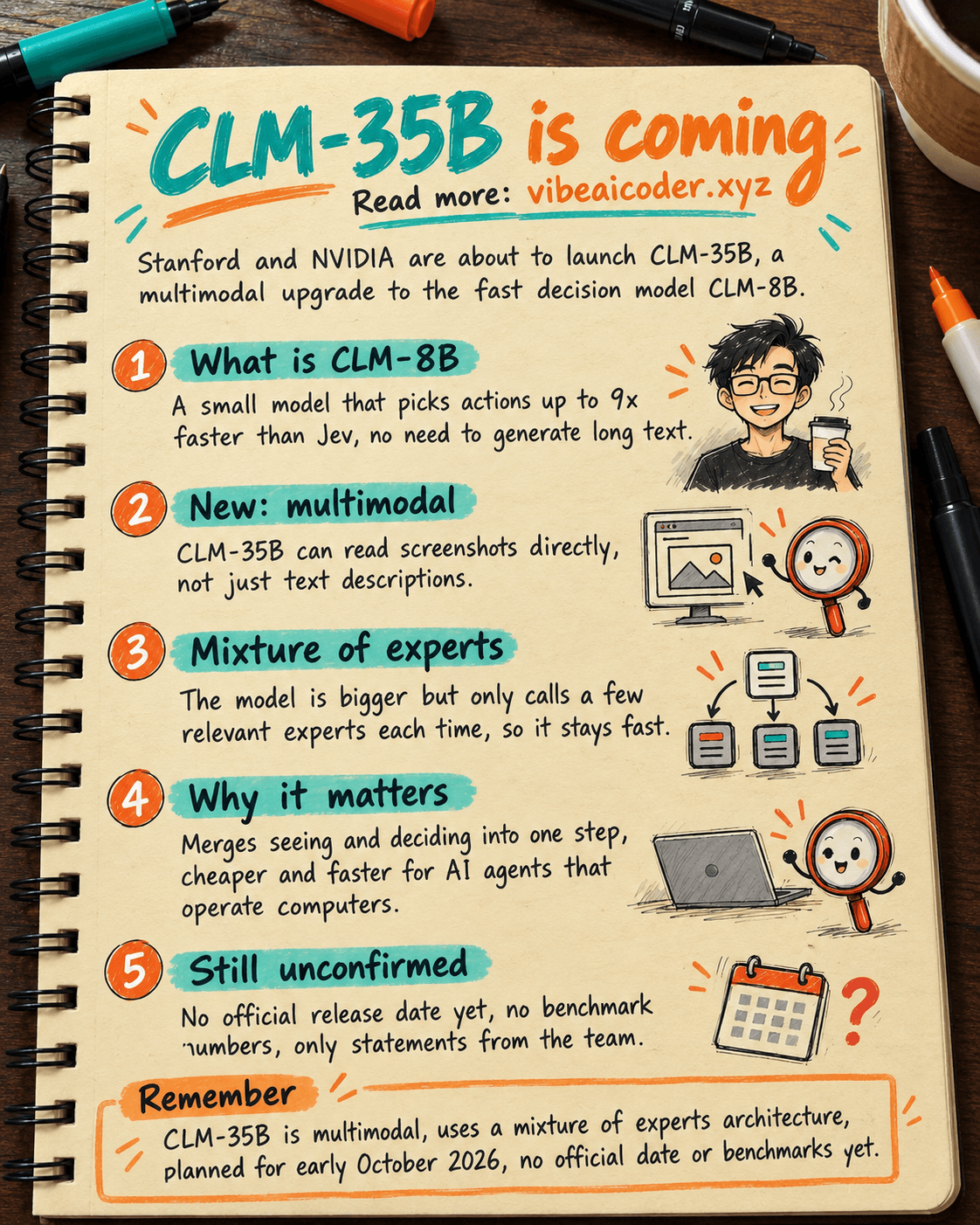
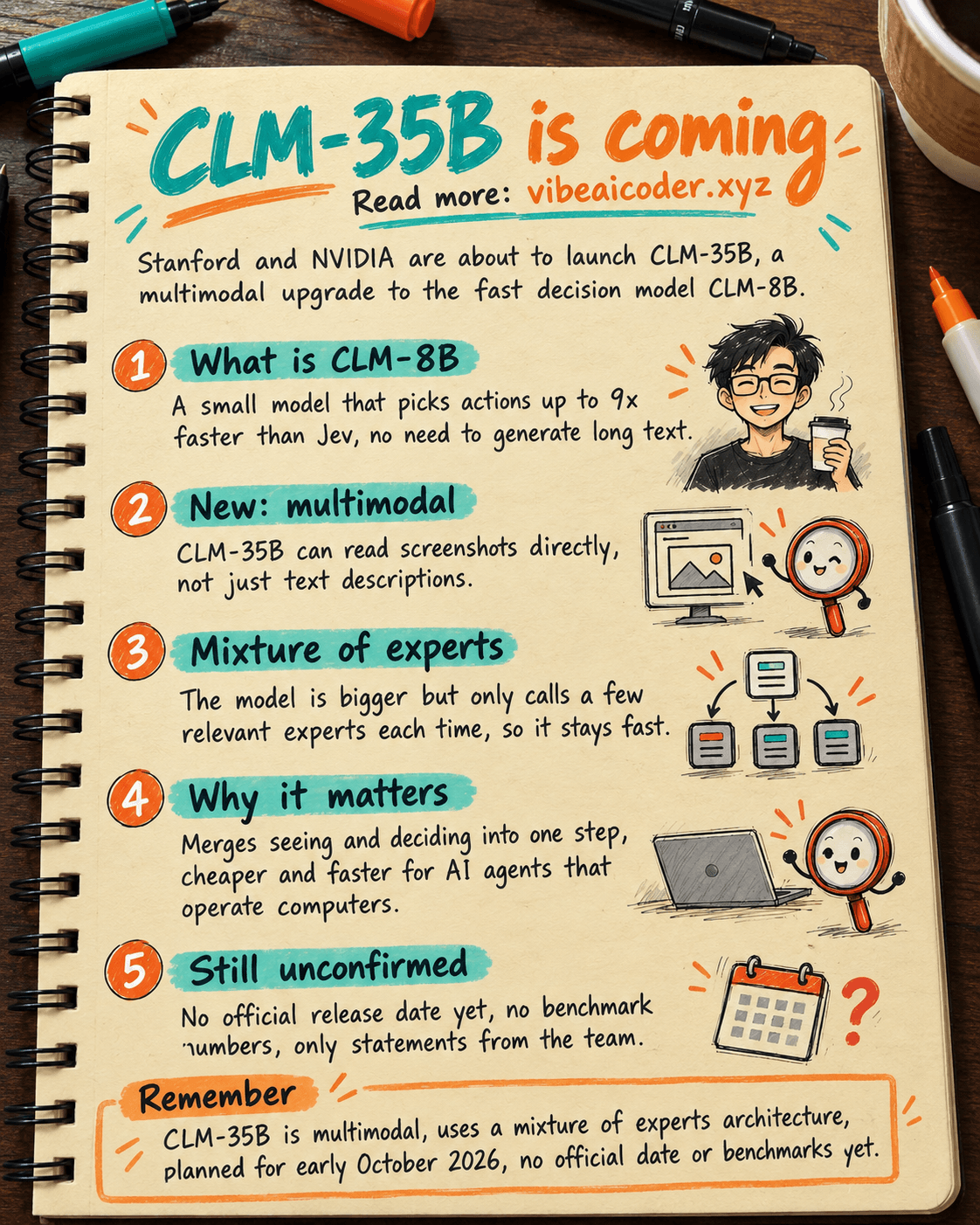
Late last month, Stanford and NVIDIA turned heads with CLM-8B, a small AI model that lets AI agents (AI assistants that act on their own) pick an action up to 9 times faster than the popular tool Jev. Now the team behind the project has revealed what comes next: CLM-35B-A3B, a bigger, multimodal version, planned for release in early October.
A quick recap: what is CLM
Most AI you use day to day (ChatGPT, Claude, Gemini) works by generating one word at a time. That is flexible, but slow, especially when an AI agent only needs to pick one option out of a few (which button to click, which file to choose, answer yes or no).
CLM-8B solves exactly that. Instead of generating text, it turns the current situation and each candidate action into number sequences (called embeddings, the way AI turns information into numbers it can compare), then picks whichever option matches best. Because it never has to write out a full answer, it runs much faster than Jev, the tool familiar to AI agent builders.
What is new in CLM-35B-A3B: it can "see"
According to Jacky Kwok, who leads the project at Stanford, CLM-35B-A3B is being trained with more data and more compute, with a release planned for early October 2026. Two things set it apart from its smaller sibling:
- Multimodal: the new model can read screenshots directly, not just text descriptions of a situation. If it ships as planned, it would be the first model of its kind able to "look" at an actual screenshot and pick an action, instead of needing someone to write out a text description first.
- Mixture of experts (MoE) architecture: in plain terms, instead of one giant brain that has to think through every question, the model is split into many small "experts," and only a few relevant ones get called each time. That lets the model grow bigger (35 billion parameters, versus 8 billion before) while still running fast.
Why this matters if you build AI agents
Many AI agents today (ones that control a computer, read invoices, process documents) have to "look" at the screen through a screenshot before deciding what to do next. Until now, that step usually needed a large, slow, expensive model just to describe the image in words before any decision could happen. If CLM-35B-A3B works as advertised, it could merge both steps into one: look at the image, decide right away, no text description in between. For anyone building AI agent products, that is a cheaper, faster decision layer to pair behind big models like Claude or Qwen.
Still worth a grain of salt
To be honest with you: as of this writing, CLM-35B-A3B is still in training. There is no confirmed release date yet, and no benchmark numbers have been published to verify its real speed or accuracy. Everything known so far comes from the development team's own statements, not an official release. It is worth watching over the coming weeks, but not something to build into a product just yet.
Takeaway
CLM-35B-A3B is a bigger, multimodal version of the fast decision model CLM-8B (Stanford, NVIDIA), using a mixture of experts architecture, planned for release in early October 2026, but with no official date or benchmark numbers yet. If it ships, it would be the first model able to pick an action straight from a screenshot, useful for AI agents that operate computers and process documents.
More articles

Gemini 4 Argon Reads a 500-Page Chemistry Patent in One Afternoon

Claude Opus 5.5 Codes a Real Money Trading Game in One Day

What Is a Token in AI? Why ChatGPT and Claude Charge by Tokens

What Is Chain of Thought? Why Asking AI to Think Step by Step Works Better

Claude Sonnet 5.5 vs GPT-6.1 Sol: Which AI Model Is Worth Using?

 Claude Opus 5.5 Launches: 30% Faster, 40% Cheaper, Blocks AI Brain Copying