 CLM-8B: The AI Model That Decides 9x Faster Than Jev
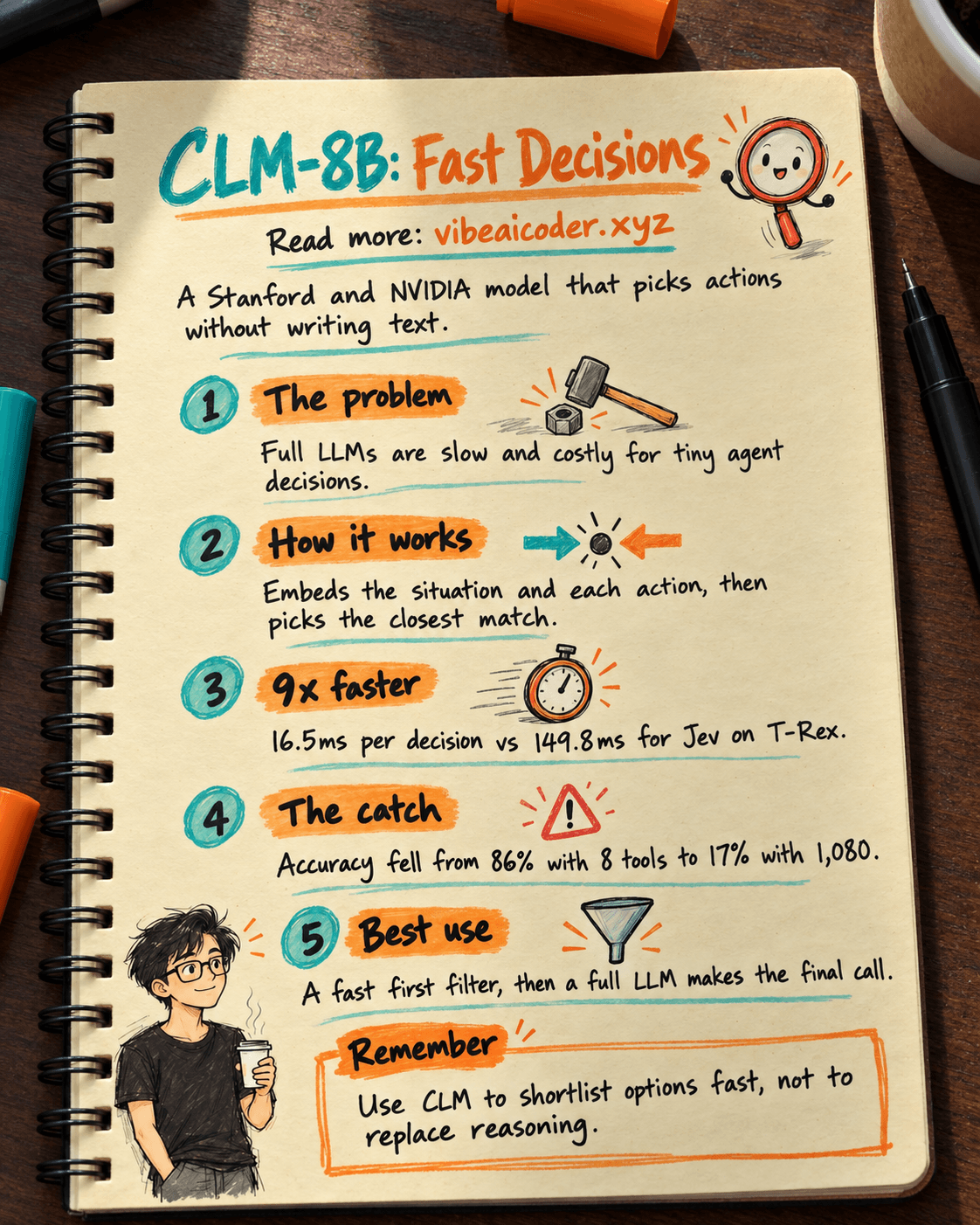
Ever notice your agent burning through hundreds of milliseconds just to decide which tool to call? That is exactly the problem CLM-8B, a brand new model from Stanford and NVIDIA Research, was built to solve. It does not write a single word. It just guesses correctly, extremely fast.
The problem: LLMs are too heavy for small decisions
Inside every AI agent there is a constant stream of small decisions: which tool to pick, which patch to rank higher, where to route a request, what action to take next. Using a full-size LLM to generate tokens for each of these tiny decisions is like using a sledgehammer to crack a nut: slow and expensive. This is the exact territory where Jev (the System 1 model from TypeSafe AI) has dominated. Now Stanford and NVIDIA bring a completely different approach to the table.
How CLM actually works
Instead of generating an answer, CLM (Contrastive Language Model) turns decision-making into a retrieval problem, similar to how CLIP matches images with captions. It embeds the current situation and every possible action into the same vector space, then picks whichever action lands closest.
The dual-encoder architecture consists of:
- A frozen Qwen3-8B backbone as the foundation.
- Two MLP projection heads with about 20 million parameters each, one for state and one for action, the only parts that actually get trained.
- Training uses InfoNCE contrastive loss across three stages: about 60 million question-answer pairs, about 30 million "hard negatives" (answers that look close but are wrong), and about 1 million agent trajectories for post-training.
Because each action is encoded once and cached, comparing 1,000 options costs roughly the same as comparing just one.
How fast is it, really
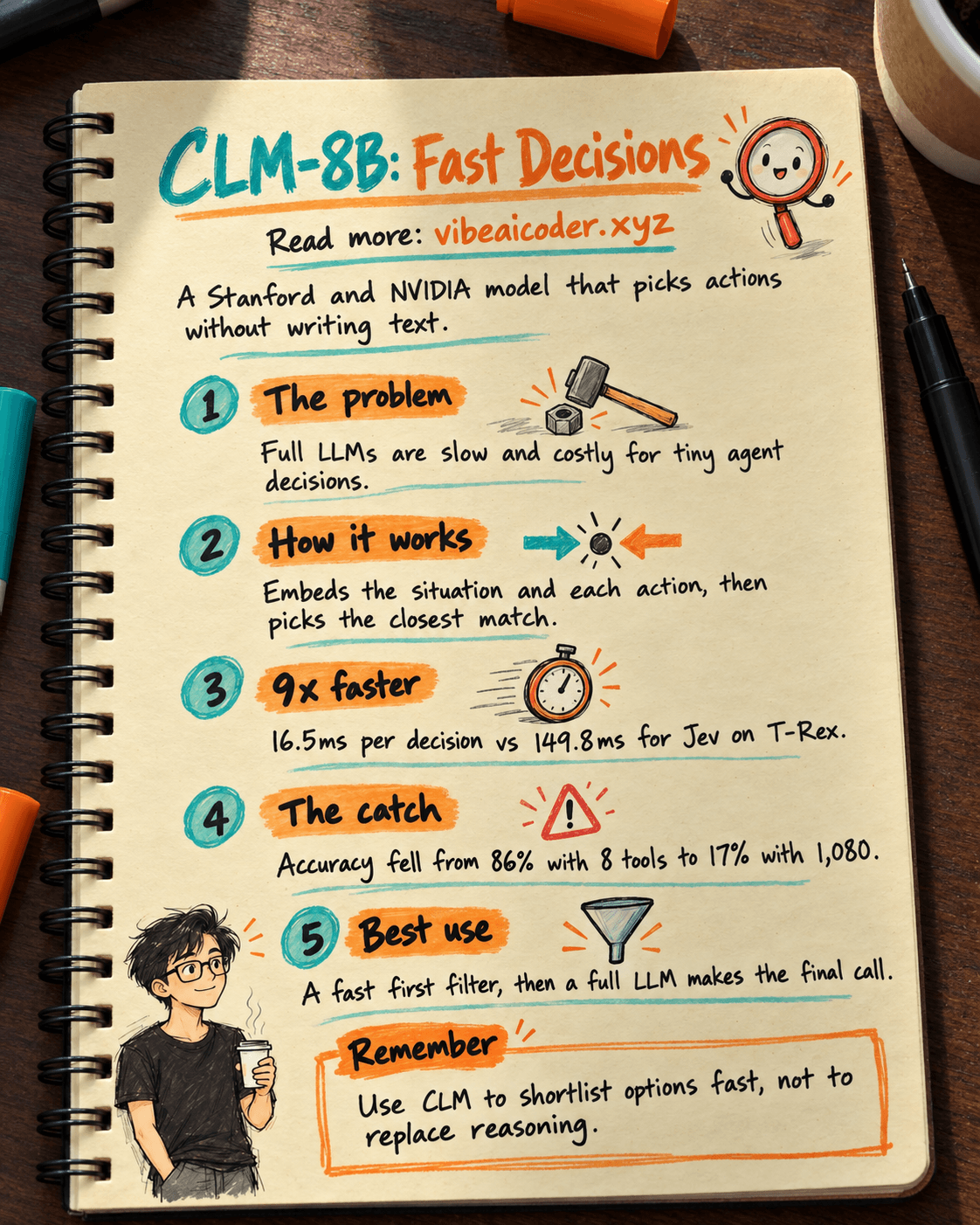
The research team's official numbers, from a T-Rex game benchmark, show CLM-8B making a decision in 16.5ms compared to 149.8ms for Jev, about 9 times faster.
The YouTube channel Prompt Engineering ran its own independent measurement and found the gap even more striking under heavier load: with 1,000 possible actions, CLM took just 44ms while Jev needed 579ms, because Jev has to score each option one at a time while CLM simply looks up cached vectors.
The catch: no side-by-side comparison
Here is the most important tradeoff to weigh before putting CLM into a production pipeline: because every action is encoded independently, CLM never directly compares options against each other the way an LLM would after reading through all of them and reasoning.
The consequence shows up clearly as the number of choices grows. That same Prompt Engineering channel tested CLM with 1,080 tools on a DGX Spark: accuracy dropped from 86% with just 8 tools down to 17% with the full set of 1,080 tools. The research team reported similar patterns in their own benchmarks:
- BFCL v4 (tool calling): CLM-8B scored 95.2% versus 99.2% for Jev.
- WikiRacing: CLM completed 26 out of 30 tasks versus 30 out of 30 for Jev.
- But on two other tests, CLM actually won: 81.6% versus 71.1% for Jev on DeepSWE coding, and 87.6% versus 83.1% for Jev on Terminal-Bench.
In other words, CLM does not always win, and the more choices it has to tell apart with fine-grained precision, the more it tends to falter.
So where should you actually use CLM
Jacky Kwok, the project lead for CLM, is direct about its limits: "I would not use CLM to replace a general-purpose reasoning model for tasks that need open-ended reasoning, like solving math problems, generating long-form answers, or high-level planning."
The most sensible place for CLM in an agent pipeline today is as a cheap, fast first-pass filter: narrow a long list of tools or actions down to a handful of candidates, then hand the final decision off to a full-size LLM. Do not let it decide entirely on its own when the option set is too large or the choices are too similar to each other.
Stanford and NVIDIA have open-sourced CLM-8B, and a multimodal successor called CLM-35B is expected to launch in early October 2026. If you are building an agent that calls dozens of tools at every step, this architecture is worth testing right now, as long as you understand its blind spots.
More articles

AI Training vs Inference: What Is the Difference?

Gemini 4 Argon Reads a 500-Page Chemistry Patent in One Afternoon

Claude Opus 5.5 Codes a Real Money Trading Game in One Day

What Is a Token in AI? Why ChatGPT and Claude Charge by Tokens

What Is Chain of Thought? Why Asking AI to Think Step by Step Works Better

Claude Sonnet 5.5 vs GPT-6.1 Sol: Which AI Model Is Worth Using?