Can AI Really Replace Human Jobs? What the Data Actually Shows
AI can already do a lot of things that only humans could do a few years ago, from writing reports and answering customer questions to writing entire programs. But the short answer to "can AI really replace human jobs" is: yes, for some jobs, but not all of them, and AI is also creating brand new jobs. This article shows you real numbers instead of vague fear, so you can judge for yourself how worried you should be.
 What the real data says, not just rumors
Many people think AI will "wipe out" jobs within a few years. The real data is more nuanced than that.
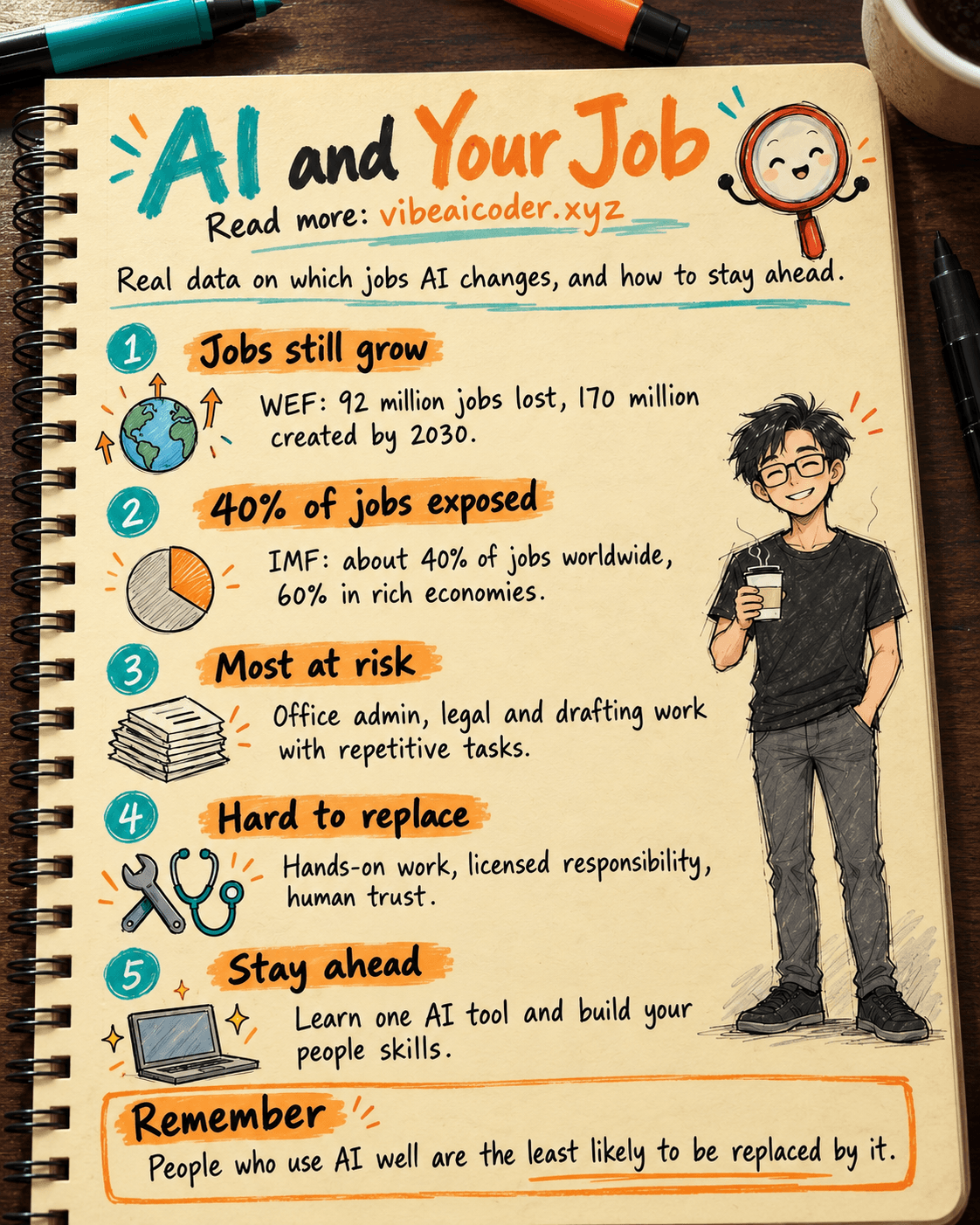
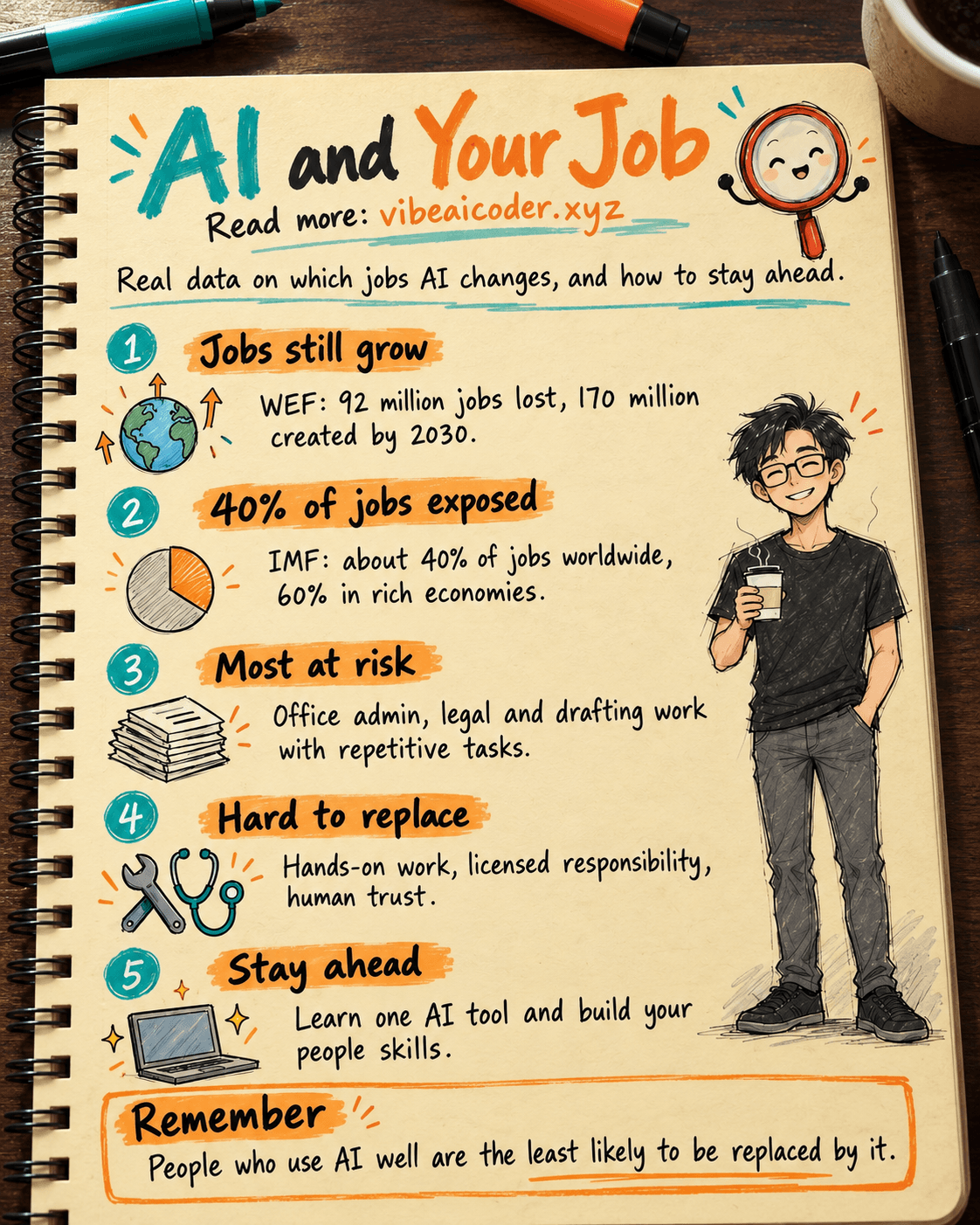
The World Economic Forum (WEF, an organization that brings together governments and major companies to discuss the global economy) published its Future of Jobs Report 2025, predicting that between 2025 and 2030 the world will lose around 92 million jobs to technology, while creating around 170 million new jobs. Net of both, the world still gains roughly 78 million jobs, just different ones from before.
The International Monetary Fund (IMF) estimates that nearly 40% of global employment is exposed to AI in some way, and that share rises to about 60% in developed economies like the US, Japan and European countries, where office work makes up a larger share of jobs.
Goldman Sachs, a major investment bank known for its economic research, calculates that AI could affect the equivalent of 300 million full time positions worldwide, and could automate about 25% of work hours in the US.
These numbers sound huge, but "exposed" does not mean "losing your job overnight." In most cases AI takes over part of a job, like drafting emails, summarizing documents, or writing sample code, while humans still check the work and make the final call.
 Which jobs are affected the most
According to the WEF, the hardest hit group is repetitive administrative and clerical work: data entry clerks, bank tellers, postal workers, ticket sellers. These are jobs with repeated steps that are easy to teach a machine to copy.
More specifically, the categories with the highest share of tasks that could be handed to AI are:
- Office administration: around 46% of tasks
- Legal work (drafting contracts, researching law): around 44%
- Architecture and engineering (drawings, calculations): around 37%
It makes sense: these jobs mostly deal with structured information, meaning data already organized into clear patterns like forms, contracts, or technical drawings, so AI learns the pattern quickly.
If your job looks like this, don't panic, but do read the "how to stay ahead" section below.
 Which jobs AI struggles to replace, and why
On the other hand, three groups of jobs are considered hard for AI to replace for years to come.
1. Jobs that require hands-on skill and handling unexpected real world situations. Electricians, plumbers, and mechanics have to show up in person, look at a situation they've never seen before, and fix it on the spot. AI doesn't yet have good enough "hands" and "eyes" to do this instead of a person.
2. Jobs that carry legal or safety responsibility tied to a specific person. A doctor examining a patient and deciding on treatment, or a nurse providing care, both need a licensed person who is legally accountable if something goes wrong. AI can help look things up, but it cannot be the one who signs off and takes responsibility.
3. Jobs that depend on trust and emotion between people. A teacher notices which student isn't following the lesson and adjusts on the spot. A counselor or social worker needs real empathy. A manager needs to motivate people and resolve conflicts between coworkers. These all require a kind of subtle human judgment that AI can't yet replicate.
In short, three traits make a job "AI resistant": hands-on work in unpredictable environments, legal responsibility that must fall on a real licensed person, and work that depends on direct human trust.
 So how worried should you be
The right way to worry isn't to fear AI in general, but to look closely at your specific job and ask: which part of my work is processing repetitive, templated information, and which part is judgment, creativity, and human to human communication.
If your job leans toward templated work, like data entry, filling in standard report formats, or answering the same customer questions over and over, AI will likely take over a meaningful chunk of it in the next few years. If your job leans toward judgment calls, caring for others, or handling unexpected real world situations, you have more time to adapt.
Either way, one thing holds true: people who know how to use AI to work faster will have an advantage over those who don't, no matter the industry.
 What to do so you don't get left behind
Three simple things you can start today:
- Learn to use an AI tool relevant to your job. You don't need to know how to code. You just need to know how to ask the right question, the same way an AI agent works, meaning an AI assistant that can carry out several steps on its own instead of just answering one question, so AI handles the repetitive parts while you focus on judgment calls.
- Build the skills AI still struggles with, like communication, persuasion, handling unexpected situations, and teamwork. These are skills that get better the more you use them, and AI doesn't easily copy them.
- Track how your own job is changing every year, instead of waiting to react only after you're affected. Anthropic, the company behind Claude, ran a simulation suggesting that by 2030, average worker pay could drop to about 45% of today's level if automation accelerates and people don't adapt in time. This is a warning scenario, not a guaranteed prediction, but it shows why adapting early matters. If you want to understand the technology behind all of this, start with what AI actually is.
AI isn't a storm that blows through and then it's over. It's a new tool, the same way computers or the internet were once new tools. The people who learn to use it early will be the ones least likely to be replaced by it.
FAQ
Will AI replace all jobs in the next few years? No. According to the WEF, AI is expected to displace about 92 million jobs but also create about 170 million new ones between 2025 and 2030, meaning total global employment is still expected to grow, just with a different mix of jobs.
Which industries are most exposed to AI? Office administration, legal work, and engineering drafting have the highest share of tasks that could be handed to AI, because these jobs mostly process information that follows clear templates.
Are manual jobs safer than office jobs? Usually yes, as long as the job involves handling unexpected situations on site, like an electrician or plumber. AI doesn't yet have the physical capability to replace this kind of work.
I'm not tech savvy, should I worry? You don't need to be a tech expert, just comfortable using one basic AI tool in your daily work. Knowing how to use AI matters more than understanding how it works internally.
What should kids learn today so they aren't replaced by AI later? Besides subject knowledge, they should build communication skills, critical thinking, teamwork, and adaptability, since these are the skills AI struggles to copy and that every future job will need.
More articles

AI Training vs Inference: What Is the Difference?

Gemini 4 Argon Reads a 500-Page Chemistry Patent in One Afternoon

Claude Opus 5.5 Codes a Real Money Trading Game in One Day

What Is a Token in AI? Why ChatGPT and Claude Charge by Tokens

What Is Chain of Thought? Why Asking AI to Think Step by Step Works Better

Claude Sonnet 5.5 vs GPT-6.1 Sol: Which AI Model Is Worth Using?