Block Uses OpenAI's AI to Chain Security Flaws Before Hackers Do
Block Uses OpenAI's AI to Chain Security Flaws Before Hackers Do
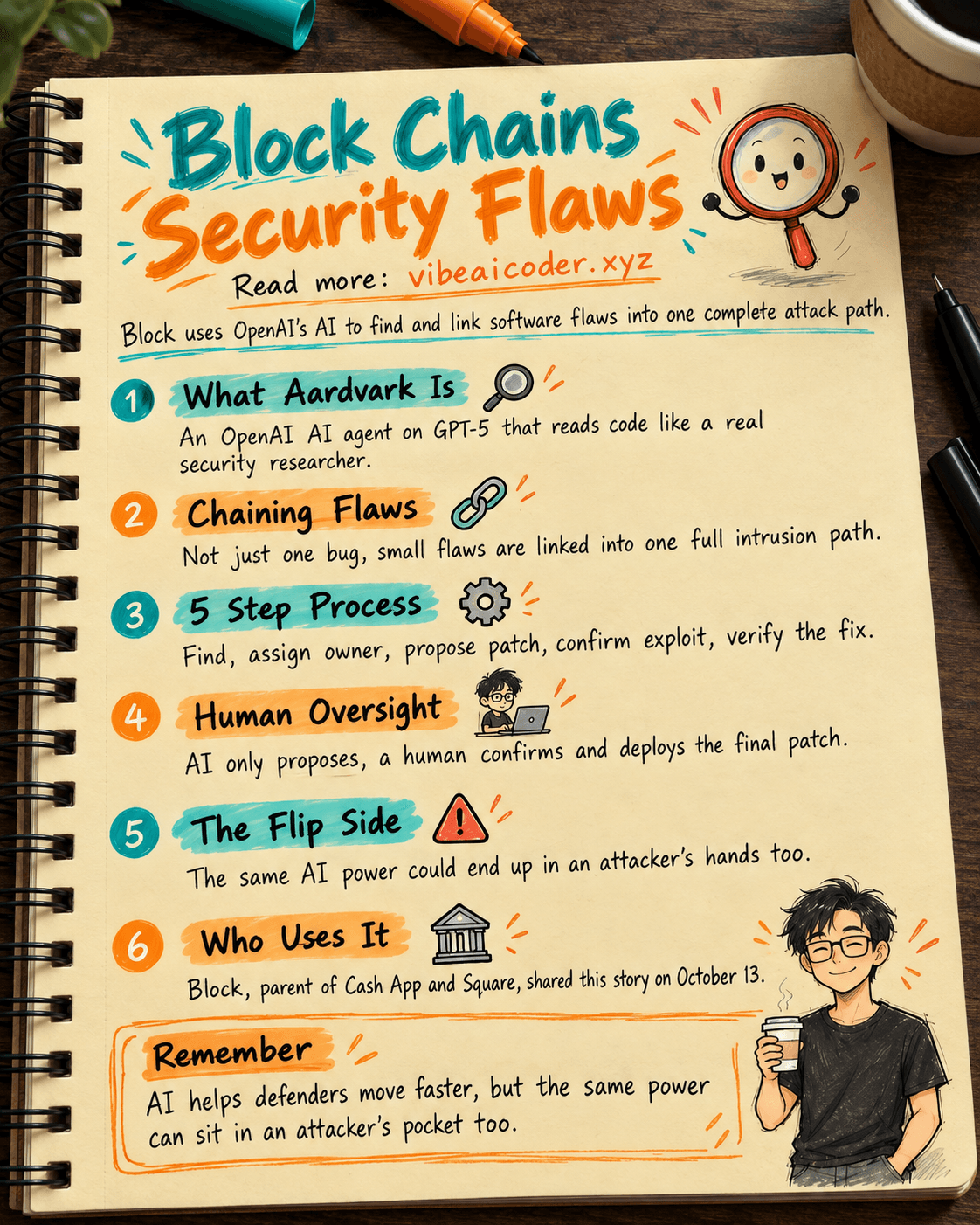
Block, the parent company of Cash App and Square, has publicly shared how its security team uses an OpenAI AI tool to find and patch software vulnerabilities. What stands out is not that the AI finds a single bug, but that it links small flaws together into one complete path an attacker could use to break in.
Block's Chief Information Security Officer, James Nettesheim, who previously handled security incident response at Google and led forensic investigations for Mandiant, shared the story in a customer video OpenAI published on October 13.
AI Security That Thinks Like a Real Researcher
The tool Block uses is built on Aardvark, an OpenAI AI agent running on GPT-5, designed to "think like a security researcher." Instead of just scanning code for known bug patterns the way traditional security software does, Aardvark reads code, analyzes its logic, and writes and runs its own tests to check whether a piece of code is actually safe.
In internal testing, Aardvark caught about 92% of known and intentionally planted vulnerabilities, including hard-to-spot issues like logic flaws, incomplete fixes, and privacy leaks. The tool is still in private beta.
What Is New: Not Just Finding Bugs, But Chaining Them Into an Attack Path
The most notable part of Block's story is how different this is from older vulnerability scanners. Nettesheim explains that his team now uses AI to "hypothesize about attack patterns crossing trust boundaries, then chain together a series of attacks to give you an end to end compromise."
In plain terms: one small vulnerability on its own might not be dangerous. But if it connects to another flaw in a neighboring system, the two combined can open a full path for an attacker to steal data or gain control. This kind of chaining used to require a team of experienced security experts piecing it together by hand. Now AI can do that connecting step far faster.
The 5 Step Process Block's Security Team Follows
According to Block, the workflow with AI follows these steps, always with a human supervising the final stage:
- Find the vulnerability: AI scans code to spot weak points.
- Identify who owns it: find the team or person responsible for that piece of software.
- Propose a patch: AI drafts a fix for a human to review.
- Confirm it is actually exploitable: to avoid false alarms.
- Verify after patching: make sure the fix truly closes the gap, with a human making the final call and deploying it.
The Flip Side: Anyone Can Have This Capability in Their Pocket
Block is also candid about the risk. The same model that lets a small security team punch above its weight could just as easily end up in the hands of an attacker looking for flaws faster. In the team's own words, every attacker potentially has an advanced capability in their pocket too.
This is not a reason to fear AI, but a reminder that defenders now need to find and fix bugs as fast as attackers, who are also using AI.
Why Block's Story Matters to You
You do not need to work in security for this story to matter. It shows a broader trend: AI agents are no longer just answering simple questions, they are being handed entire multi step workflows that require reasoning and checking their own work, the same way Block uses Aardvark to find, confirm, and propose fixes all at once.
If your company is considering AI for security, three takeaways from Block's story are worth remembering: always keep a human at the final decision point, never lower your guard just because AI is helping, and remember that a powerful defensive tool is often just as powerful an offensive one in the wrong hands.
This is not the first time AI has proven its value in cybersecurity. Sophos previously used OpenAI's AI to cut incident response time by 96%, and Gemini 4 Argon has also been shown to catch twice as many vulnerabilities as earlier models. If you are curious why these kinds of AI agents can sometimes still be tricked into doing the wrong thing, our explainer on prompt injection covers that weak point in more depth.
FAQ
What is Aardvark? It is an OpenAI AI agent built on GPT-5 that acts like a security researcher: reading code, finding vulnerabilities, and proposing patches. It is currently in private beta.
What company is Block? Block is the parent company of two familiar platforms: Cash App (a money transfer app) and Square (payment hardware and software for merchants).
Does the AI patch vulnerabilities automatically, without a human? No. According to Block, the AI only proposes a patch; a human confirms and deploys the final fix.
Could this tool be dangerous in the wrong hands? Possibly. Block's own security team warns that this vulnerability chaining capability does not only benefit defenders, attackers can access similar capabilities too.
Can small businesses use a similar tool? Aardvark is currently in private beta, limited to select projects and partners. But the broader trend of AI agents assisting with security code review is spreading to more tools on the market.
More articles

AI Training vs Inference: What Is the Difference?

Gemini 4 Argon Reads a 500-Page Chemistry Patent in One Afternoon

Claude Opus 5.5 Codes a Real Money Trading Game in One Day

What Is a Token in AI? Why ChatGPT and Claude Charge by Tokens

What Is Chain of Thought? Why Asking AI to Think Step by Step Works Better

Claude Sonnet 5.5 vs GPT-6.1 Sol: Which AI Model Is Worth Using?