arXiv Caps Papers at 2 a Month
The world's biggest research archive just locked its doors, a little
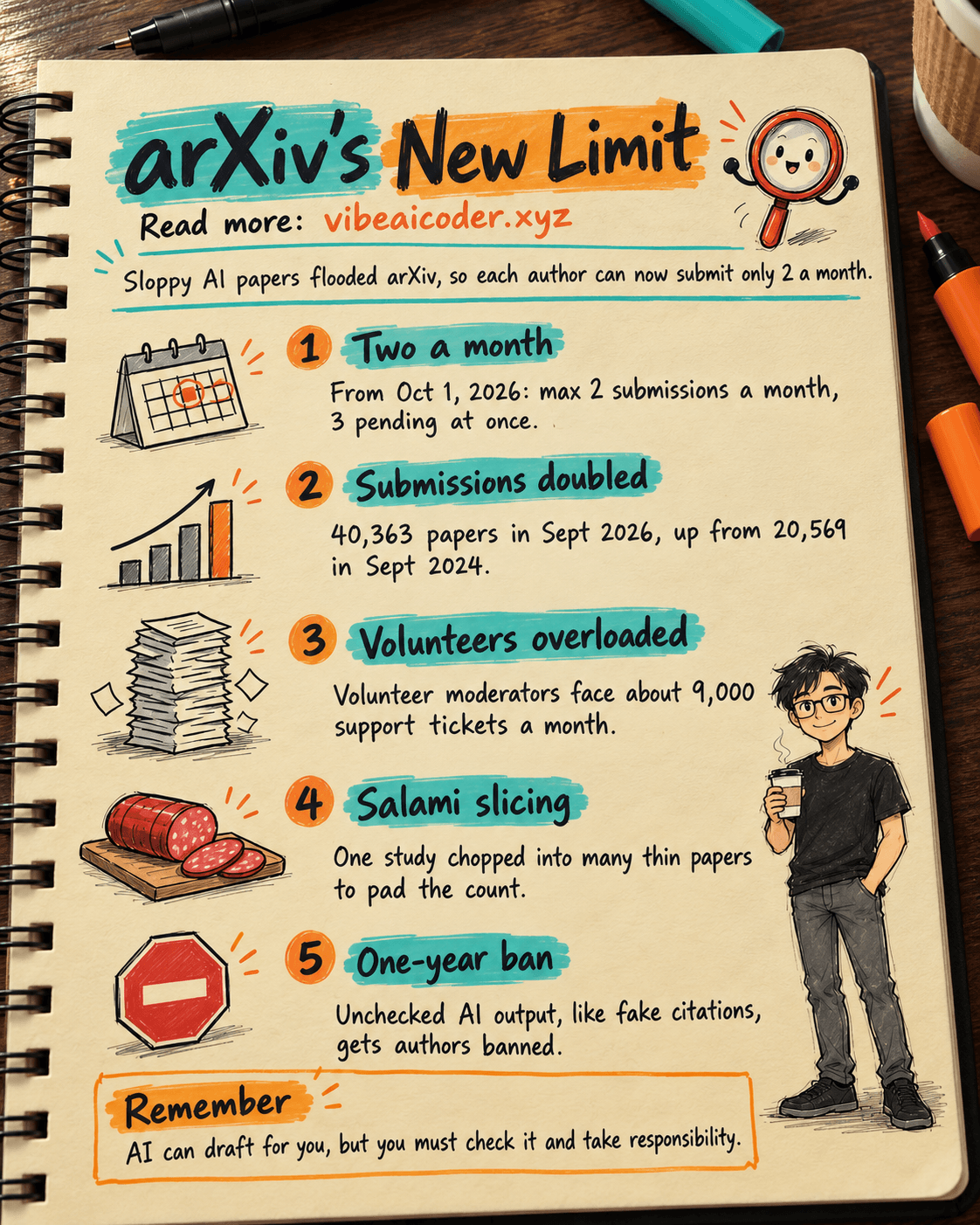
Have you noticed how AI can now write an essay, a report, even an entire scientific paper for you? That trend has gotten so big that arXiv, the world's largest preprint archive (where scientists post research before it gets formally peer reviewed), just rolled out a rule it has never needed before. Starting October 1, 2026, every author is capped at two submissions a month, and can never have more than three papers awaiting review at once.
The reason is simple: too many papers, and a lot of them are sloppy AI output.
The numbers tell the story
In September 2026 alone, arXiv received 40,363 submissions. Two years earlier, in September 2024, that number was just 20,569, roughly half. Compared with ten years ago (2016, around 9,869 submissions), the growth is staggering. The cs.AI category (artificial intelligence research) alone grew 6x in just two years.
Most of arXiv's moderators are volunteers, working scientists who donate their free time to read and approve papers for the community, not full-time staff. The submission surge has buried them under roughly 9,000 support tickets a month. It got bad enough that Thomas Dietterich, chair of arXiv's Editorial Advisory Council, said: "A relatively small proportion of authors are submitting a large number of low-quality papers and consuming a disproportionate fraction of the moderators' time."
What does "low quality" actually look like?
arXiv calls one pattern "salami slicing", chopping a single piece of research into multiple thin papers just to pad a publication count, on top of a flood of narrow, shallow papers that add nothing new. Once AI can produce something that merely looks scientific in a few minutes, anyone can crank out dozens of submissions a month, leaving readers to sift the real work out of a pile of noise.
It gets more absurd: since May 2026, arXiv has enforced a one-year ban on authors caught submitting papers with clear, unchecked AI output. Real examples have surfaced in the wild: leftover chatbot phrasing like "here is a 200-word summary, would you like me to make any changes?", unremoved placeholder instructions like "fill in the real numbers here", and citations to papers that simply don't exist (the AI invented them, the same hallucination problem many ChatGPT and Claude users have run into). The new rule doesn't ban using AI to draft, edit, or analyze data, only submitting AI output nobody bothered to check. Authors remain fully responsible for everything in a paper, no matter what wrote it.
Why this matters even if you're not a scientist
This isn't just academic drama. It's a blunt reminder for anyone using AI to write content, reports, or homework: AI is a phenomenal drafting assistant, but it can't take responsibility for you. You still need to read it back, check the numbers, and delete whatever the model accidentally left behind before you send it, whether it's a research paper or just a work email.
What makes this funnier is that AI has also proven it can do real, careful science. Claude recently proved a mathematical theorem that had stumped humans for 350 years. The problem was never the AI itself, it's how people use it: writing carelessly, submitting carelessly, never checking the output. If you're still wondering what AI actually is and how it differs from an ordinary tool, this is a vivid example: even the most powerful tool still needs a responsible human behind it.
More articles

Gemini 4 Argon Reads a 500-Page Chemistry Patent in One Afternoon

Claude Opus 5.5 Codes a Real Money Trading Game in One Day

What Is a Token in AI? Why ChatGPT and Claude Charge by Tokens

What Is Chain of Thought? Why Asking AI to Think Step by Step Works Better

Claude Sonnet 5.5 vs GPT-6.1 Sol: Which AI Model Is Worth Using?

 Claude Opus 5.5 Launches: 30% Faster, 40% Cheaper, Blocks AI Brain Copying