What Is Local AI? How Powerful Does Your Computer Need to Be
What Is Local AI? How Powerful Does Your Computer Need to Be
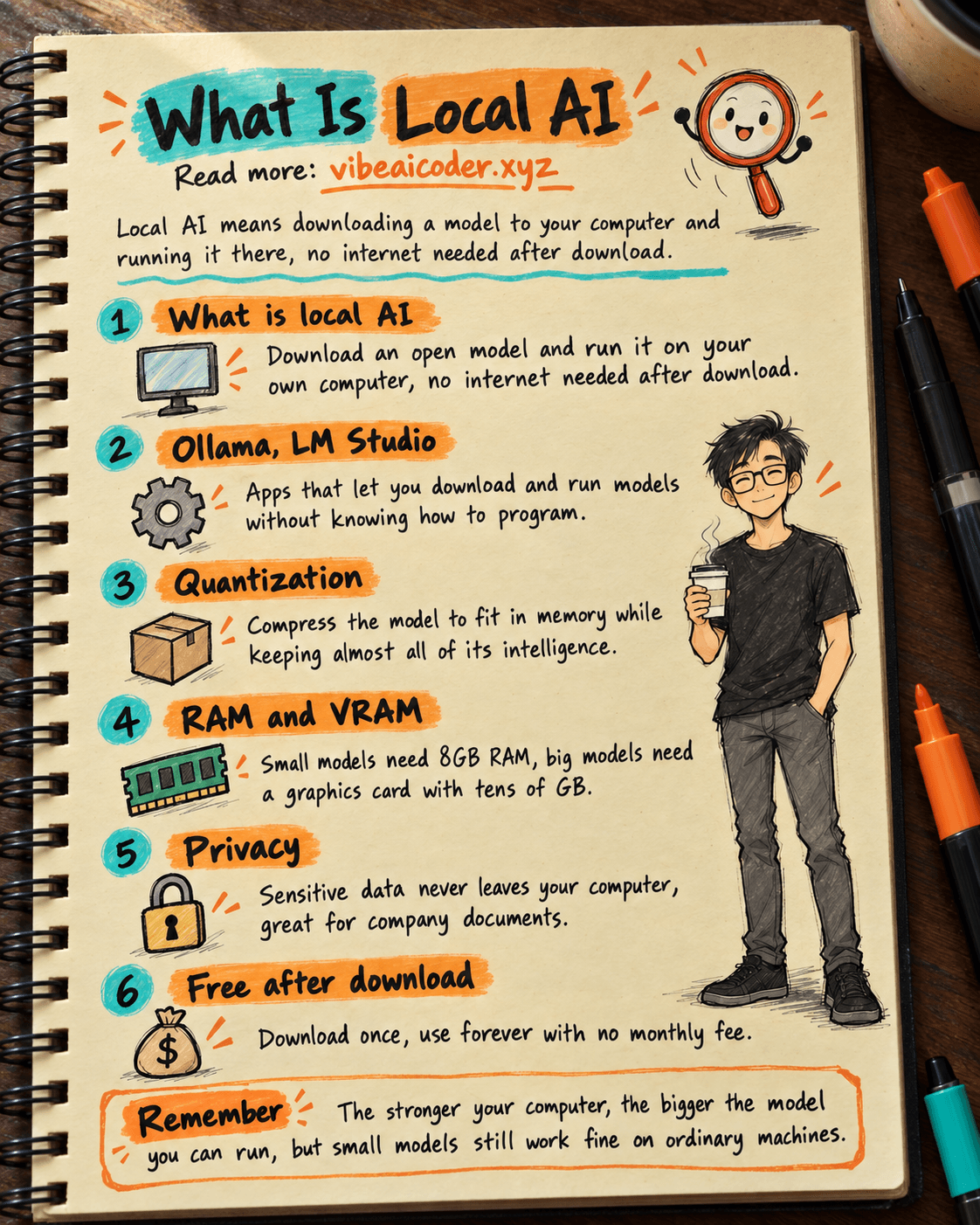
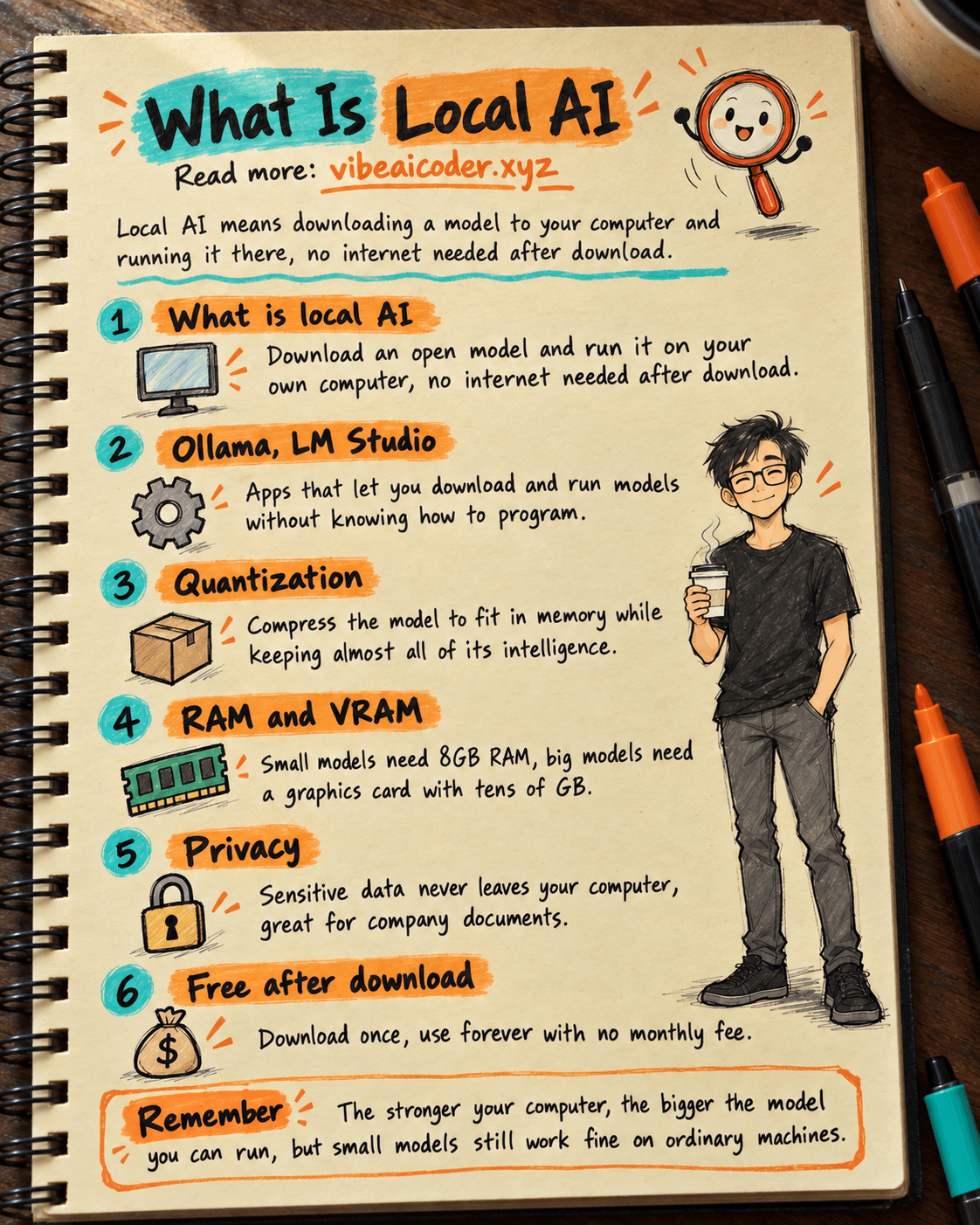
Local AI means downloading an AI model onto your own computer and running it right there, instead of typing a question and sending it over the internet to a server owned by OpenAI or Anthropic. All the "thinking" happens on your own hard drive and processor, no internet connection needed once the model is downloaded, and nobody far away ever sees your question. It sounds technical, but with a powerful enough computer and a few clicks, anyone can run a miniature AI right at home.
Understand it with an everyday example
Using Claude or ChatGPT is like ordering food delivery: you place an order (type a question), a restaurant far away (the AI company's server) cooks it and sends it over. The food is always good because the kitchen and the chef are top notch, but you have to pay every month or every time you order, and you have to trust the restaurant with whatever you share.
Local AI is like cooking at home: you buy the ingredients once (download the model), then cook with your own kitchen (your computer) as many times as you want without paying extra, and nobody sees what you are cooking. In exchange, how good the meal turns out depends on the kitchen you have (your computer hardware) and the recipe you choose (the AI model), and a home kitchen is usually no match for a five star restaurant.
How it actually works
- Pick an open source model. These are AI models that companies release publicly for anyone to download, like Llama from Meta, Qwen from Alibaba, or DeepSeek, unlike Claude or GPT which you can only use through their own app or API.
- Install a "launcher" app such as Ollama or LM Studio. It works like a music player: you download the model, then press run, no programming knowledge needed.
- Your computer compresses the model to fit in memory, a process called quantization. This keeps almost all of the model's intelligence while making it several times lighter, similar to compressing a photo or a song so the file gets smaller while still looking or sounding fine.
- The model loads into your computer's memory (RAM, and VRAM if you have a graphics card), then your processor computes and generates the answer one word at a time, right on your machine.
- Once the model is downloaded, the whole process no longer needs the internet. Your questions and answers never leave your computer.
What this means for you
Complete privacy for sensitive data. If your work involves company documents, contracts, or customer information you do not want to send over the internet, you can ask a local AI instead of pasting it straight into ChatGPT or Claude in a browser.
No monthly fees after setup. Once you have downloaded a model, you can use it as many times as you like at no extra cost, only paying for electricity, which is ideal if you ask AI many times a day for repetitive tasks.
In exchange, local AI running on a personal computer is usually noticeably weaker than Claude or the latest closed models, so complex work like writing long code, deep analysis, or anything needing high accuracy is still better done with cloud AI services. A few concrete examples:
- A freelancer translating a client's confidential documents can run a roughly 7 billion parameter model through Ollama on a 16GB RAM laptop, with no worry about data being sent anywhere.
- A student who wants to ask unlimited questions without hitting usage limits can install LM Studio with a small model that runs on a computer with an ordinary 8GB graphics card.
- Someone new to content creation who wants to experiment with AI freely, with no limits, can still run a very small model on CPU alone on an office laptop with no dedicated graphics card, just a bit slower.
Common misunderstandings
"Running AI at home means my computer has to be a supercomputer." Not true for small models. Models in the 1 to 4 billion parameter range only need an ordinary office computer with about 8GB of RAM, and the speed is still enough for summarizing or simple conversation.
"Local AI is exactly like Claude or ChatGPT, just running somewhere else." Not true. The small open models that a personal computer can run are usually quite a bit weaker than the top closed models, especially at complex reasoning, writing long code, or remembering context over a long conversation.
"Any gaming graphics card can run a big model just fine." Not quite. An ordinary gaming graphics card with 8GB of memory is only enough for a model around 7 to 14 billion parameters. A 70 billion parameter model needs a specialized card with 48GB of memory or more, or a Mac with a very large amount of unified memory, costing well into the thousands of dollars.
FAQ
Can a computer with no dedicated graphics card run local AI? Yes. For small models in the 1 to 4 billion parameter range, the computer can run entirely on its processor and RAM, just slower than a machine with a graphics card.
What is the difference between Ollama and LM Studio? Both are apps that help you download and run open models on your computer without needing to know how to program. Ollama is popular with people who like typing commands, while LM Studio has a more visual interface that is easier for beginners.
Is running AI at home really free? The software and most open models are free to download. You only pay for electricity and any hardware upgrades you might need, with no monthly or usage based fees like you would pay for Claude or ChatGPT.
Should I drop Claude or ChatGPT and switch entirely to local AI? You do not have to choose one or the other. Many people use Claude for important work that needs high accuracy, and use local AI for simple, repetitive tasks or anything involving private data they would rather not send online.
What do 7B, 13B, or 70B mean in a model's name? That number refers to billions of parameters, the internal values a model uses to "think" and generate answers. A model with more parameters is usually smarter, but also needs a more powerful computer and runs slower.
If you are still exploring what AI actually is from the basics, or want to know how fine tuning an existing model for a specific task works, those are both worthwhile reads before setting up local AI at home.
More articles

AI Training vs Inference: What Is the Difference?

Gemini 4 Argon Reads a 500-Page Chemistry Patent in One Afternoon

Claude Opus 5.5 Codes a Real Money Trading Game in One Day

What Is a Token in AI? Why ChatGPT and Claude Charge by Tokens

What Is Chain of Thought? Why Asking AI to Think Step by Step Works Better

Claude Sonnet 5.5 vs GPT-6.1 Sol: Which AI Model Is Worth Using?