Opus 5.5 coded a full game solo for 20 hours straight, and people are calling it the best coding AI right now
 Opus 5.5 coded a full game solo for 20 hours straight, and people are calling it the best coding AI right now
A well known tech YouTuber just let Claude Opus 5.5, Anthropic's newest model, write code on its own for almost 20 hours straight to build a complete game. The result surprised even him, and his video is one of the most talked about clips in the AI world today.
A real 20 hour test, not a demo
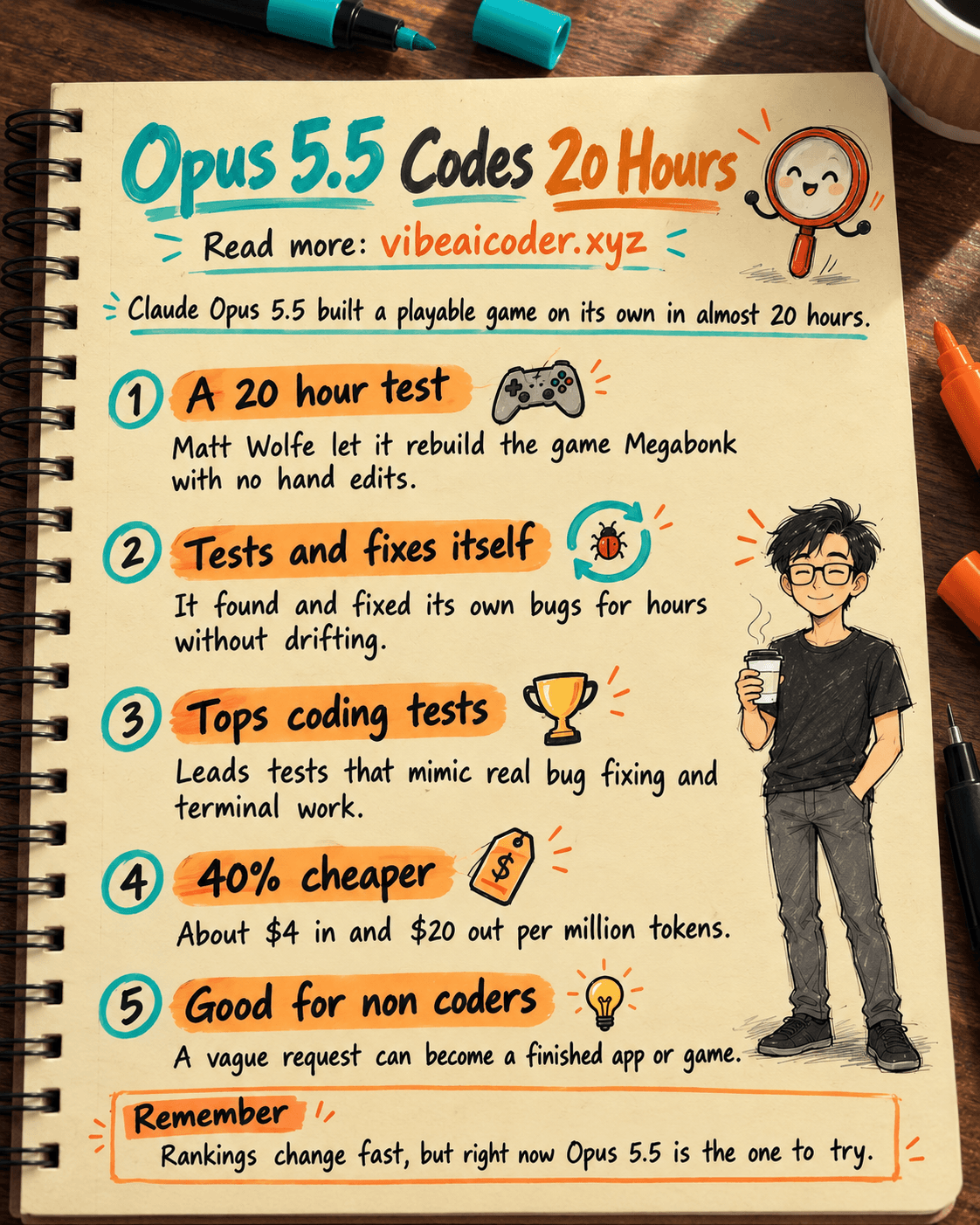
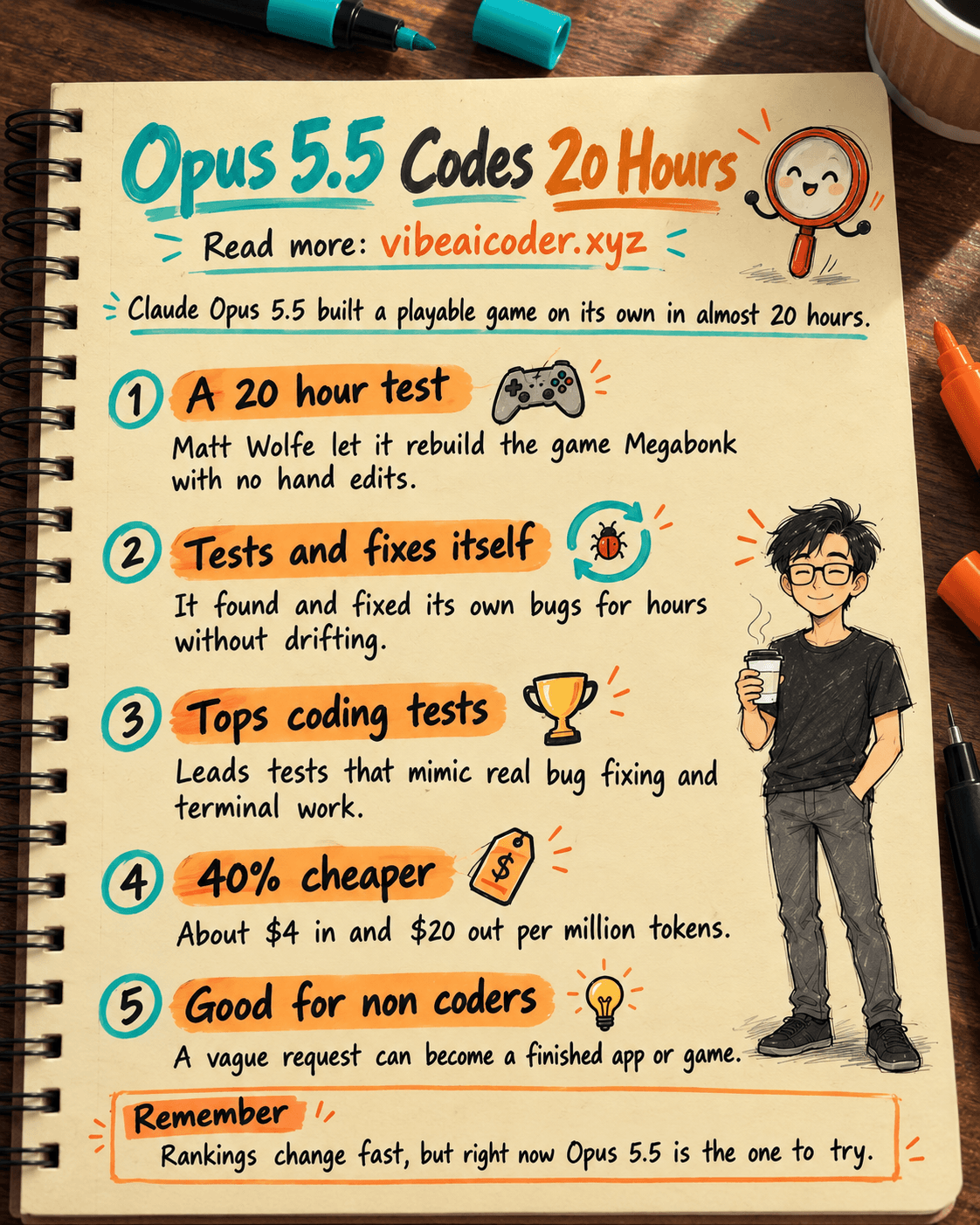
Matt Wolfe, a trusted YouTube channel covering AI, had Opus 5.5 rebuild a game called Megabonk, a survival style dodge them all game that has been trending lately. He did not sit there editing lines of code. He handed off the task and let the AI work on its own, testing itself, fixing its own bugs, and repeating that loop for nearly 20 hours.
The result was a genuinely playable game: multiple character tiers, sound effects, and even a detailed pause menu that looked close to the original. An AI staying focused and working alone for that long, without constant supervision, is a level of endurance that earlier models usually could not hold. They tended to drift off track or repeat mistakes after just a few hours.
He put it bluntly in the video title: this is "the hands down best coding model right now," both for accuracy and for price.
Why Opus 5.5 is getting so much praise
Anthropic released Opus 5.5 on September 22, 2026. It is marketed as performing close to the company's strongest model on most tasks, while costing 40 percent less to run than the previous Opus.
On coding benchmarks (tests used to compare AI models against each other), Opus 5.5 leads on several tests that simulate real world tasks like fixing software bugs and working in a terminal (the command line window developers use). In plain terms: on tests that mimic what real developers do when fixing code, Opus 5.5 currently ranks above most other AI models, including some newer releases from competitors.
What surprised people even more was the price. Through the API (how developers call a model directly from their own programs), Opus 5.5 costs about 4 US dollars per million input tokens (small units of text an AI reads and writes) and 20 dollars per million output tokens. If you just need the regular chat interface, Opus 5.5 is already included in the 20 dollar a month Pro plan, as well as the Max, Team and Enterprise plans for teams and businesses.
Why this matters if you do not code
You do not need to understand benchmarks or tokens to see what matters here: an AI can now take a vague request like "build me a game like Megabonk" and work on it for hours on its own, producing a finished product with almost no one hovering over it making constant fixes.
This is the spirit behind vibe coding, or building software with AI even if you do not know how to code. Every test like Matt Wolfe's, where AI keeps working longer and more reliably, brings an ordinary person's dream of building their own app, website or small game a little closer to reality.
If you are new to Claude, a good place to start is what Claude AI is and how to use it as a beginner. If you care more about the coding side, check out the Claude Opus 5.5 launch from late September or see how Claude Sonnet 5.5 compares to GPT-6.1 Sol at the same price point.
Should you trust it is really the "best coding AI" right away
It is worth staying a bit skeptical. AI leaderboards shift constantly, sometimes a new model takes the top spot within weeks. Matt Wolfe himself says in the video that these rankings can change anytime. But right now, with a real test that ran for almost 20 hours, stable results, and a price that is easy to access, Opus 5.5 is the strongest option worth considering for anyone who wants to let AI write software for them.
#OpusAI #ClaudeOpus5 #VibeCoding #AI2026 #CodingAI #AnthropicAI
More articles

Gemini 4 Argon Reads a 500-Page Chemistry Patent in One Afternoon

Claude Opus 5.5 Codes a Real Money Trading Game in One Day

What Is a Token in AI? Why ChatGPT and Claude Charge by Tokens

What Is Chain of Thought? Why Asking AI to Think Step by Step Works Better

Claude Sonnet 5.5 vs GPT-6.1 Sol: Which AI Model Is Worth Using?

 Claude Opus 5.5 Launches: 30% Faster, 40% Cheaper, Blocks AI Brain Copying