OpenAI's 'Mathocalypse': 722 AI Math Proofs Spark Backlash
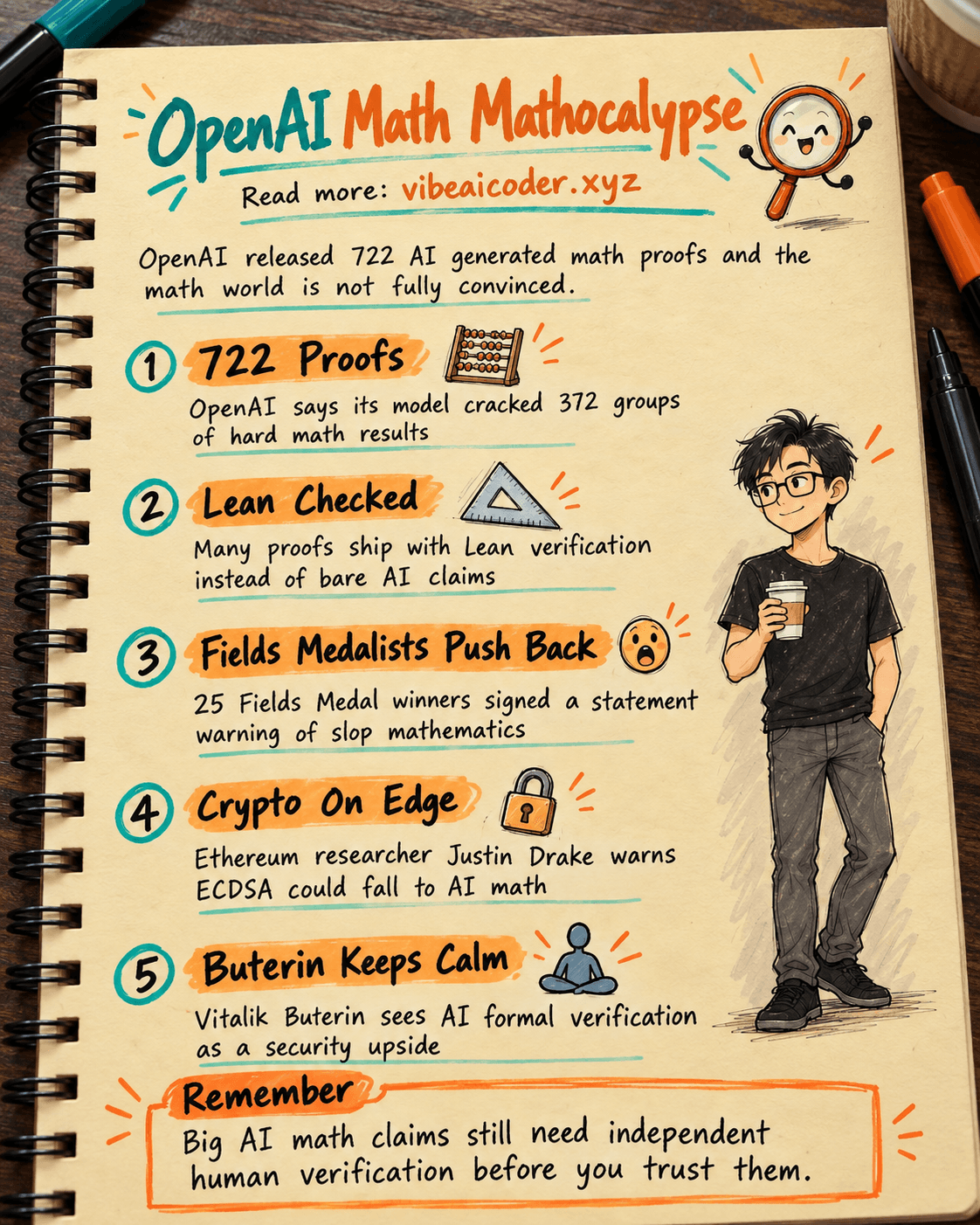
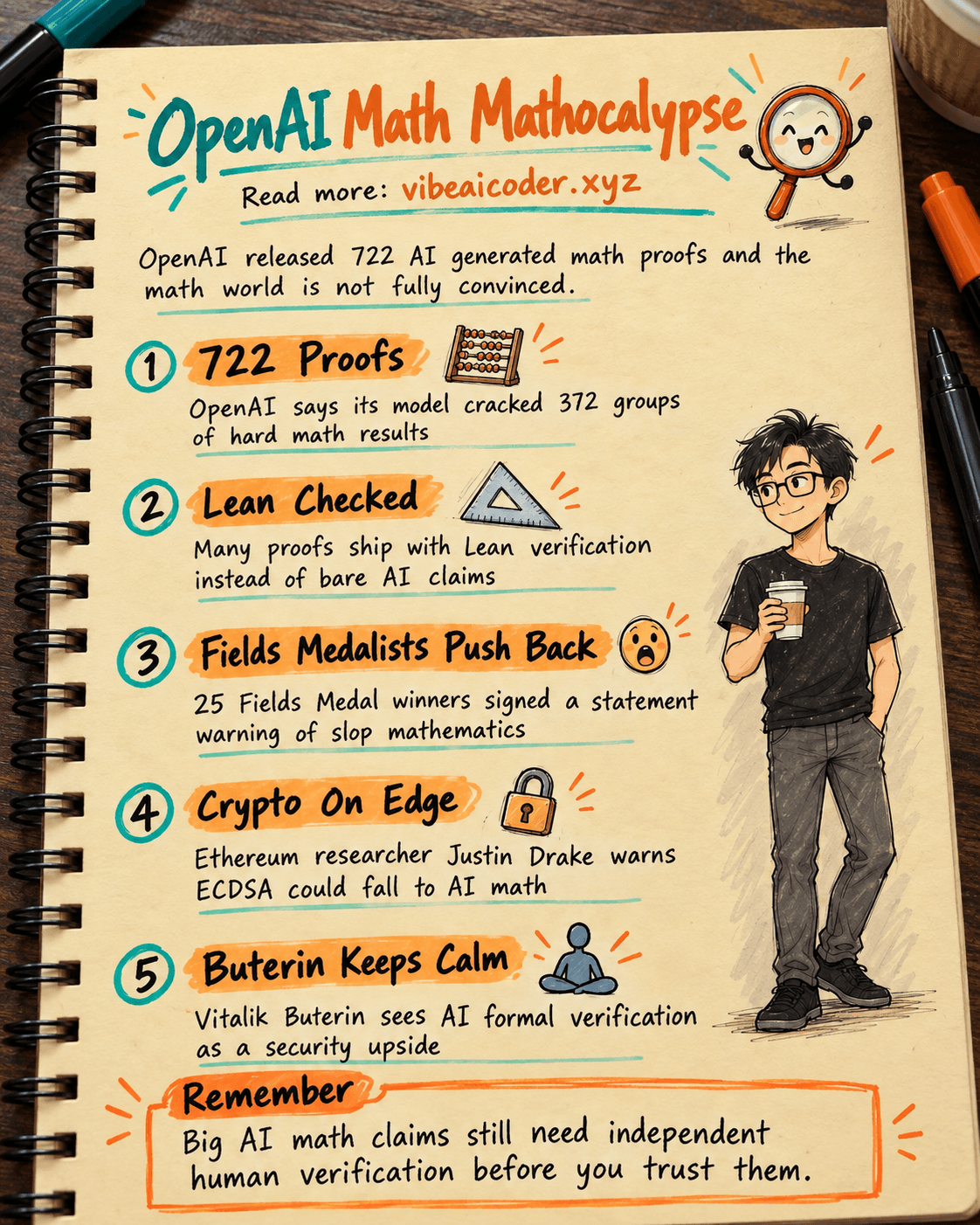
On October 6, 2026, OpenAI announced a massive release: 722 manuscripts, grouped into 372 new math results, produced by an internal, unreleased model. Within hours, computer scientist Scott Aaronson wrote on his personal blog that this was one of the greatest days in the history of mathematics, coining a name that quickly spread across social media: "Mathocalypse." But not everyone was celebrating. Both the mathematics community and the crypto world are now locked in a heated debate about what it means.
🧮 What OpenAI actually announced
The results were posted publicly on GitHub, claiming to solve or come close to solving a number of hard problems across several fields: number theory, geometry, theoretical computer science, algebra, mathematical physics, and differential equations. The list includes names familiar to mathematicians, such as the Mahler conjecture, the exact irrationality exponent of pi, the Unique Games Conjecture, the isomorphism problem for free group factors, and a result on the relativistic Vlasov-Maxwell system of equations.
What stands out is that many of the proofs came with verification in Lean, a programming language built specifically so a computer can check the correctness of a mathematical proof on its own, rather than relying purely on the AI's own claims. OpenAI also said the release followed the recommendation of an independent advisory board at the Institute for Advanced Study (IAS), which includes two prominent figures, Timothy Gowers and Edward Witten. That board had issued public guidance starting on September 29.
😲 Why mathematicians aren't thrilled
This controversy did not appear out of nowhere. Back in September, OpenAI had sponsored a contest called the Caltech Mathathon, where participants used AI to attack open research problems. An open letter opposing the event, signed by around 771 mathematicians, forced OpenAI to withdraw its sponsorship. Shortly after, 25 Fields Medal winners, the highest honor in mathematics, including Terence Tao, Peter Scholze, Maryna Viazovska, and Cedric Villani, co-signed a statement titled "A Serious Distortion of AI in Mathematics."
Their shared concern is something they call "slop mathematics": results that look plausible at first glance but are actually shallow, mass-produced by AI, and end up cluttering the body of research. When an AI company announces hundreds of "results" all at once, it is mathematicians who must spend their own time verifying, refuting, or confirming each one, work that usually goes unrecognized and uncompensated. That is why even a release that looks this impressive is met with wary skepticism rather than pure praise.
 Why crypto holders are also on edge
The most unexpected reaction came from the crypto world. Justin Drake, a researcher at the Ethereum Foundation, called on the entire industry to prepare for "bunker mode," meaning gradually moving funds into wallet addresses whose public keys have never been exposed. The reason is ECDSA, the digital signature algorithm behind both Bitcoin and Ethereum, which is used to prove that a transaction really was authorized by the wallet's owner. Once a wallet has made a transaction, its public key becomes visible on the blockchain. If someone were to mathematically break ECDSA, they could work backward from the public key to the private key and drain the wallet. Drake warned that the pace of AI-driven mathematical progress is fast enough that ECDSA could be broken before quantum computers ever get the chance, warning that in the worst case this could be a matter of "months, not years."
By contrast, Vitalik Buterin, co-founder of Ethereum, has remained far more composed. He has dismissed predictions that AI could cut Bitcoin's price by more than half, calling that scenario highly unlikely. Instead, Buterin sees an upside: AI-assisted formal verification could help mathematically prove that software is secure exactly as designed, shifting security work from reactively hunting for bugs after the fact to proactively proving safety in advance with mathematics.
 What this means for you
You do not need to understand Lean or the Mahler conjecture to recognize this as a notable milestone. It shows how quickly AI is moving into territory once thought to be exclusively human, such as advanced mathematical proof. But precisely because these results were announced so fast, it is worth keeping a healthy dose of skepticism: a result produced by AI, even one accompanied by a "certificate" like Lean verification, still needs time for the scientific community to independently confirm before it can be treated as settled fact. This is also a real-world example of AI hallucination, a phenomenon you may already be familiar with, where AI gives a very confident answer that is not necessarily fully correct.
If you hold Bitcoin or Ethereum, the ECDSA story is a reminder to keep an eye on wallet security news, even though experts still disagree on how urgent the risk really is. And if you are curious how AI "thinks" its way to such complex proofs, that is exactly what happens when a model switches on reasoning mode, writing out each step of its logic before committing to a final answer, much like a person working out scratch paper before writing a clean solution.
 FAQ
FAQ
Has OpenAI actually fully solved these hard problems? Not with full certainty. OpenAI released Lean verification alongside many of the proofs, but the international mathematics community still needs time to independently verify them before they can be treated as officially accepted results.
Why are mathematicians worried instead of celebrating? Because they fear a flood of mass-produced AI results that look correct but have not been carefully checked will clutter the body of research and dump uncompensated verification work onto scientists.
If ECDSA gets broken, will my Bitcoin or Ethereum wallet lose money right away? Not yet. This is still a precautionary warning. But if ECDSA is genuinely broken in the future, wallets whose public keys are already exposed on the blockchain would be at higher risk than wallets that have never transacted.
What exactly is Lean, and why does it keep coming up? Lean is a specialized programming language that lets a computer check every logical step of a mathematical proof on its own, reducing the risk that a proof contains a flaw the human eye might miss.
Should I fully trust every loudly announced "AI result"? No. Always treat it as preliminary information that needs verification, especially for big claims. This is a general lesson for using AI in anything that demands high accuracy.
Read more about what AI is, to understand the basics before following big news like this, about what AI reasoning mode is and when to turn it on, about what AI hallucination is and why AI confidently makes things up, and about how to read AI benchmarks correctly when you see shocking numbers.
More articles

Gemini 4 Argon Reads a 500-Page Chemistry Patent in One Afternoon

Claude Opus 5.5 Codes a Real Money Trading Game in One Day

What Is a Token in AI? Why ChatGPT and Claude Charge by Tokens

What Is Chain of Thought? Why Asking AI to Think Step by Step Works Better

Claude Sonnet 5.5 vs GPT-6.1 Sol: Which AI Model Is Worth Using?

 Claude Opus 5.5 Launches: 30% Faster, 40% Cheaper, Blocks AI Brain Copying