OpenAI Launches GPT-6.1 Sol: Half the Price of Claude Opus 5.5, Worth the Switch?
OpenAI just played a price card
On September 29, 2026, at its DevDay event, OpenAI introduced GPT-6.1 Sol, a new AI model with a clear message: nearly as smart as big brother GPT-6 Astra, but at one fifth of the price. This is clearly a shot aimed straight at Claude Opus 5.5, Anthropic's strongest coding model today. So who actually gives you more value for your money?
More than half price off, here are the real numbers
When used through the API (the way developers pay for a model to process each "token," meaning each small chunk of text the AI reads or writes):
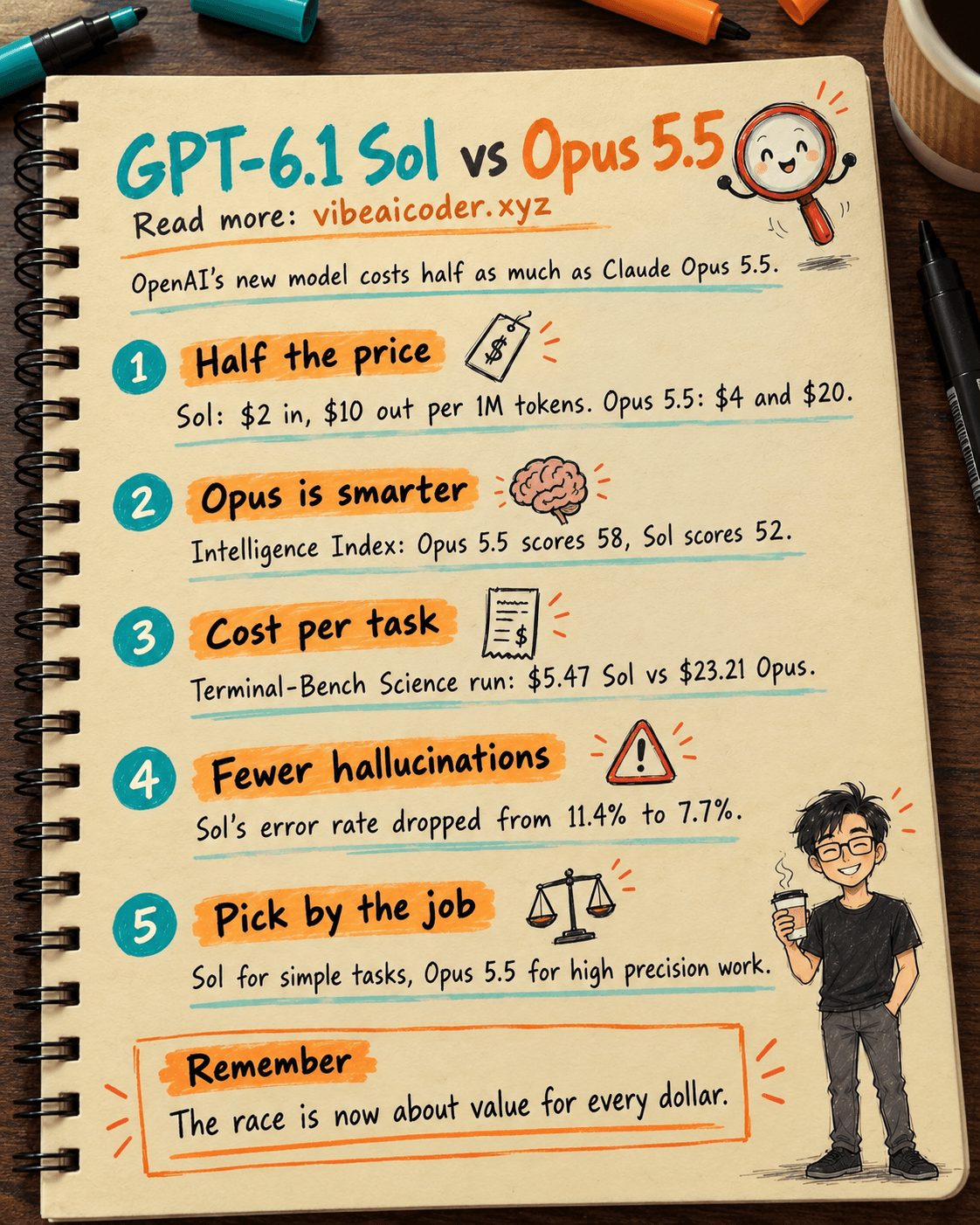
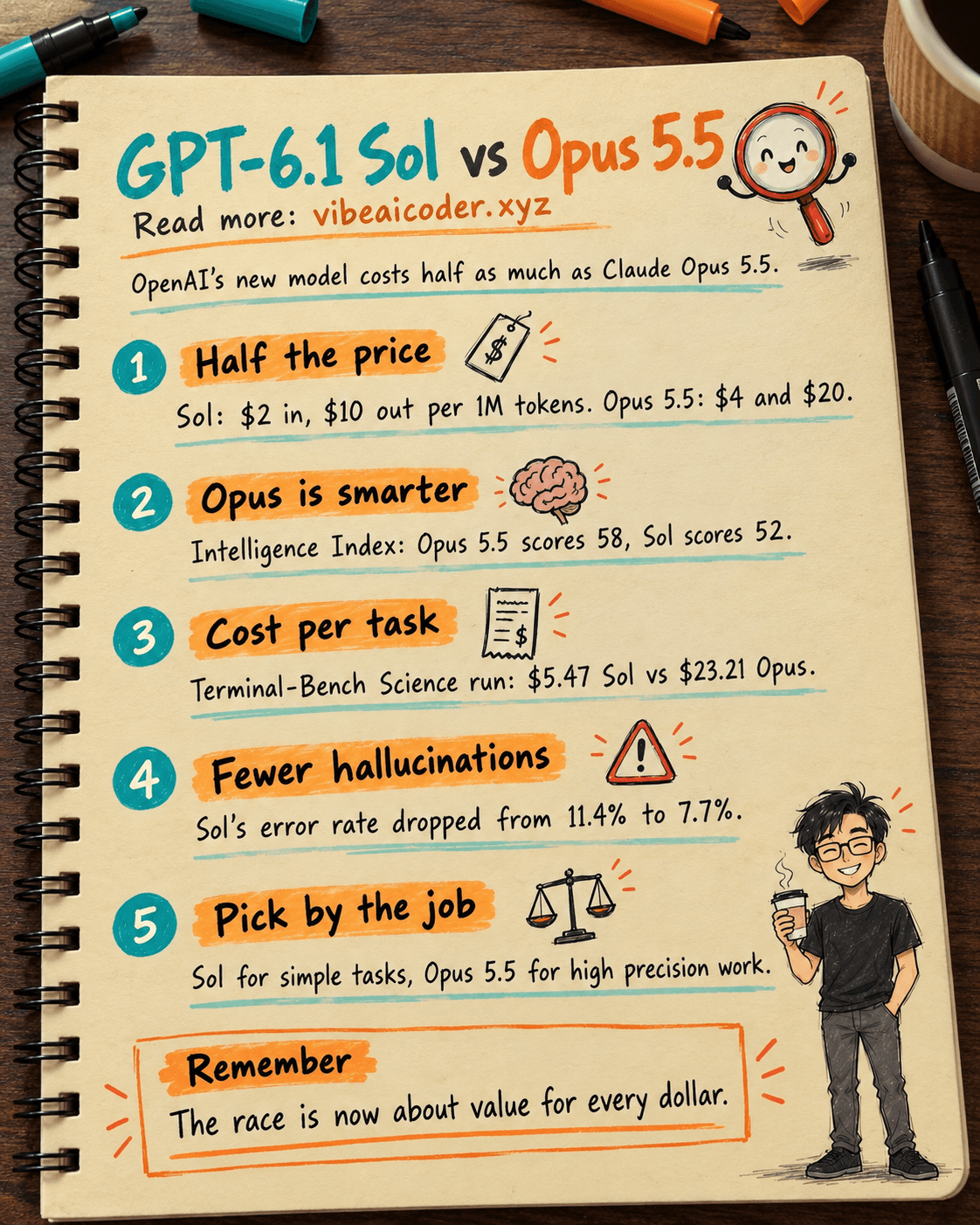
- GPT-6.1 Sol: 2 dollars per million input tokens, 10 dollars per million output tokens, with cached input at just 0.1 dollars.
- Claude Opus 5.5: 4 dollars per million input tokens, 20 dollars per million output tokens.
In plain terms: for the same amount of work, Sol costs exactly half of Opus 5.5. And compared to its own big brother GPT-6 Astra (10 dollars in, 50 dollars out), Sol is up to 5 times cheaper. OpenAI confidently calls it "near-Astra intelligence for a fifth of the price."
But is cheaper the same as smarter?
Not quite. According to the independent Artificial Analysis Intelligence Index (a combined benchmark that scores AI across many skills), Opus 5.5 scores 58, while Sol scores 52. So Opus 5.5 is still smarter, but that extra intelligence costs a lot more: measured by average cost per benchmark task, Opus 5.5 costs about 5.98 dollars while Sol costs only 0.72 dollars.
A more concrete example: in the Terminal-Bench Science test (which simulates an AI handling real tasks on a computer by itself), the average cost per run is 5.47 dollars with Sol, versus 23.21 dollars with Opus 5.5 and 23.80 dollars with Astra. A roughly 4x cost gap for a comparable result is a number no one building AI products billed by usage can ignore.
Why this matters to you
If you are a regular user chatting with ChatGPT or Claude every day, this price war barely touches you, since you still pay a fixed monthly subscription. But if you are building an app, a chatbot, or an automation tool that calls an AI model through the API millions of times a month, a two to five times price gap directly decides your product's running costs.
That is exactly why, right after Sol's launch, direct comparisons popped up everywhere online: should you pick the cheaper, slightly less capable model, or pay more for better accuracy on tasks that really matter. For simple work like summarizing text or drafting emails, Sol is a sensible pick. For work that demands high precision, like debugging complex code or making important decisions, Opus 5.5 is still worth the extra cost.
One more point in Sol's favor: OpenAI says the rate at which the model "hallucinates" (confidently giving a wrong answer without flagging uncertainty) dropped from 11.4% to 7.7% compared to the previous version. Good news for anyone worried about AI confidently lying.
If you want to understand more about what Claude AI is and how beginners can start using it, or you're curious how Claude Sonnet 5.5 compares to GPT-6.1 Sol at the same price point, those are worth reading next. The full rundown of everything OpenAI announced at DevDay is in OpenAI DevDay 2026: GPT-6.1 Sol 5x cheaper, Codex 8x faster. And if you want to see Opus 5.5 flex its muscles, read Opus 5.5 coded a game nonstop for 20 hours straight.
Bottom line
GPT-6.1 Sol isn't the smartest model on the market, but it's playing a different game: winning on price. Claude Opus 5.5 keeps its lead in accuracy and remains the safer pick for work that really matters. The race between the two biggest AI labs today isn't just about who's smarter anymore, it's about who delivers more value for every dollar you spend.
#GPT61Sol #ClaudeOpus55 #OpenAI #Anthropic #AI #AIComparison #AITech
More articles

AI Training vs Inference: What Is the Difference?

Gemini 4 Argon Reads a 500-Page Chemistry Patent in One Afternoon

Claude Opus 5.5 Codes a Real Money Trading Game in One Day

What Is a Token in AI? Why ChatGPT and Claude Charge by Tokens

What Is Chain of Thought? Why Asking AI to Think Step by Step Works Better

Claude Sonnet 5.5 vs GPT-6.1 Sol: Which AI Model Is Worth Using?