What Is Tool Use? How AI Searches the Web, Runs Code, and Reads Files
 What is tool use? How AI searches the web, runs code, and reads files instead of just guessing
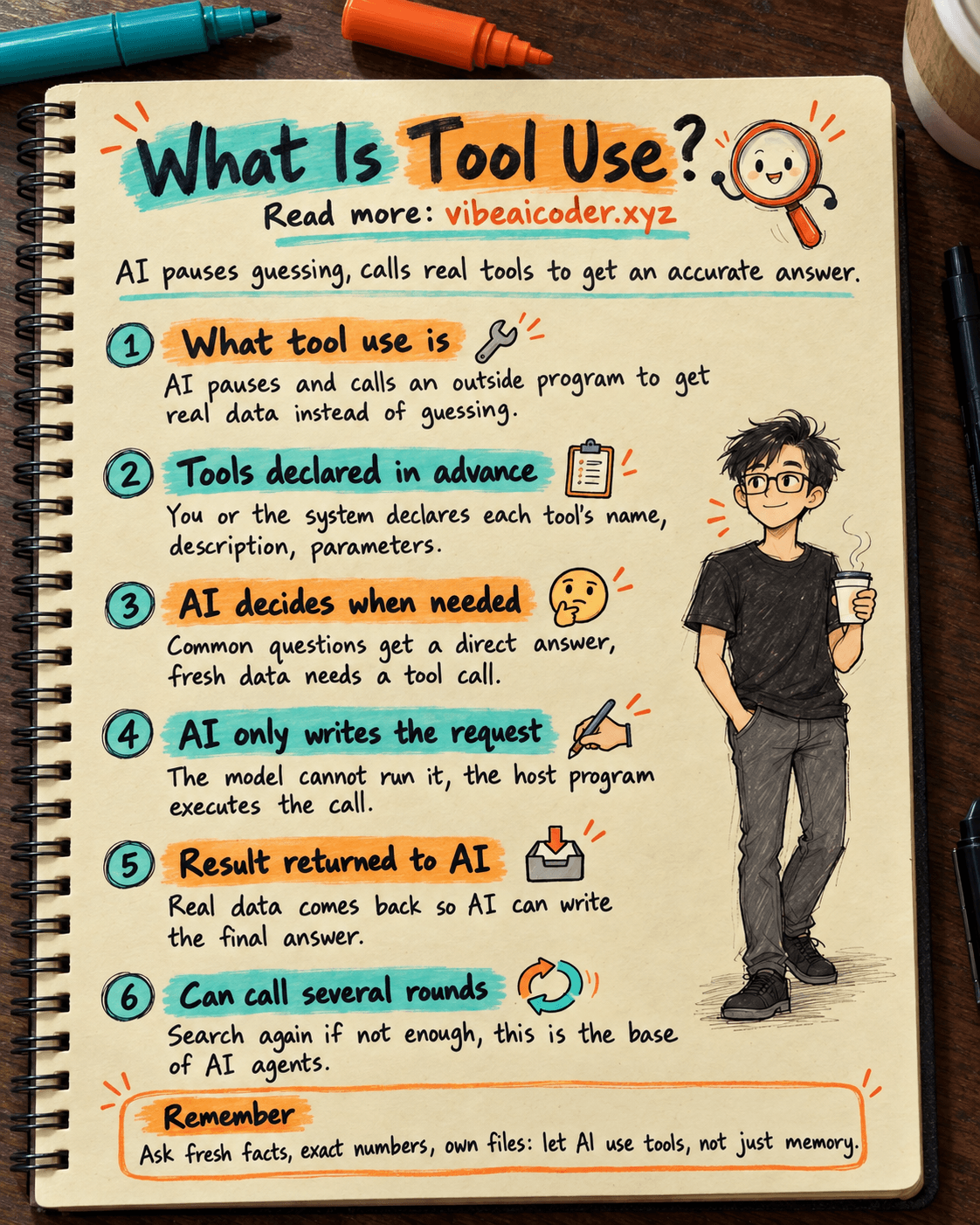
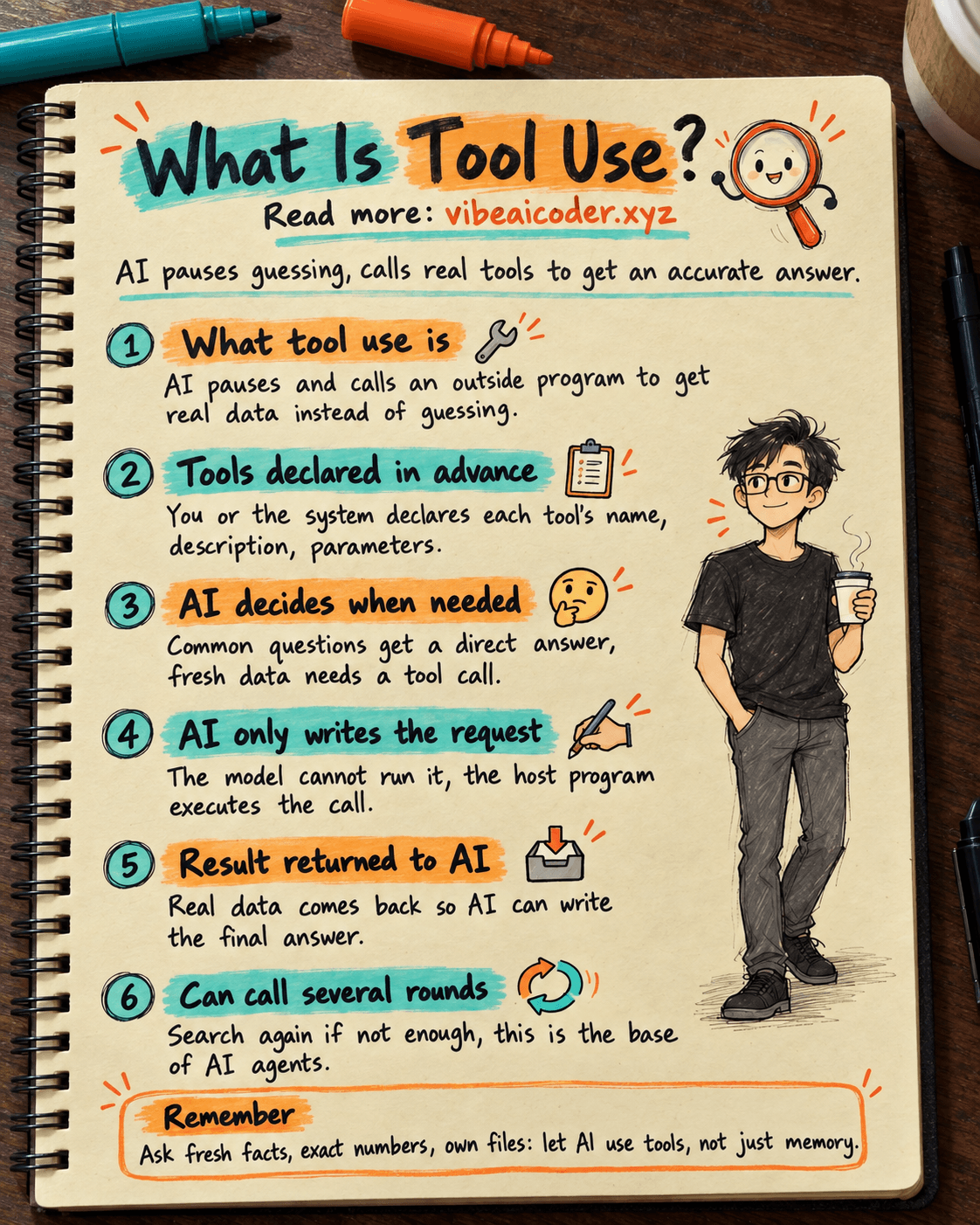
Tool use (also called function calling) is an AI's ability to pause before answering from memory, call an outside program to get real information or perform a specific action, then use that result to give you a more accurate answer. In short: instead of guessing, the AI goes and checks, or goes and does, then answers you.
This is exactly what turns a chatbot that only "talks" into an AI agent that can check today's weather, read a file you attached, run a piece of code to calculate something, or search the web for news it was never trained on.
 A simple everyday example
Imagine you ask a very smart friend who has not left their house in two years: "Is it raining in Hanoi right now?" That friend has no way of knowing, because they cannot look out a window. Such a friend has two choices: make up an answer that sounds plausible, or admit "let me call someone who is outside and ask, then I will tell you".
An AI without tool use is like the friend who only makes things up, because all of its knowledge is frozen at the moment it was trained. An AI with tool use is like the friend who actually picks up the phone, calls a real weather service, listens to the result, and only then answers you with the correct number. The "tool" here is the phone, and the "call" is the AI pausing to fetch real data before speaking.
 How it works
- You or the system declares in advance which tools the AI is allowed to use. Each tool has a name, a description of what it does, and a list of information it needs (for example, a "check weather" tool needs a city name). The AI does not invent tools on its own; it can only pick from the list it has already been given.
- The AI reads your question and decides whether it needs a tool. If the question only needs general knowledge ("what is the capital of France"), the AI just answers directly, no tool needed. If the question needs fresh data or an exact calculation, the AI picks the matching tool.
- The AI does not run the tool itself, it only writes a request to call it. This is the part people often misunderstand: the language model only generates a structured piece of output like "call tool X with parameter Y". The program hosting the AI (the chatbot app, Claude Code, or an agent) is what actually executes that request.
- Once the tool finishes, the result is handed back to the AI. At this point the AI receives real data: search results, file contents, code execution output, numbers from an API.
- The AI uses that result to write its final answer to you. Some tasks need several rounds of calling in a row. For example, after a web search the AI may decide it still does not have enough information, so it searches again or opens a specific page to read more closely before putting together the final answer.
 What this means for you
Understanding tool use helps you know when to trust an AI's answer right away, and when to turn on "let it look things up":
- Turn on web search when asking about recent news or current prices. Many chatbot apps have a toggle for "web search" or "browsing". If your question contains words like "today", "latest", or "current price", turn this on instead of trusting the model's older memory.
- Use Claude Code or a coding tool to let AI actually run code and check the result. For example, if you ask "what is 127 times 893, plus 17 percent tax", an AI with tool use actually runs the calculation instead of doing mental math, so the result is exactly right instead of just "sounding right".
- Attach a file instead of only describing it in words. When you upload an Excel sheet or a PDF, the AI uses a file-reading tool to get the real content and real numbers inside it, instead of guessing based on your short description.
 Common misunderstandings
- "AI can run anything on its own, even send emails or delete files, with no one controlling it." Not true. Tool use only works with tools that have already been declared and granted permission in advance. AI does not automatically gain access to the internet or your computer unless someone connects that tool first, which is exactly why MCP exists as a standardized, controlled way to connect tools to AI.
- "Tool use and AI agent are the exact same thing." Not quite. Tool use is the ability to call a tool, while an AI agent is a system that uses that ability repeatedly, planning multiple steps on its own to complete a longer task. Even a simple chatbot can use tool use for a single question, without becoming a full agent.
- "The stronger the model, the less it needs tools." It is actually the opposite. Stronger models are usually trained to recognize when they are uncertain and should look something up instead of guessing, which is why today's best models tend to use tools more often, not less.
 FAQ
FAQ
Is tool use a feature unique to Claude? No. This is a general capability supported by most major AI providers: Claude, GPT, and Gemini all have their own tool use or function calling mechanisms, differing mainly in how tools are declared and how results are handled.
How do I know if an AI's answer actually used a tool? Many apps show this clearly, for example Claude often displays a "searching" indicator or a source citation card alongside the answer. If an answer shows no sign of looking anything up while you asked about recent information, there is a good chance the AI is just answering from older training data.
Does tool use make AI slower to respond? Yes, because the AI has to wait for the tool to finish before continuing its answer, sometimes across several rounds if it needs to look things up more than once. In exchange, you get an answer grounded in real data instead of a fast answer that might be wrong.
Is tool use related to system prompts? Yes. Which tools are allowed and the rules for using them are usually declared right inside an app's system prompt, which is why the same underlying model can have a completely different set of tools and tool behavior from one app to another.
Is it hard to build a custom tool for AI to use? Technically, a tool just needs a name, a clear description, and the right parameters for the AI to be able to call it. The harder part is writing a description clear enough for the AI to pick the right tool at the right time, which is why teams like Anthropic publish specific principles for writing good tools for agents.
Understanding tool use helps you use AI for the right job: whenever you need fresh facts, exact numbers, or content from your own files, let the AI "go look it up" instead of trusting only what it already remembers.
More articles

Gemini 4 Argon Reads a 500-Page Chemistry Patent in One Afternoon

Claude Opus 5.5 Codes a Real Money Trading Game in One Day

What Is a Token in AI? Why ChatGPT and Claude Charge by Tokens

What Is Chain of Thought? Why Asking AI to Think Step by Step Works Better

Claude Sonnet 5.5 vs GPT-6.1 Sol: Which AI Model Is Worth Using?

 Claude Opus 5.5 Launches: 30% Faster, 40% Cheaper, Blocks AI Brain Copying