MiroFish: Swarm Intelligence Engine Explained
MiroFish is a notable open source project on GitHub, described as a general purpose Swarm Intelligence Engine used to simulate and predict real world scenarios. The project has attracted a lot of attention, with more than 37,000 stars at the time of writing, which says a lot about its potential for data analysis and trend forecasting.
https://github.com/666ghj/MiroFish
Here is a detailed look at how MiroFish works.
1. Design Philosophy and Goals
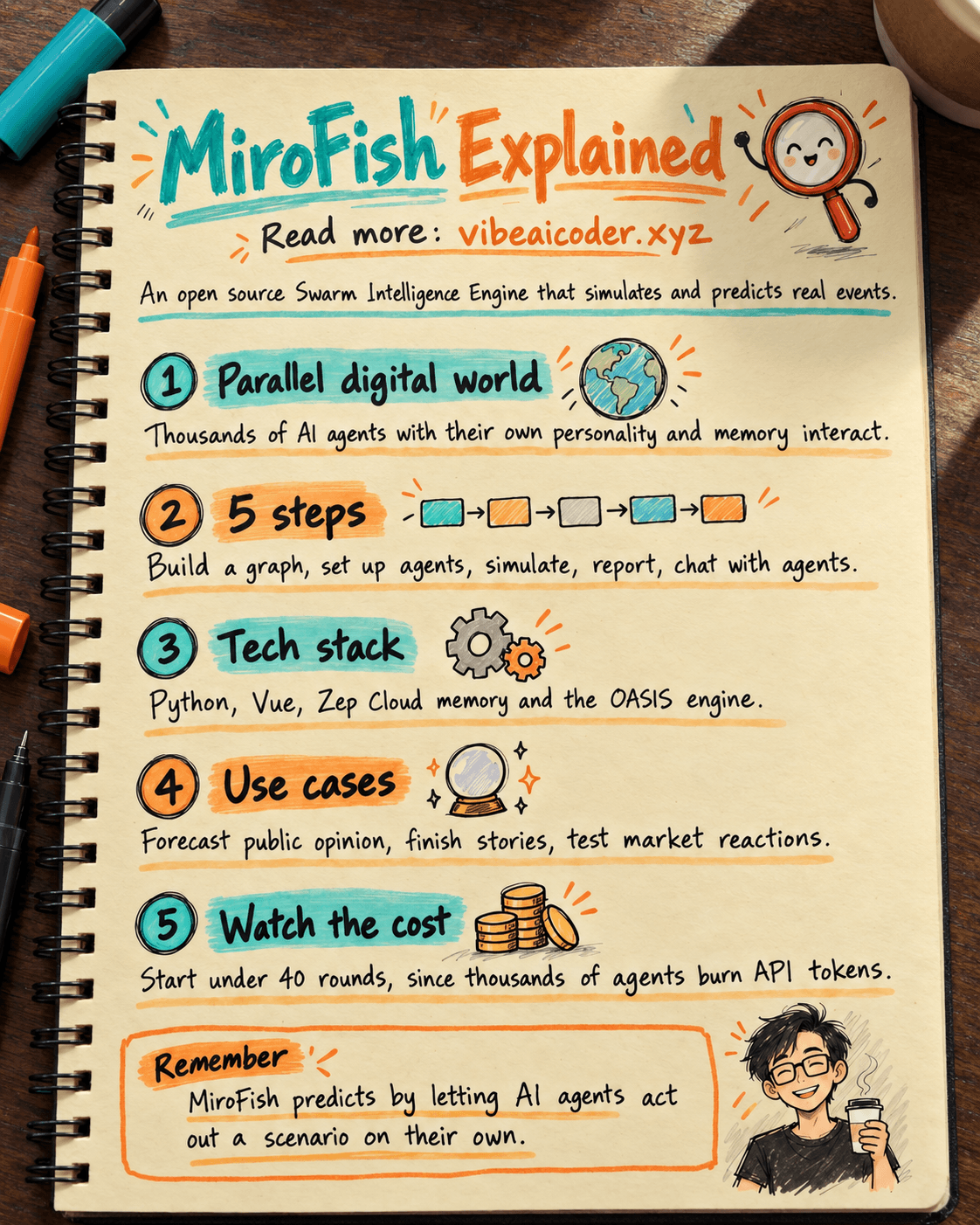
MiroFish is not just another AI chatbot. It is built around the idea of creating a "Parallel Digital World."
- Mechanism: the system extracts information from "seed" data, such as news articles, financial reports, or even fiction, and uses it to build a simulated environment.
- Behavior: inside that environment, thousands of AI agents, each with their own personality, long term memory, and behavioral logic, interact with one another.
- Purpose: it lets you observe how events unfold from a "God view," so you can make predictions about the future based on how the agents interact on their own.
2. How MiroFish Works
MiroFish runs through five main steps:
- Graph construction. It extracts real world information and builds a GraphRAG system (retrieval augmented generation on top of a knowledge graph) to form the knowledge foundation of the virtual world.
- Environment setup. It identifies entities and relationships, then creates detailed personas for each agent.
- Simulation. It runs a multi platform simulation where agents automatically process information and update their memory in real time.
- Report generation. A dedicated ReportAgent gathers the simulation results and writes a detailed report.
- Deep interaction. You can chat directly with any agent inside the simulated world to understand the motives behind its behavior.
3. Core Tech Stack
The project is built on a modern set of technologies:
- Languages: Python for the backend and Vue for the frontend.
- Memory management: Zep Cloud keeps long term memory for each agent, so they do not "forget" context during long running simulations.
- Language models: any LLM compatible with the OpenAI SDK works, though Qwen plus or another strong reasoning model is recommended.
- Simulation engine: powered by OASIS, a contribution from the CAMEL AI team.
4. Real World Use Cases
MiroFish has already proven itself across several practical scenarios:
- Media and public opinion forecasting: simulating how a media crisis spreads (for example, modeling an incident at Wuhan University).
- Literature and creative writing: feeding in the first 80 chapters of Dream of the Red Chamber to predict the missing final chapters based on each character's personality.
- Finance and policy: forecasting how markets might react to financial signals or draft policy changes.
5. How to Try It Yourself
If you want to run MiroFish on your own, the project supports two setup paths:
- Source deployment: requires Node.js 18+ and Python 3.11+. It uses the
uvpackage manager to speed up backend installation. - Docker: the fastest way to spin up the simulated environment without configuring every component by hand.
Important note: because the simulation runs thousands of agents interacting continuously, this project can burn through a fair amount of API tokens. It is a good idea to start with small simulations (under 40 rounds) to keep costs under control.
MiroFish represents a new step forward in using AI to understand collective intelligence and how swarm like behavior emerges within digital societies.
More articles

Gemini 4 Argon Reads a 500-Page Chemistry Patent in One Afternoon

Claude Opus 5.5 Codes a Real Money Trading Game in One Day

What Is a Token in AI? Why ChatGPT and Claude Charge by Tokens

What Is Chain of Thought? Why Asking AI to Think Step by Step Works Better

Claude Sonnet 5.5 vs GPT-6.1 Sol: Which AI Model Is Worth Using?

 Claude Opus 5.5 Launches: 30% Faster, 40% Cheaper, Blocks AI Brain Copying