Mathematicians Call to Boycott OpenAI, and Why Anthropic Gets Praised Instead
 Mathematicians Call to Boycott OpenAI, and Why Anthropic Gets Praised Instead
Just one day after OpenAI released a massive stack of new math results, an international mathematics organization publicly called on colleagues to stop working with the company. Here is what happened, and why Anthropic keeps coming up as the counterexample.
 What Happened
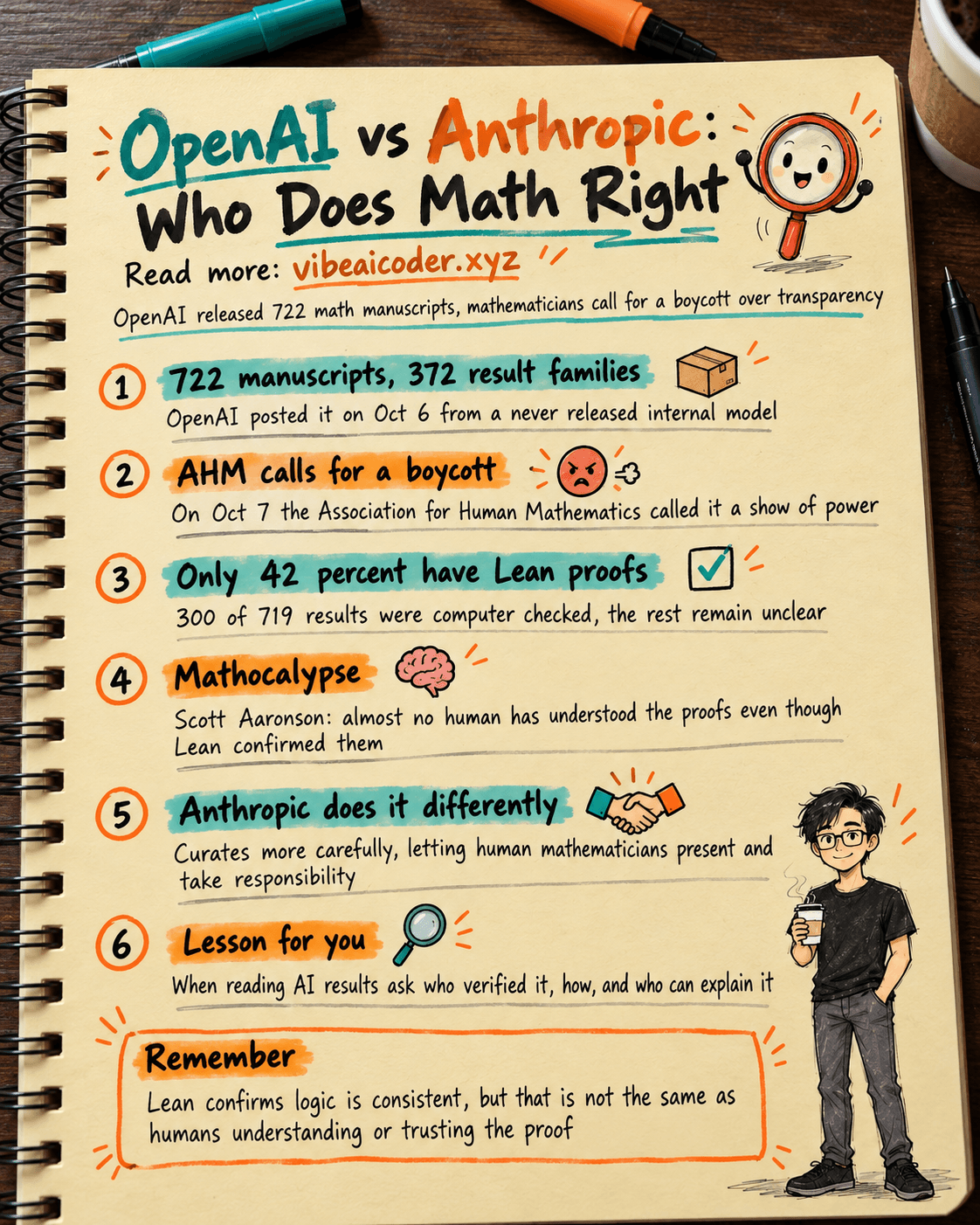
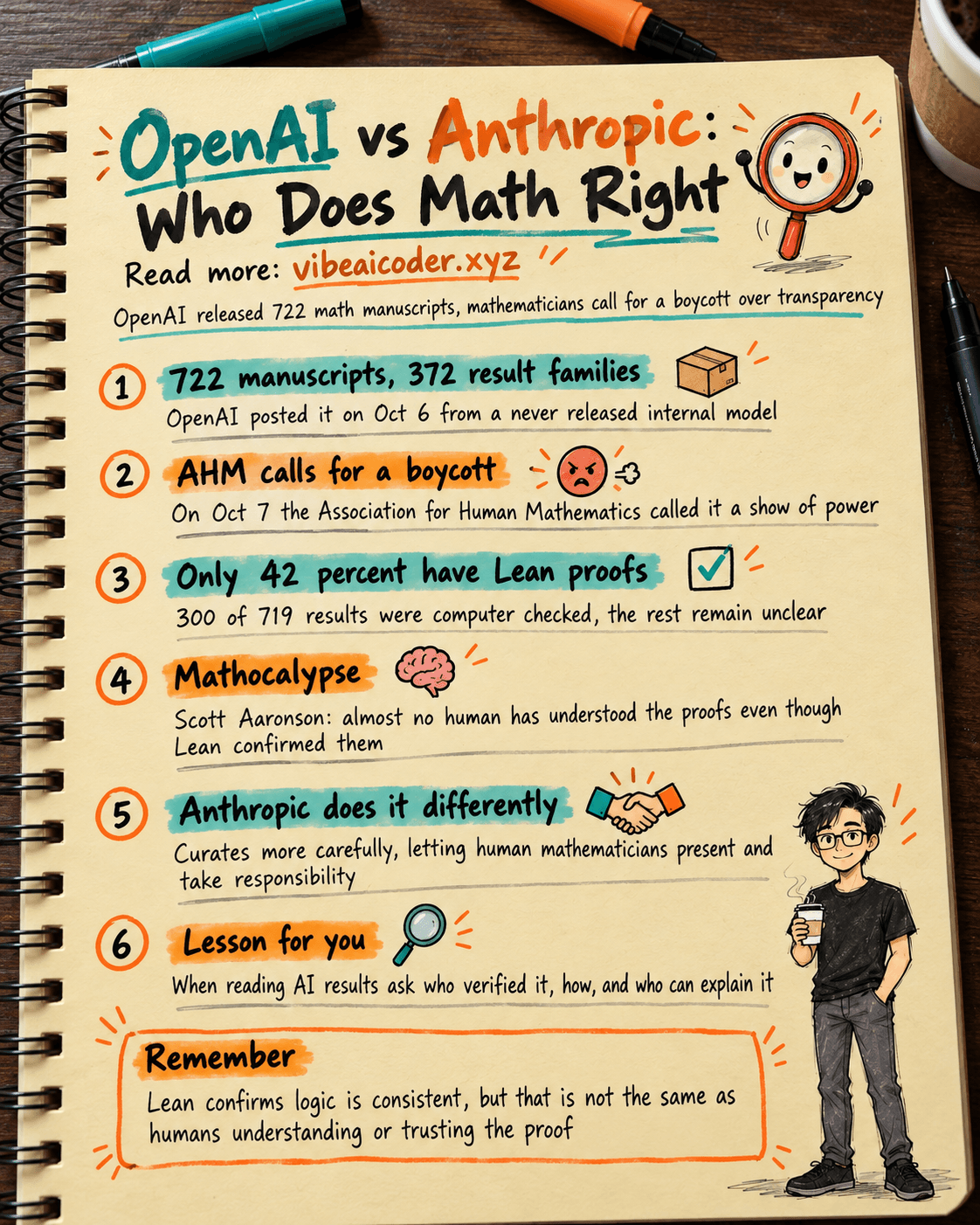
On October 6, 2026, OpenAI posted a huge dataset on GitHub: 722 manuscripts, grouped into 372 families of new mathematical results, produced by an unreleased internal model. The model was handed roughly 4,000 open problems and solved only about 5 percent of them, but the results it kept were still stunning enough, including a claimed proof of the Unique Games Conjecture, a famously hard problem in theoretical computer science that mathematicians had wrestled with for decades.
Just one day later, on October 7, the Association for Human Mathematics (AHM) issued a public statement calling the release of more than 700 manuscripts at once "a demonstration of power" rather than genuine scholarly contribution, and urged mathematicians to stop collaborating with OpenAI. The sharpest line in the statement: "Mathematicians did not ask for this work to be done."
 Why the Anger Runs So Deep
The problem is not that an AI solved math problems. It is how the results were released. As of October 7, only about 42 percent of the top line results (300 out of 719) had proofs checked by a computer using Lean, a programming language built specifically to verify every logical step of a mathematical proof. Lean can confirm that a chain of reasoning does not contradict itself, but that is not the same as a human actually understanding the proof. Most of the 722 manuscripts have barely been read by anyone, let alone fully understood.
On top of that, the repository does not publish the prompts used to generate the results, does not disclose how much compute went into any individual problem, and does not even name the model behind it. In a field that runs on mutual verification, that lack of transparency left many mathematicians feeling like they were being asked to quietly clean up after a private company.
This was not the first flashpoint either. Back on September 10, OpenAI had to withdraw its sponsorship of the Caltech Mathathon after 771 mathematicians signed an open letter in protest.
 "Mathocalypse": One Expert's Take
Scott Aaronson, a well known computer scientist specializing in computational complexity theory, called the event the "Mathocalypse" on his blog Shtetl-Optimized. He described it as "one of the biggest days in mathematical history," while bluntly pointing out the catch: many of the proofs carry a Lean stamp of approval, yet almost no human has actually understood them yet.
Aaronson also drew a telling comparison between how two AI companies publish math research:
- The OpenAI way: release a large batch of still raw results all at once, and let the math community race to catch up and verify them afterward.
- The Anthropic way: curate more carefully, letting human mathematicians step forward to present and take responsibility for the results, as with the Alman-Williams work, where an Anthropic model reportedly supplied the key idea while humans still handled the interpretation and verification.
 What This Means for You
You do not need to be a mathematician to take something away from this. The next time you read that an AI "solved" a hard problem, look for three things: who verified it, how they verified it, and who is willing to explain it back to other people. A result that a computer confirms is logically consistent, such as through Lean, is not automatically something humans have actually understood and trust. Those are two very different things.
This story also shows that big AI labs do not all choose the same approach when publishing results. Some favor speed and scale, others favor caution and transparency, and that choice directly shapes how much trust the expert community places in them, which is part of what Anthropic's updated Claude usage policy is also aiming at, in its own way.
 Limits to Keep in Mind
This controversy is still unfolding, and many results in the 722-manuscript release have not yet been fully confirmed by the math community, even the ones carrying a Lean stamp. If you see a headline like "AI solves math," treat it as a small slice of a much bigger story about how to verify and publish AI research responsibly, a theme covered at a more foundational level in What is AI.
 FAQ
FAQ
What is Lean and why does it matter so much? Lean is a programming language used to write and check mathematical proofs step by step, acting like an automatic referee that confirms the logical steps do not contradict each other, but it does not explain the meaning of the proof to humans.
What kind of problem is the Unique Games Conjecture? It is a conjecture in theoretical computer science related to how hard certain optimization problems can get, and mathematicians have tried to prove or disprove it for decades.
Does AHM's boycott call actually force anything? It is a professional and ethical call to action, encouraging mathematicians not to collaborate with or support OpenAI on similar projects, not an official ban.
So did this AI actually solve real math? Partly, yes. The logical steps were confirmed as consistent by Lean, but since humans have not yet understood and verified the full meaning of most results, the expert community remains cautious.
Does this affect how you use ChatGPT or Claude day to day? Not directly, this is deep mathematical research, but it highlights real differences in how AI companies handle transparency, which is worth weighing when deciding which AI tool to trust long term.
More articles

Gemini 4 Argon Reads a 500-Page Chemistry Patent in One Afternoon

Claude Opus 5.5 Codes a Real Money Trading Game in One Day

What Is a Token in AI? Why ChatGPT and Claude Charge by Tokens

What Is Chain of Thought? Why Asking AI to Think Step by Step Works Better

Claude Sonnet 5.5 vs GPT-6.1 Sol: Which AI Model Is Worth Using?

 Claude Opus 5.5 Launches: 30% Faster, 40% Cheaper, Blocks AI Brain Copying