Use ChatGPT Work to Audit a Workflow Before Automating It
A slow order-handling process does not automatically call for a new automation tool. In about an hour, you can use ChatGPT Work to map how work happens, locate bottlenecks, and draft a small experiment. You need process documents, a tracker, handoff records, and a process owner who can confirm the findings.
This guide turns OpenAI's workflow audit use case into steps for an operations team. You will produce a current-state audit, a draft of an updated process, and a narrow automation proposal. Keep these outputs separate. The audit describes what the team does today, while the proposal describes something the team may choose to do later.
 Prepare
Open ChatGPT Work in an authorized workspace. Add files to the conversation or use a connection enabled by your administrator. Check access rights before connecting an internal source.
Choose one specific process, such as the path from receiving an order to confirming delivery. Record its starting and ending points, the recipient of the output, the review date, and the process owner.
Assemble a compact evidence set: the current procedure, a tracker with timestamps and owners, handoff notes, a few incident tickets, measures of time or error rates, and discussions that explain exceptions. Remove unnecessary personal data. Mark which documents are current and which are drafts. If no measurement exists, write "not measured" rather than inventing an estimate. This is also a good time to give AI clear inputs and a defined output.
Record the name, date, and owner of each source. That will help you spot a written procedure that conflicts with recent practice.
 Step by step
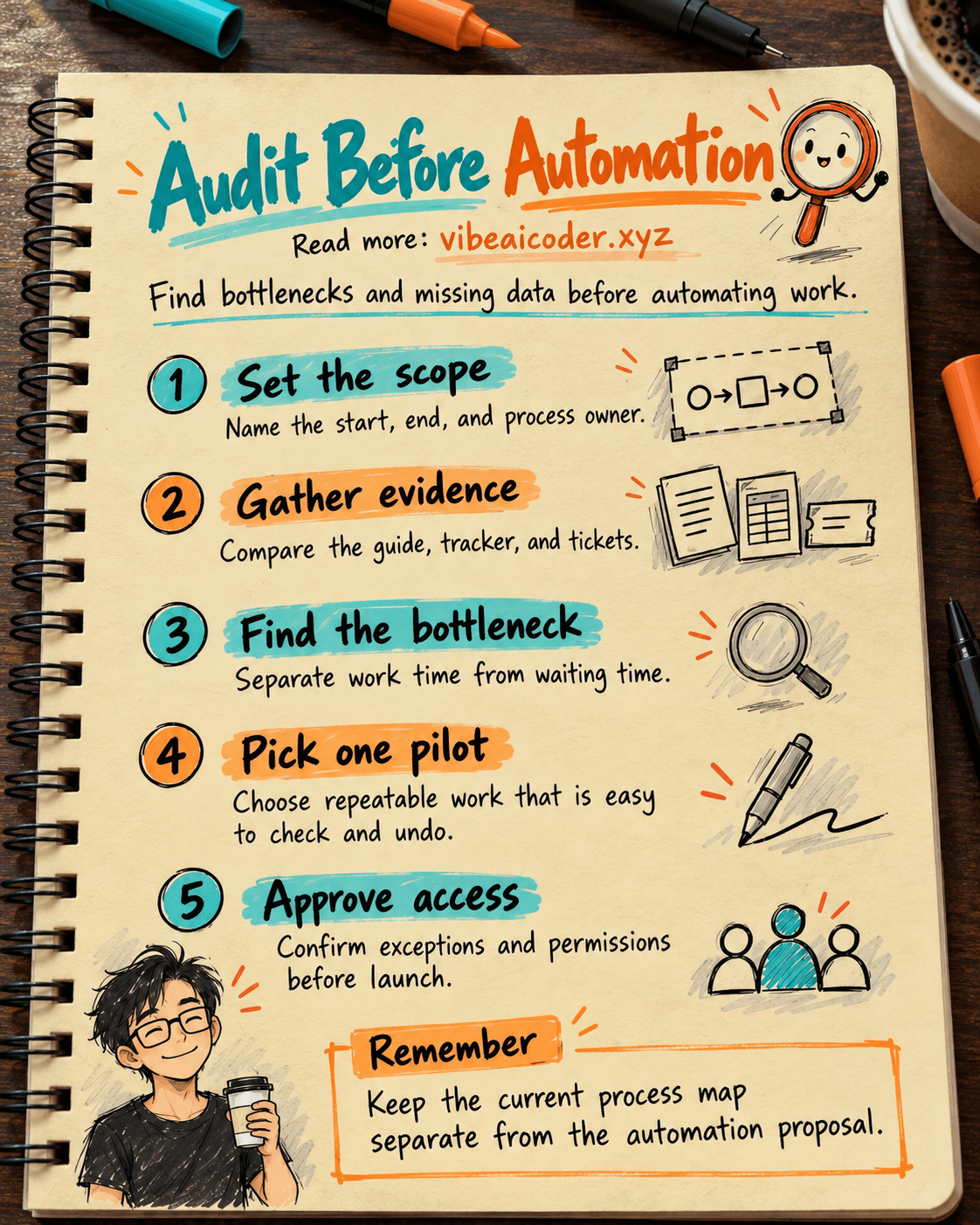
1. Set the boundaries and map the current process
Add the documents to a conversation with the right permissions. Ask ChatGPT to describe only the current state supported by evidence. Each step needs an input, an owner, a handoff condition, an output, and a supporting source.
Audit [process name] from [starting point] to [ending point], as of [review date].
Use only the documents I provided. Create a table with the current step, input, responsible person, handoff condition, output, and supporting source.
Distinguish what the documents confirm from what you infer from discussions or tracker entries. If evidence is missing, mark the point "unverified" and list a question for the process owner.
For now, describe only how the team works today. Do not propose automation or edit the source documents.
Read the map with people who do the work. Ask what the documentation misses, who decides when information is incomplete, and who handles a failed handoff. Correct any responsibilities that AI assigned to the wrong person.
2. Find bottlenecks in records, not impressions
A bottleneck may be an approval queue, repeated data entry, or a ticket sent back to the previous team. Tie each observation to a date, row, or ticket. Separate active work time from waiting time. Making an order check faster will not resolve a two-day wait for confirmation.
Use the current-state map and tracker to identify steps with delays, rework, or unclear handoffs.
For each issue, give specific evidence, the number of occurrences if the data supports it, its effect on customers or the next team, and your confidence level.
Separate active work time from waiting time. Do not invent measurements. List the additional data we need to collect during [time period] to test each hypothesis.
Describe problems and possible causes that we can verify. Do not write solutions yet.
Check normal cases, returned tickets, and exceptions. If start or end timestamps are missing, you cannot calculate a trustworthy average duration. The guide to choosing between ChatGPT Work, Chat, and Codex can help you select a tool for later work.
3. Compare the written procedure with recent practice
An old procedure might say the warehouse confirms orders, while recent tickets show another team doing it. Record both sources and ask the process owner to resolve the difference. A team discussion is not automatically a formal decision.
Compare [process document] with [tracker], [handoff notes], and [ticket history].
List contradictions and outdated steps. For each, record the source and date on both sides, the effect on the current-state map, the person who must confirm it, and a specific question.
Draft an updated procedure. Mark which passages have supporting evidence and which require a decision from [process owner]. Do not publish it or change the original document.
After the owner confirms the decision, save it with the date and approver's name. Use the same source-checking habit when drafting a PRD from internal documents.
4. Rank one small automation experiment
Once the current state is confirmed, compare recurring steps by frequency, risk, data quality, and the cost of checking results. Select a step only when its inputs, permissions, exception path, and way to reverse mistakes are clear.
Using the confirmed audit, rank repetitive steps that automation might support.
For each step, describe current effort, evidence of frequency, required data and access, errors or exceptions, how to check the output, whether mistakes can be reversed, where a person must approve, and why we should proceed or wait.
Propose only the smallest experiment for [trial period]. Write success criteria and stop conditions. Do not implement anything, send notifications, or change a system.
For example, prepare a draft list of orders with missing addresses for an employee to review. Do not let AI change addresses, confirm payments, or send customer messages. If the task needs one field from a tracker, do not grant access to an entire mailbox.
5. Name reviewers and define the measurement
Record who runs the trial, approves its outputs, handles mistakes, and can stop it. Compare measures before and during the trial, such as the share of missing-address orders found and minutes spent checking each order. Keep the input, proposed result, reviewer, errors, and run time. Start implementation only after the process owner and access administrator approve its scope.
 Example result
Suppose a shop handles 200 orders per week. This is an illustrative example only:
| Part | Draft audit |
|---|---|
| Current state | Sales passes the order tracker to the warehouse; the warehouse confirms stock; customer support calls when an address is missing. |
| Suspected bottleneck | In a sample, 12 tickets required a follow-up about addresses. Check the full tracker before estimating a rate. |
| Conflicting sources | An older procedure says the warehouse calls customers, but recent tickets show customer support doing it. The operations lead must decide what the official process should say. |
| Proposed trial | Create a draft list of orders missing required fields. An employee checks it before contacting customers. |
| Stop condition | Stop if the list misses one order in the test sample or accesses data beyond the approved scope. |
The audit describes what is happening. The proposal identifies a possible experiment. Keep observed facts separate from future intentions.
 Tips for better results
Choose actual cases. Include ordinary orders, returned orders, and exceptions. They reveal steps that the procedure may leave out.
Attach evidence to conclusions. Ask for row numbers, ticket IDs, or notes. Without timestamps, treat a claim about delays as a hypothesis to measure.
Let people in the process correct the map. They know why exceptions are handled as they are. Record disagreements and name the person who will decide.
Trial a step you can check. A review list or reconciliation draft is easier to verify than automatically sending emails or changing order statuses.
 Limits to know
ChatGPT may miss exceptions, misread timestamps in a tracker, or mistake a discussion for a final decision. The process owner must check findings that affect roles, customers, money, or access rights. Do not put sensitive data into a conversation beyond your organization's policy. OpenAI's permissions guide is a starting point for limiting tool and connected-app access.
A tracker full of blank cells cannot prove that a process is efficient or inefficient. The right outcome may be a list of what to measure, who will record it, and when. Automating a process with poor data or unclear permissions can make errors happen faster. A proposal written by ChatGPT does not authorize AI or employees to implement it. Changes to systems, external messages, and actions that are hard to reverse require approval from the people responsible.
 FAQ
FAQ
Can we audit a workflow without a complete tracker? You can create a provisional map from documents, interviews, and sample tickets. Mark conclusions that lack enough data, and plan to collect timestamps before declaring the main bottleneck.
Should we automate the most time-consuming step first? Not necessarily. Consider frequency, input quality, access rights, exceptions, how to check the result, and whether errors can be reversed. A slow but high-risk step may require better data before automation.
Can ChatGPT revise the procedure and implement it immediately? This guide covers a draft audit and proposal. The process owner must confirm the current state, approve an updated procedure, and make a separate implementation decision.
How do we know AI assigned the right owner to each step? Compare role descriptions, ticket history, and handoff notes, then ask people on both sides of the handoff. If sources conflict, mark the owner "unconfirmed" instead of choosing one.
How long does an audit take? OpenAI's example estimates about an hour for a first draft when the sources are ready. Confirmation with owners and collection of additional measurements depend on the process. A one-hour draft is not a final conclusion.
Main source: OpenAI Learn, Audit a workflow. The sample order process and its figures are illustrative.
#ChatGPTWork #WorkflowAudit #Automation #Operations #AIAtWork
More articles

Gemini 4 Argon Reads a 500-Page Chemistry Patent in One Afternoon

Claude Opus 5.5 Codes a Real Money Trading Game in One Day

What Is a Token in AI? Why ChatGPT and Claude Charge by Tokens

What Is Chain of Thought? Why Asking AI to Think Step by Step Works Better

Claude Sonnet 5.5 vs GPT-6.1 Sol: Which AI Model Is Worth Using?

 Claude Opus 5.5 Launches: 30% Faster, 40% Cheaper, Blocks AI Brain Copying