What Is Knowledge Cutoff? Why AI Does Not Know the Latest News
 What Is Knowledge Cutoff? Why AI Does Not Know the Latest News
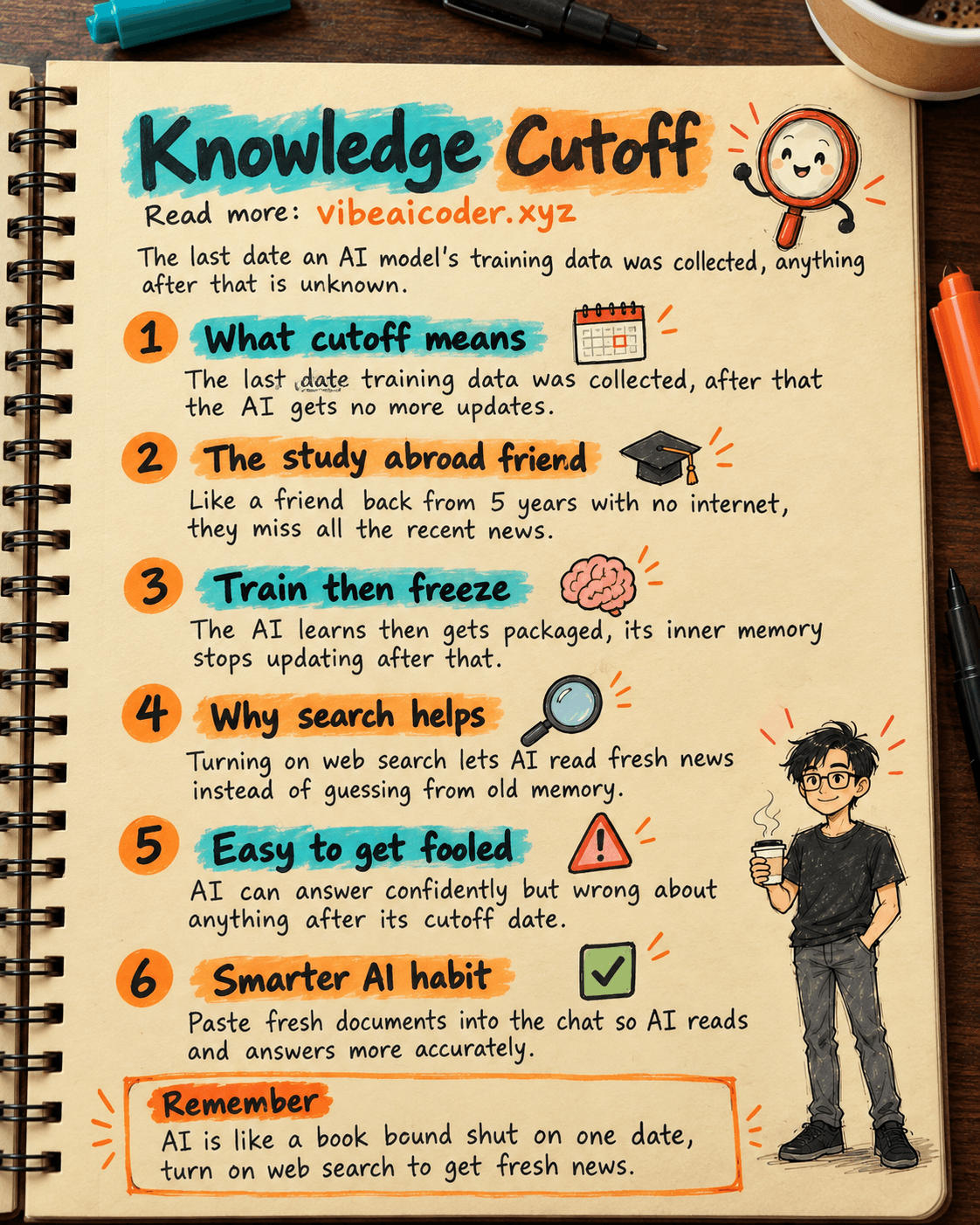
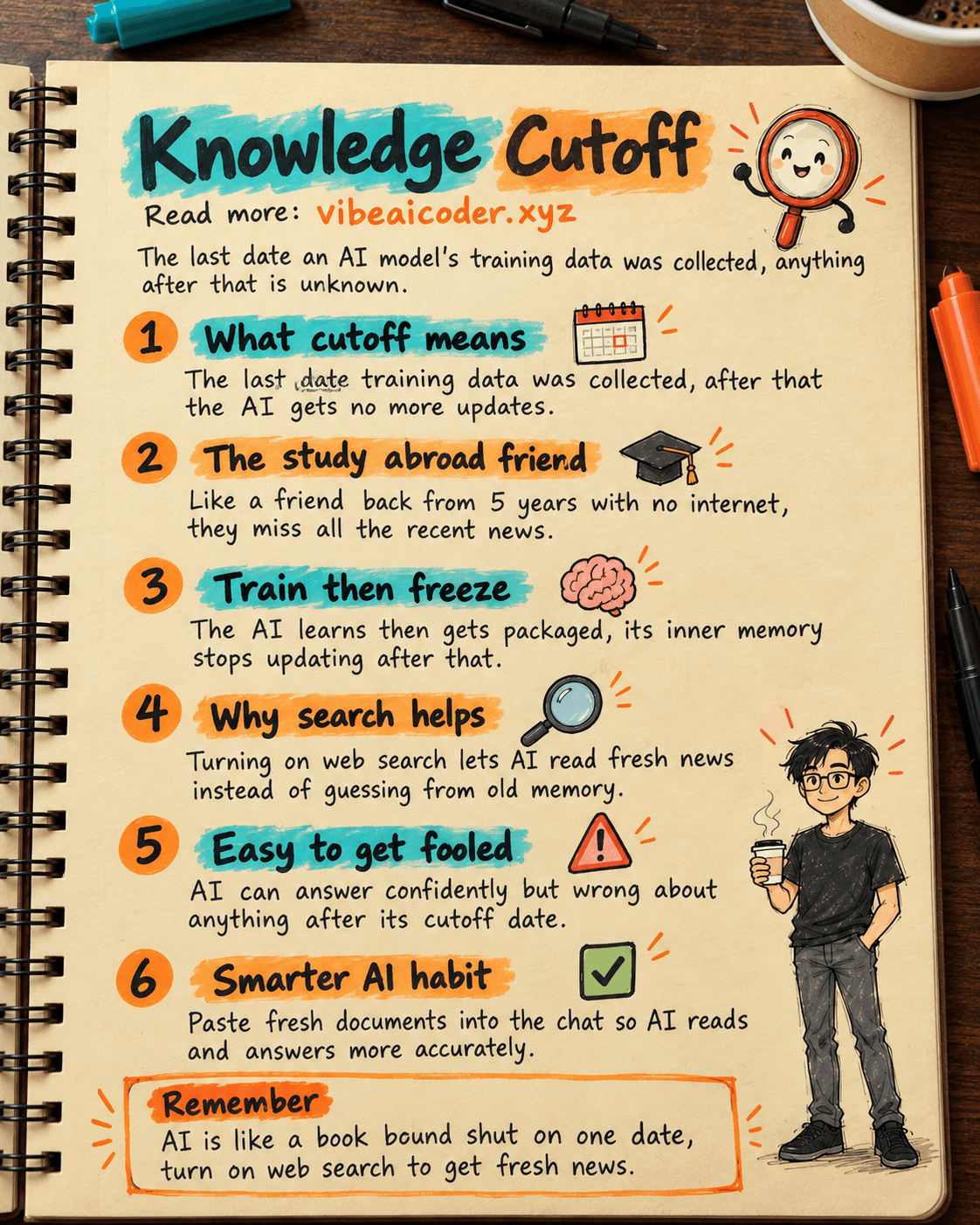
Knowledge cutoff is the last date up to which an AI model's training data was collected. Anything that happened after that date is simply unknown to the model, unless it is connected to the internet to look things up live. This is why Claude or ChatGPT sometimes answers "I do not have information on that" when you ask about something very recent, or worse, gives a confident but outdated answer.
 A Simple Everyday Example
Picture a friend who just came back from five years studying abroad somewhere with no internet, no TV, no newspapers. That friend studied hard and remembers almost everything they learned during those five years: history, science, how to talk, how to solve math problems. But the day they came home is exactly the day their knowledge froze. If you ask "which team won the tournament last week", they will draw a blank, because that news happened after they stopped receiving updates.
AI works the same way. Companies that build AI, such as Anthropic with Claude or OpenAI with ChatGPT, collect a huge amount of text up to a certain date, then spend months training the model on that data. That stopping point is the knowledge cutoff. Once training finishes, the model is packaged and released, but its internal "memory" stays frozen at the cutoff date, just like the friend who came home from abroad.
 How It Actually Works
- Data collection: the engineering team gathers text from books, websites, articles and public documents up to a fixed point in time. That point is the knowledge cutoff.
- Model training: the AI learns to "predict the next word" from all that data, a process that takes months and a huge amount of computing power.
- Testing and fine-tuning: before release, the model goes through testing and adjustments to be safer and more helpful, but it does not absorb any new information about the world during this stage.
- Release and freeze: when you chat with the AI, you are talking to the exact "brain" produced in step 2, with no awareness of anything that happened after the cutoff.
- Patching the gap with outside tools: to answer questions about recent events, many AI systems, including Claude and ChatGPT when search is enabled, can search the web live during the conversation and read the results before replying. This is a form of tool use, completely separate from the knowledge baked in during training.
In short, an AI model is not like a constantly updated website. It is more like a printed book, bound shut on a specific date.
 What This Means For You
- Ask the model directly when in doubt: you can simply type "what is your knowledge cutoff date" to find out, then judge how much to trust its answer on recent topics.
- Turn on web search for anything time sensitive: if the tool you use has a "search" or "browse the web" option, like many versions of Claude, ChatGPT and Gemini do, turn it on when asking about today's stock price, last night's score, or breaking news. Only then is the AI actually looking things up instead of guessing from old memory.
- Feed it fresh information yourself: if you already have an article, email or recent data on hand, paste it directly into the conversation. The AI will read and answer based on what you gave it, no prior knowledge required.
- Be careful with software versions, prices and current regulations: these change constantly and are easy for an AI to get wrong with outdated information if search is not enabled and you do not double check.
 Common Misunderstandings
- "If the AI sounds confident, it must be correct." Not true. When a question falls beyond the knowledge cutoff and no live search is used, the AI can still answer confidently even while guessing or mixing up old information, a form of AI hallucination. Always verify important answers against another source.
- "Turning on web search means the AI now knows everything." Not quite. Web search lets the AI read fresh information, but the quality of the answer still depends on whether the search results it finds are accurate and complete. It can still pick an unreliable source.
- "Knowledge cutoff and context window are the same thing." These are two different concepts. Knowledge cutoff is a limit on when the AI was trained, while context window is a limit on how much text the AI can keep track of during one ongoing conversation. One is about time, the other is about short term memory capacity.
 Frequently Asked Questions
What is the knowledge cutoff date for Claude or ChatGPT? Each model version has its own cutoff, usually documented officially by the company, or the AI itself can tell you if you ask directly. This date changes with every new model release.
Why don't companies just update AI knowledge every day like a website? Because retraining an entire large model takes enormous time, cost and computing power. Instead of retraining constantly, companies release new versions on a cycle and add live web search to patch the gap for recent news.
How do I know if an answer might be affected by knowledge cutoff? If the question involves recent events, products, prices or figures from the last few months, be skeptical and verify, especially if web search was not turned on.
Does web search make AI smarter? Not exactly smarter, just better informed. The AI's reasoning ability stays the same, it simply has fresh material to work with instead of relying only on what it learned during training.
Can I work around knowledge cutoff without using web search? Yes. You can paste documents, articles or the latest figures directly into the conversation so the AI reads and answers based on that, or use tools that can read files, which works very well when you already have the information you need on hand.
Understanding knowledge cutoff helps you use AI more wisely: knowing when to trust it, when to turn on search, and when to verify an answer yourself before relying on it.
More articles

AI Training vs Inference: What Is the Difference?

Gemini 4 Argon Reads a 500-Page Chemistry Patent in One Afternoon

Claude Opus 5.5 Codes a Real Money Trading Game in One Day

What Is a Token in AI? Why ChatGPT and Claude Charge by Tokens

What Is Chain of Thought? Why Asking AI to Think Step by Step Works Better

Claude Sonnet 5.5 vs GPT-6.1 Sol: Which AI Model Is Worth Using?