Use ChatGPT or Claude to Build a 30 Day Learning Plan for Any New Skill
 Use ChatGPT or Claude to Build a 30 Day Learning Plan for Any New Skill
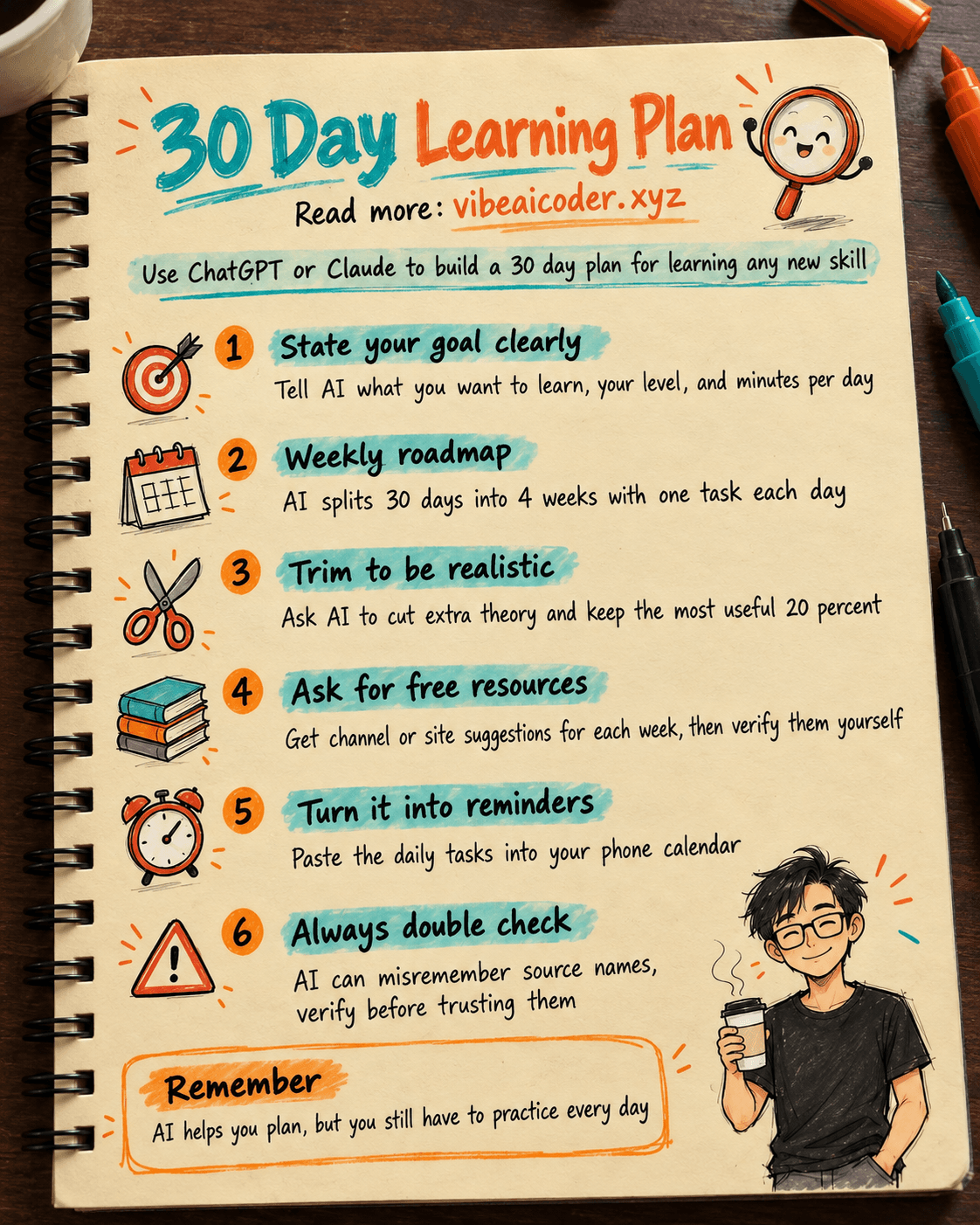
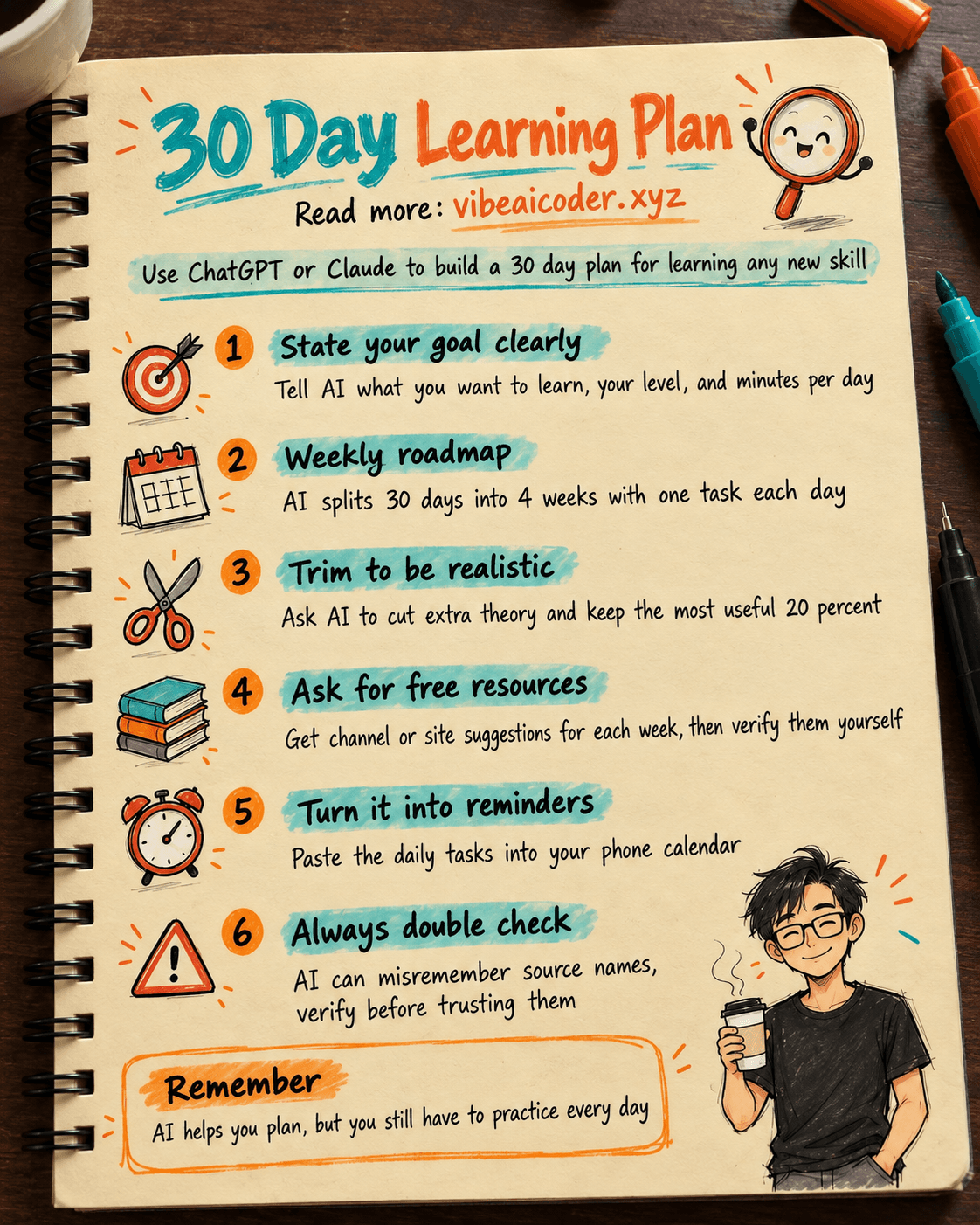
You want to learn something new, cooking, drawing, playing an instrument, conversational English, or spreadsheets, but you are not sure where to start or how long it should take. This guide shows you how to use ChatGPT or Claude to build a 30 day plan broken down into a short daily task, and it only takes about 10 minutes to create. All you need is to know what you want to learn and how many minutes a day you can spare.
 What you need
- A ChatGPT account (chatgpt.com, free tier works) or a Claude account (claude.ai, also has a free tier).
- Answer three questions for yourself first: what skill you want to learn, your current level (complete beginner, know a little, or already know the basics), and how many minutes you can spend each day.
- No paid course or extra software needed. The plan the AI creates will rely only on free resources and what you already have.
 Step by step
Step 1: Describe your goal and your time limit clearly
Open ChatGPT or Claude and paste the following prompt, filling in the brackets with your own details:
You are an experienced learning coach.
I want to learn [skill name, e.g. basic sketching].
My current level is: [complete beginner / know a little / know the basics].
I have about [number of minutes, e.g. 20] minutes a day to practice.
Build me a 30 day self study plan, grouped by week, with one specific task
for each day (not vague advice like "read more").
Use only free resources (videos, articles, exercises), no paid courses needed.
At the end of each week, add a short quiz or a small project so I can check
my own progress.
The AI will return a list or table of 30 days, grouped into 4 weeks, with a clear task for each day.
Step 2: Ask the AI to make the plan more realistic
The first plan is usually too ambitious. Follow up with:
This plan looks like more than I can do in [number of minutes] minutes a day.
Please trim it down, prioritize the 20 percent of knowledge and practice that
delivers 80 percent of the results, cut theory that a beginner does not need
yet, and confirm each day's task actually fits inside my available time.
Step 3: Ask for concrete resources for each week
For each week in the plan above, suggest one or two specific free resources
(a YouTube channel, website, or app name) suited to a beginner, with a short
reason why that resource fits that particular week.
Note: AI can misremember channel names or links. Always type the name into Google or YouTube yourself to check before trusting it, and never click a link the AI invented on its own.
Step 4: Turn the plan into real daily reminders
Copy the 30 day plan into a note (Google Docs, Notion, or even a paper notebook), then ask:
Rewrite this plan as 30 short lines, each one a single reminder for exactly
one day (for example: "Day 5: Practice 10 phrases for the topic of grocery
shopping"). I will paste each line into my phone's calendar to remind me
every day.
Paste these 30 lines into your phone's calendar or reminder app, one line per day.
 Sample result
For the goal "basic Excel", 20 minutes a day, level "know a little", the AI typically returns something like:
- Week 1 (Getting started): day 1 learn basic shortcuts, day 2 practice SUM and AVERAGE, day 3 practice table formatting, ... end of week build a simple personal budget sheet.
- Week 2 (Common functions): practice VLOOKUP, IF, COUNTIF, one function per day, end of week build a small sales tracking sheet.
- Week 3 (Charts and filtering): practice building charts, using filters and sorting, end of week build a report with a chart.
- Week 4 (Review and a real project): apply everything to a real file from your own work, grade yourself using the checklist the AI suggested in step 1.
 Tips for better results
- If you miss a day, do not try to double up the next day. Ask the AI to "spread the 3 days I missed across the remaining days so it stays manageable" and let it rearrange the plan for you.
- At the end of each week, paste your small quiz results back to the AI and ask "where am I still weak, what should next week focus on". The plan will stay grounded in reality instead of following the original rigid schedule.
- For skills that need muscle memory or reflex (speaking English, drawing, playing an instrument), ask for "practice exercises" instead of "reading material", since reading theory alone will not build reflexes faster.
 Limits to keep in mind
- The AI does not actually know your real level, it only works from the description you give it. If your description is off (for example claiming "know the basics" when you actually do not), the plan will not fit you.
- Channel names, books, or apps the AI suggests may no longer exist or may be misremembered. Always verify before spending time looking for them.
- 30 days is a timeframe for building a habit and an initial foundation, not for "mastering" a difficult skill. For skills that take years of practice (like playing an instrument at a high level), treat this as a starting push, not the finish line.
- The plan the AI creates is only as good as your actual daily follow through. No tool can do the learning for you.
 Frequently asked questions
Is ChatGPT or Claude better at building a learning plan? Both do this well. Claude tends to present the plan a bit more clearly organized; ChatGPT has a familiar free tier that many people already use. Try both and keep whichever one feels easier for you to follow.
Do I need to pay to create a plan like this? No. Both ChatGPT and Claude have free tiers that are enough to build a 30 day plan this way. The paid tiers mainly give you more messages per day.
What if the AI makes a mistake, like miscounting days or repeating a lesson? Just tell it directly: "day 10 and day 15 have the same task, please make them different". The AI will fix it right in the same conversation, no need to start over.
What if I finish 30 days and I am still not good at it? That is completely normal. Ask the AI to build the next 30 day plan based on what you already learned in the first round, so you go deeper instead of starting from scratch again.
Can I use this to learn several skills at once? Technically yes, but it is not a good idea. Each 30 day plan should focus on one skill so you have enough time and attention, instead of spreading yourself thin and giving up halfway.
More articles

AI Training vs Inference: What Is the Difference?

Gemini 4 Argon Reads a 500-Page Chemistry Patent in One Afternoon

Claude Opus 5.5 Codes a Real Money Trading Game in One Day

What Is a Token in AI? Why ChatGPT and Claude Charge by Tokens

What Is Chain of Thought? Why Asking AI to Think Step by Step Works Better

Claude Sonnet 5.5 vs GPT-6.1 Sol: Which AI Model Is Worth Using?