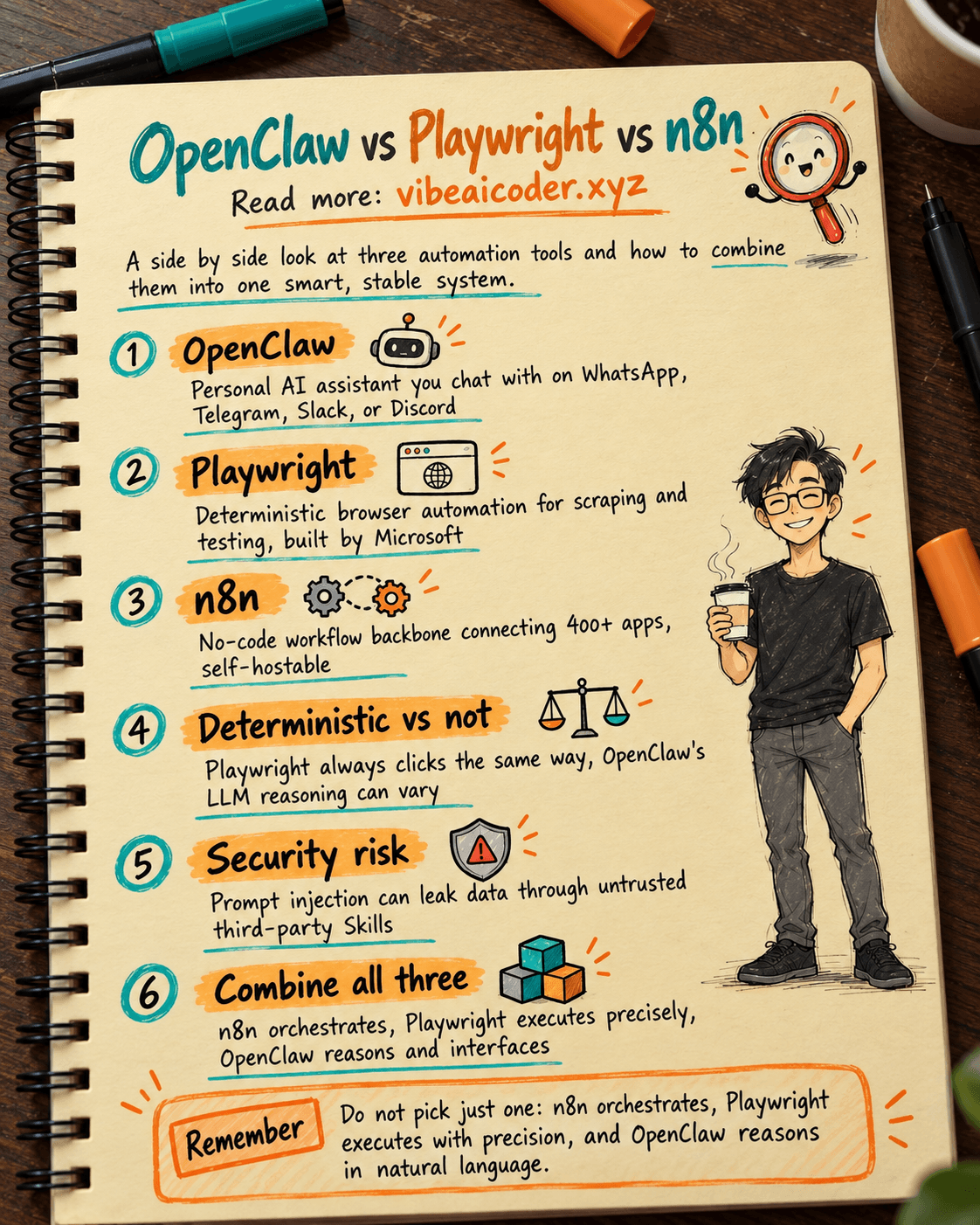
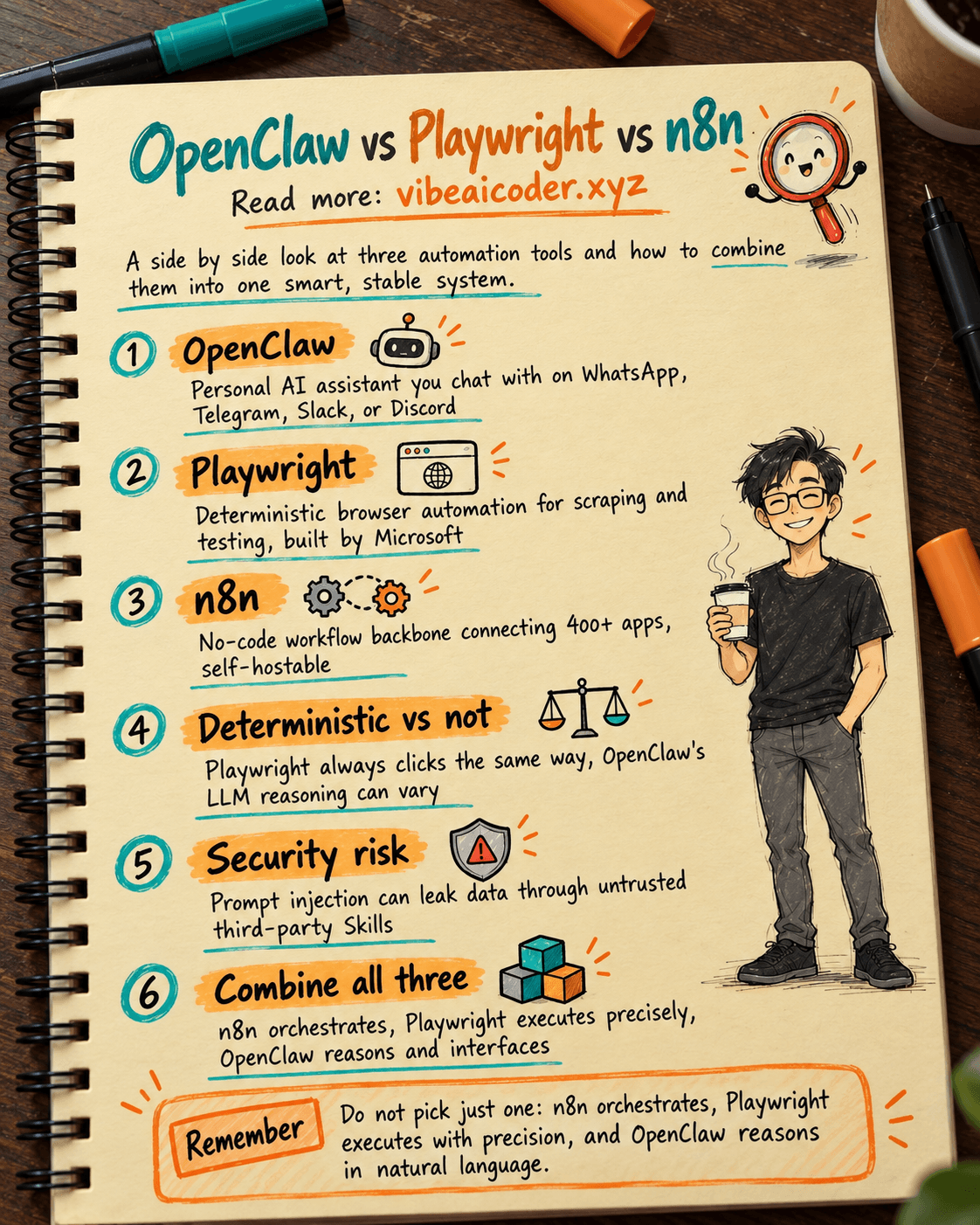
OpenClaw vs Playwright vs n8n: Which Automation Tool Should You Use?
Do you want a tool that "thinks" on its own to get a task done, or a robot that follows exact instructions to automate your business workflows?
OpenClaw: when AI does more than just chat
If you have not heard of it yet, OpenClaw is the hot new name in the AI agent framework world. Released by Peter Steinberger in November 2025 (it started out as Clawdbot), this is not just another chatbot. It is built as a Personal AI Assistant that runs directly on your own device. The best part is you can control it through apps you already use every day, like WhatsApp, Telegram, Slack, or Discord. Instead of opening a web dashboard, you just send a message and the AI carries out complex tasks for you.
Playwright and n8n: the reliable veterans
While OpenClaw is making waves with its reasoning ability, we should not forget Playwright and n8n. Playwright is Microsoft's prized tool for browser automation. If you need to scrape web data or test software with pixel perfect precision, Playwright is hard to beat.
n8n, on the other hand, acts as the backbone for workflows. It is a no-code/low-code platform that lets you connect more than 400 different apps without needing to know much about programming. If Zapier is known for convenience, n8n is known for power, since you can self-host it on your own server and keep full control of your data.
The core difference: who is better at what?
To understand this clearly, think like a product manager. OpenClaw answers the question: "Who is going to do this task for me?" It can reason on its own, create new skills, and take action across multiple platforms.
Playwright, on the other hand, answers: "How do I control the browser 100% the way I want?" It is fully deterministic, meaning the same input always produces the same output, which makes it extremely stable.
Finally, n8n solves the problem of "How do I connect all these apps together without hiring a developer?" It is the brain that coordinates a business's workflows in the most organized way.
Stability matters: deterministic vs non-deterministic
This is the most important part to understand. Imagine you want to click a "Submit" button. With Playwright, you tell it to click, and it clicks that exact button every single time, with zero deviation. That is absolute reliability for a production environment.
But with OpenClaw, because it is built on an LLM (large language model), it is non-deterministic. If you ask it to "book a flight to Hanoi," it might pick a different tab each time, fill out the form differently, or misread your intent depending on the context. It is extremely flexible, but sometimes it gets a little too "creative," which makes the outcome hard to predict in advance.
A security warning: do not get too comfortable with AI agents
One major weak point of OpenClaw is the risk of prompt injection. Cisco ran a test on a third party Skill and found that user data could be secretly leaked out without the owner ever knowing. Because OpenClaw is highly complex and open by design, these security gaps are something everyday users need to pay close attention to before handing it any sensitive data.
The perfect "agentic system" recipe
So why pick just one of the three when you can combine all of them? The current trend in the tech community is to build an integrated system:
- n8n acts as the orchestrator, managing business logic and firing triggers.
- Playwright acts as the web automation engine, stepping in whenever you need precise interaction with real page elements.
- OpenClaw acts as the interface and reasoning layer, taking in natural language requests and figuring out which step to call next.
This combination is the key to building an automation system that is both smart and stable.
Which of these three tools are you using to streamline your own work? Share your setup in the comments.
More articles

AI Training vs Inference: What Is the Difference?

Gemini 4 Argon Reads a 500-Page Chemistry Patent in One Afternoon

Claude Opus 5.5 Codes a Real Money Trading Game in One Day

What Is a Token in AI? Why ChatGPT and Claude Charge by Tokens

What Is Chain of Thought? Why Asking AI to Think Step by Step Works Better

Claude Sonnet 5.5 vs GPT-6.1 Sol: Which AI Model Is Worth Using?