🎼 OpenAI Open-Sources Symphony: Linear Becomes a Control Plane, +500% Internal PRs
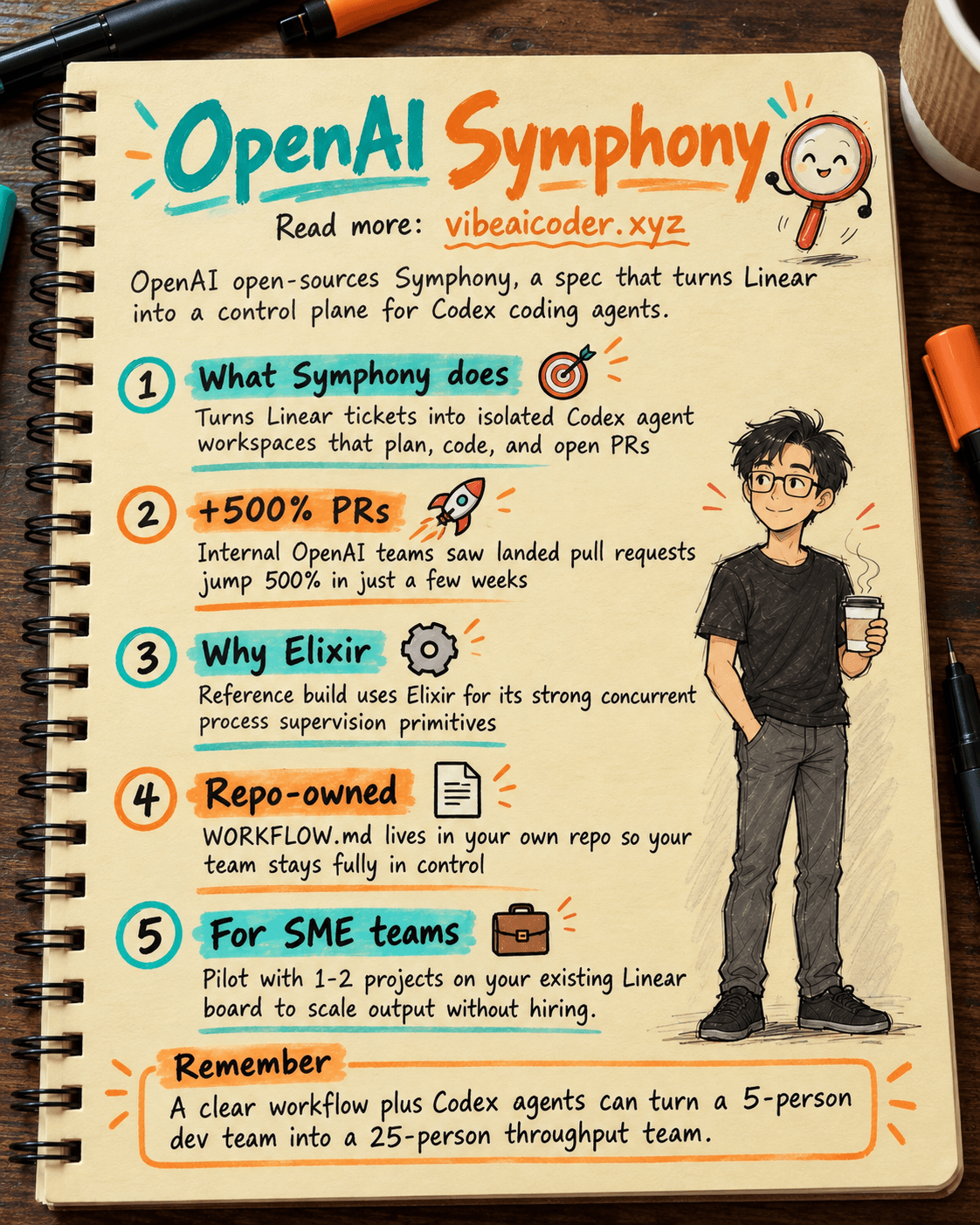
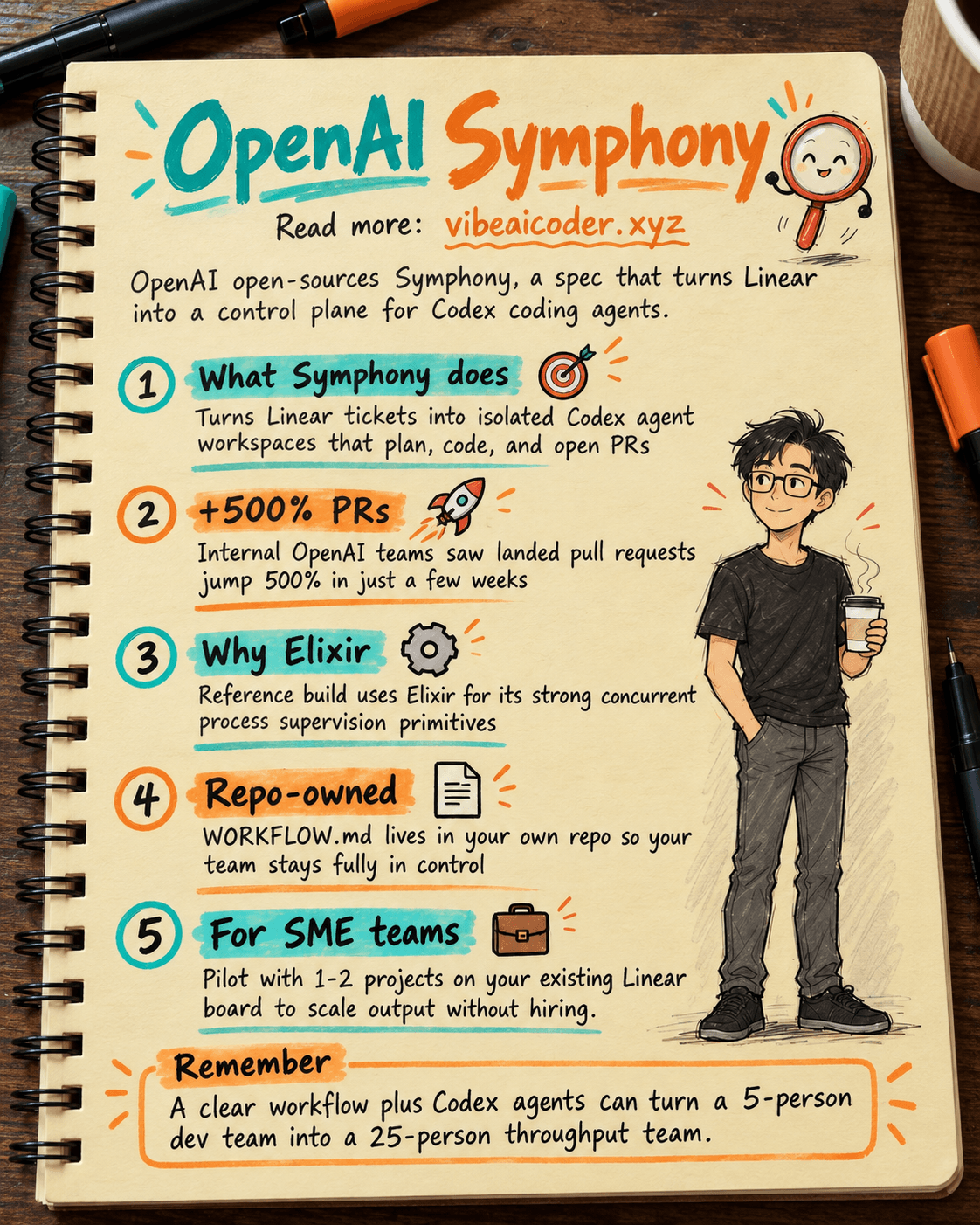
OpenAI just open-sourced Symphony, a spec that turns Linear into a "mission control" for a fleet of Codex coding agents. Some internal teams reported +500% landed pull requests within just a few weeks. Developers no longer prompt agents task by task, they manage work the way a manager runs a team of people.
What does Symphony actually do?
Symphony is an Apache 2.0 specification hosted at github.com/openai/symphony that turns a project-management board like Linear into a control plane for coding agents.
Every ticket opened in Linear is automatically assigned to a Codex agent running in its own isolated workspace. The agent handles the entire pipeline on its own:
- Reads the task and plans the work
- Writes the code changes inside a sandbox
- Opens a pull request on GitHub
- Tracks CI status in real time
- Builds a review packet: PR feedback, a complexity analysis, and a walkthrough video
- Sends the work to a human reviewer only once it's actually ready
Every tool the agent can call is defined in a WORKFLOW.md file that lives right inside your own repo. That "repo-owned" design means the team stays fully in control, with no dependency on a vendor.
Why is +500% PRs worth paying attention to?
This isn't a lab benchmark, it's internal data from OpenAI's own production teams:
- Some teams reported a 500% jump in landed pull requests within a few weeks
- Developers shifted from "prompting an assistant for each task" to managing work, not supervising an agent
- Parallel execution: multiple agents run at once, each one owning its own ticket
The key takeaway: humans are no longer the bottleneck on coding velocity. You sit down to review instead of typing code. A team of 5 developers can hit the throughput of a 25-person team if the workflow is solid enough.
The engineering choice: why Elixir?
OpenAI built the reference implementation in Elixir because the language has excellent primitives for orchestrating and supervising concurrent processes (the BEAM VM, OTP supervisors).
To stress-test the spec, Codex also built its own versions in TypeScript, Go, Rust, Java, and Python to flush out ambiguity and simplify the design.
OpenAI is explicit about this: the Elixir implementation of Symphony is a prototype, not something maintained as a product. The official recommendation is to:
- Read the SPEC.md file in the repo carefully
- Build your own hardened version for your team
- Fork freely, since it ships under the Apache 2.0 license
How should Vietnamese businesses apply this?
For CTOs, engineering managers, and founders at Vietnamese SMEs, this is a real chance to scale dev capacity without hiring more people:
- AI coding is no longer a copilot, it's a genuine co-worker that owns pull requests end to end
- Invest in process: a clear WORKFLOW.md, well-specified tickets, and solid CI can multiply productivity by 5x once AI is wired in
- Start with 1-2 pilot projects and measure PR throughput before and after
- If you already use Linear (or Jira, ClickUp), you already have 70% of the infrastructure in place
- A solo indie hacker can effectively run like a 5-person team
Don't wait for a vendor to package this up for you. The spec is open, the code is open, and the license is permissive. Vietnamese engineering teams are more than capable of forking it and customizing it for their own stack.
Do you think your team is ready for the "1 developer managing 5 agents" model? Save this post, send it to your tech lead, and start experimenting with one small ticket this week.
More articles

AI Training vs Inference: What Is the Difference?

Gemini 4 Argon Reads a 500-Page Chemistry Patent in One Afternoon

Claude Opus 5.5 Codes a Real Money Trading Game in One Day

What Is a Token in AI? Why ChatGPT and Claude Charge by Tokens

What Is Chain of Thought? Why Asking AI to Think Step by Step Works Better

Claude Sonnet 5.5 vs GPT-6.1 Sol: Which AI Model Is Worth Using?