OpenAI DevDay 2026: Codex Gets 8x Faster and Works With Your Laptop Closed
What just happened
On the night of September 29, OpenAI held its DevDay 2026 event and announced a wave of new features for Codex, its AI coding assistant. The two biggest changes are a much faster speed tier called Ultrafast, and the ability for Codex to keep working in the cloud even after you close your laptop, called Codex Cloud. If you have used AI to write code before (like in our earlier piece on why Codex accounts for 64 percent of enterprise AI token usage, not ChatGPT), this is the biggest upgrade to the tool this year.
Ultrafast: AI that answers almost 10 times faster
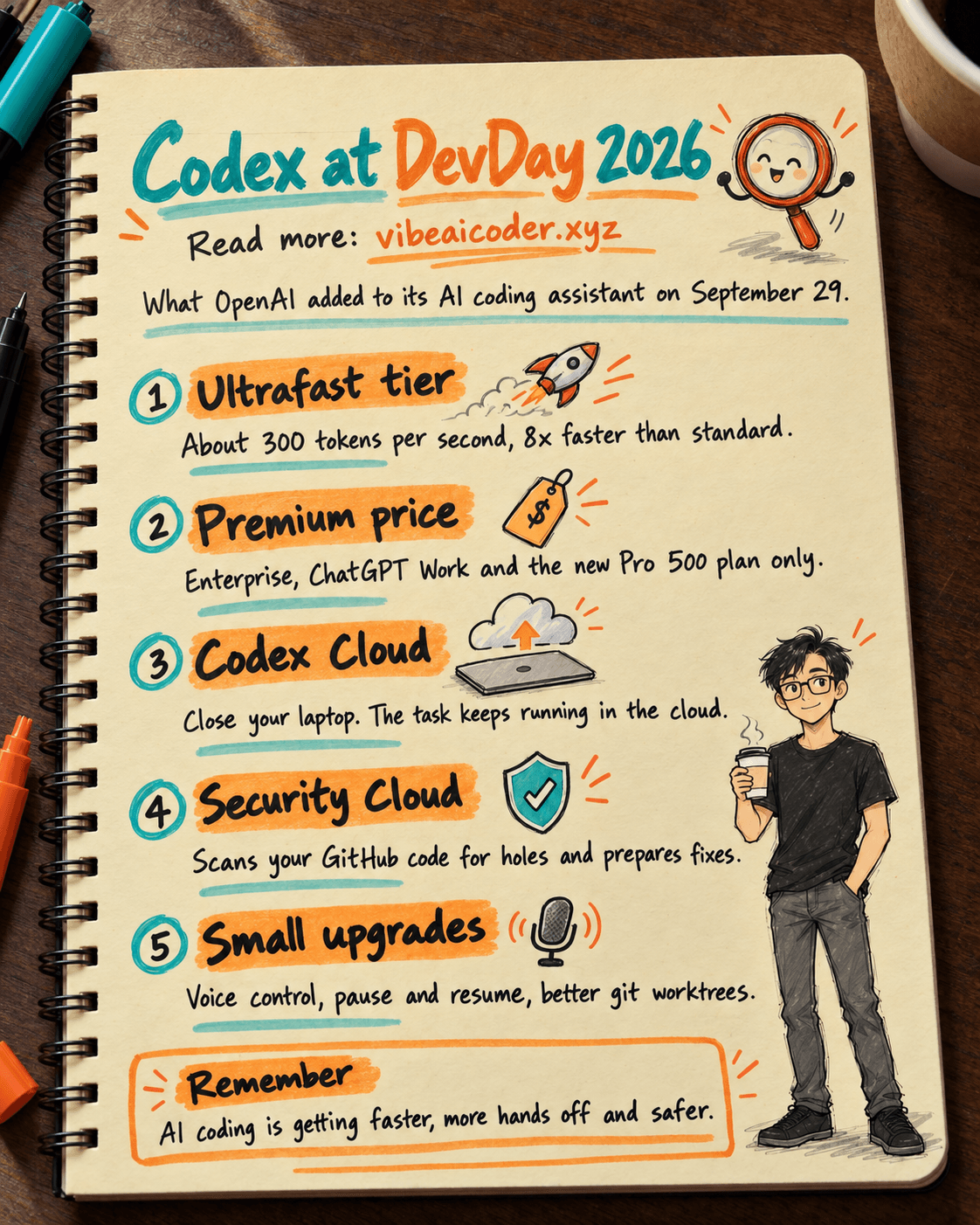
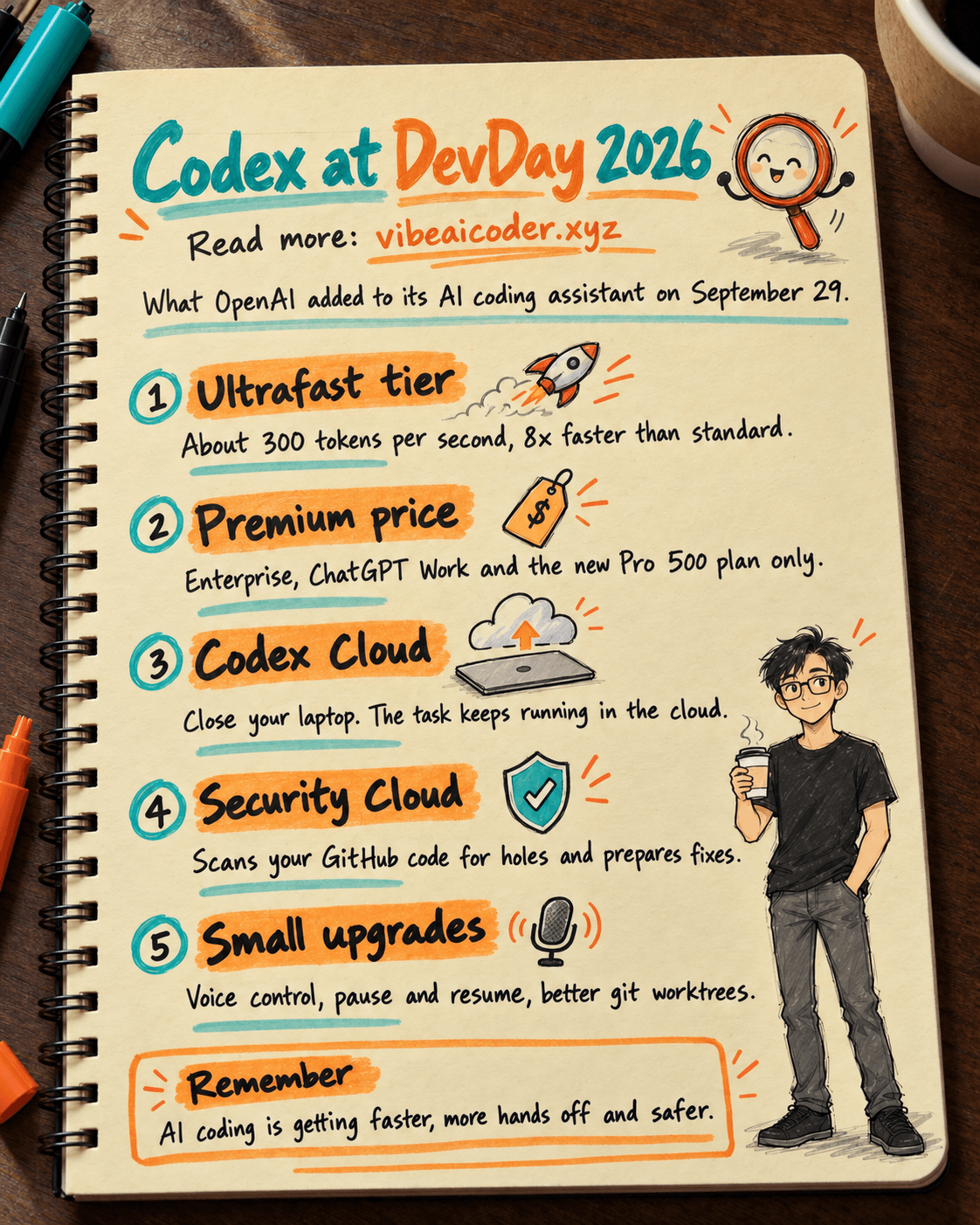
A token is the small unit AI uses to "type out" each word or line of code. The more tokens per second, the faster AI responds. With the Ultrafast tier, Codex now generates around 300 tokens per second, 8 times faster than the standard tier and 4 times faster than the previous fast tier. Through the API, for developers building their own apps, speed also increases 6 times.
The tradeoff is price. The model behind this, GPT-6 Astra (which we covered before as the model OpenAI called its safest ever), costs around 60 dollars per million input tokens and 300 dollars per million output tokens when run in Ultrafast mode, far more than standard speed. Because of that, Ultrafast is currently limited to premium plans: Enterprise, ChatGPT Work, and the new Pro 500 plan priced at 500 dollars a month for heavy users.
In plain terms, this is a "fast lane" for people who need AI coding help at top speed, for example when racing a deadline or working on a large project, and who are willing to pay more to save time waiting.
Codex Cloud: close your laptop, the work keeps going
The second feature is more interesting for everyday users: Codex Cloud. Before this, if you wanted AI to help write code, you had to keep your computer open and wait for it to finish locally. Now you can hand a task to Codex, close your laptop and go do something else, then check the result later from your phone.
Codex Cloud also lets you build a reusable "workspace": source code, network configuration, and secrets like API keys are stored in one cloud environment. A whole team can share this environment instead of everyone setting it up from scratch. This is available on plans from Plus and Pro up to Business and Enterprise, so it is not limited to large companies only.
Alongside this comes a smaller but handy upgrade: two-way voice control for Codex, the ability to pause and resume a session exactly where you left off, and better support for git worktrees, a way developers work on multiple code branches at once without them getting in each other's way.
Codex Security Cloud: patching holes while you sleep
OpenAI also launched Codex Security Cloud, a service that automatically scans your entire GitHub codebase for security vulnerabilities. It can run on a schedule, say every night, or on demand. It filters out duplicate findings and prepares fixes in advance, all while continuing to run in the cloud even after your computer is off. This feature is available on Pro, Business, Enterprise, and Edu plans.
This is a natural next step after OpenAI launched "dots," an always-on AI assistant that works 24/7 in your place not long ago. The industry trend is clear: let AI work in the background, without a human needing to watch the screen.
Why this matters to you
If you are "vibe coding," meaning you build software mostly with AI help without deep technical skill, these three features solve three familiar pain points: waiting too long for AI to answer (Ultrafast), having to babysit your computer while AI works (Codex Cloud), and worrying about security bugs you cannot spot yourself (Security Cloud). You do not need the expensive Ultrafast plan to use AI coding well, but if you are familiar with Claude Code, Anthropic's AI coding assistant, you can see where the whole industry is heading: AI coding that is faster, more hands off, and safer for everyday users.
More articles

Gemini 4 Argon Reads a 500-Page Chemistry Patent in One Afternoon

Claude Opus 5.5 Codes a Real Money Trading Game in One Day

What Is a Token in AI? Why ChatGPT and Claude Charge by Tokens

What Is Chain of Thought? Why Asking AI to Think Step by Step Works Better

Claude Sonnet 5.5 vs GPT-6.1 Sol: Which AI Model Is Worth Using?

 Claude Opus 5.5 Launches: 30% Faster, 40% Cheaper, Blocks AI Brain Copying