⚛️ Microsoft Majorana 2: Quantum Chip 1,000x More Reliable Opens the Quantum-AI Era
Microsoft just laid a foundation stone for the future of AI, and it is not another ordinary language model.
In June 2026, Microsoft made a string of major announcements in quick succession: the Majorana 2 quantum chip, the coding model MAI-Code-1-Flash, and the reasoning model MAI-Thinking-1. But it was Majorana 2 that truly stopped the tech community in its tracks.
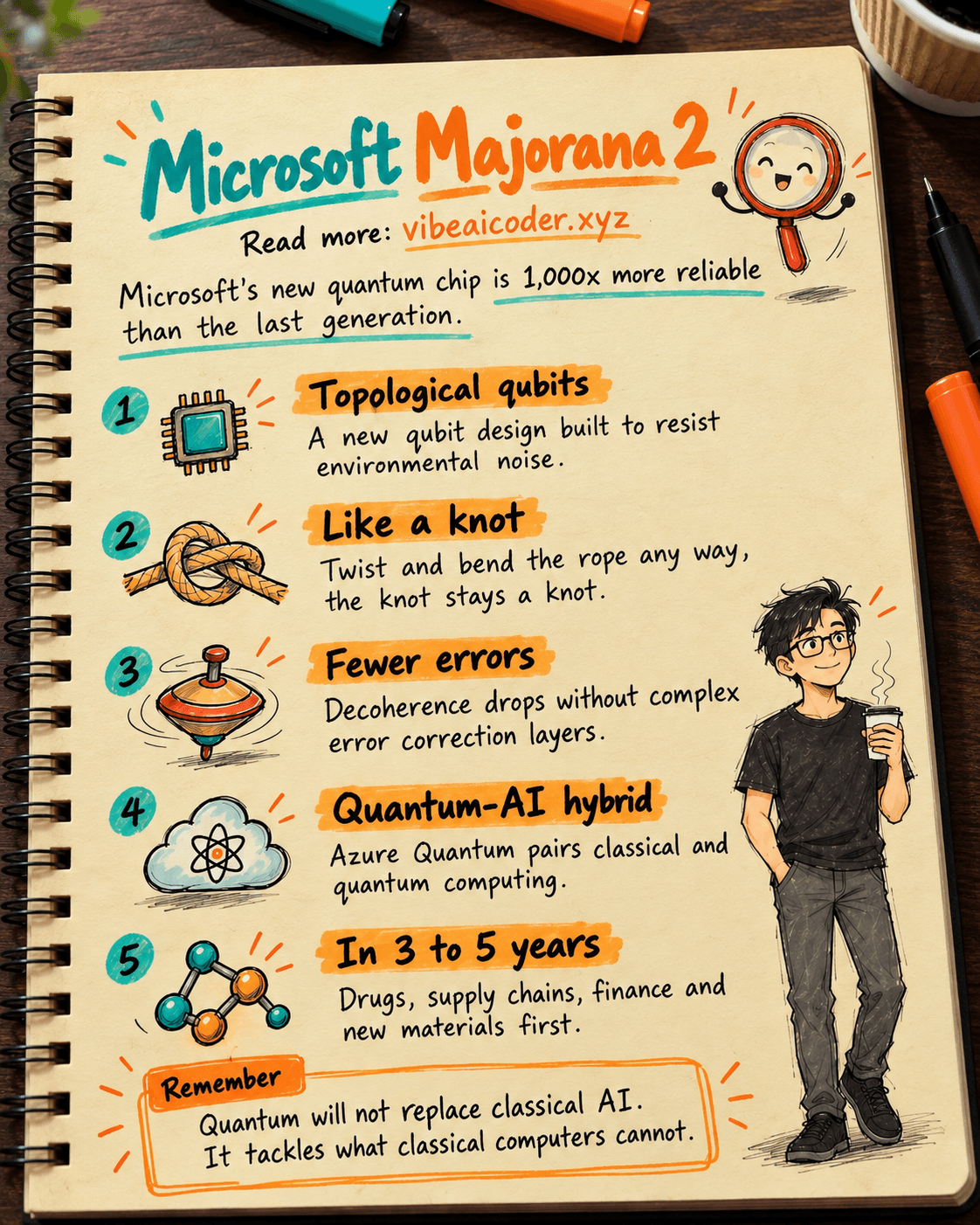
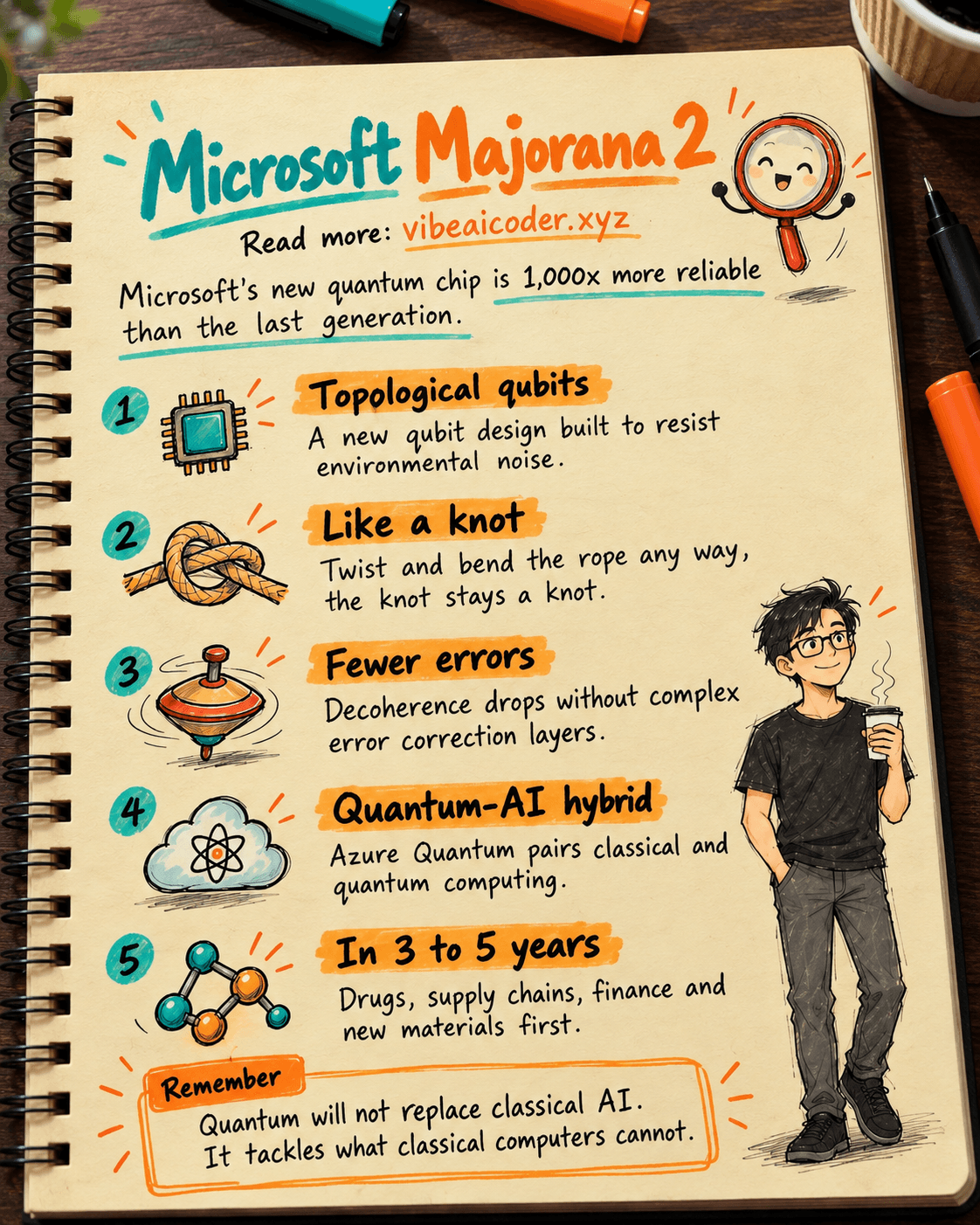
What Is Majorana 2, and Why Does the 1,000x Number Matter So Much
Majorana 2 is Microsoft's newest generation of quantum chip, built on a topological qubit architecture, a design that is fundamentally different from traditional qubits.
The biggest breakthrough: reliability improved 1,000 times over the previous generation. Traditional qubits are extremely sensitive to environmental noise, which causes decoherence. Microsoft's topological qubits are physically designed to resist that noise, so decoherence errors drop significantly without needing complex error correction layers.
How a Topological Qubit Differs From a Regular Qubit
Picture a regular qubit as a spinning top balanced on a table. The slightest breeze knocks it over. A topological qubit is more like information encoded in the shape of a knot tied in a rope. You can twist and bend the rope in many ways, but the knot stays a knot.
Quantum-AI Hybrid: Why Azure Quantum Is Making a Big Bet
Azure Quantum is not just trying to sell quantum computing as a service. Microsoft is building the infrastructure for a quantum-AI hybrid era, where the most demanding AI workloads are handled by a combination of classical computing and quantum computing.
Quantum computing does not replace classical AI. Instead, it tackles problems classical computers cannot handle efficiently, such as multi-variable optimization, molecular simulation, and large-scale graph analysis.
Commercial Applications Expected in 3 to 5 Years
Microsoft expects real commercial applications to arrive within the next 3 to 5 years. The fields with the highest expectations include drug development and molecular simulation, supply chain optimization, complex financial modeling, and new materials research.
MAI-Code-1-Flash and MAI-Thinking-1
That same month, June 2026, Microsoft also launched MAI-Code-1-Flash (its first in-house coding model) and MAI-Thinking-1 (a highly efficient reasoning model). Three major announcements in a single month signal that Microsoft is shifting from being OpenAI's partner to becoming a fully independent player in AI.
If Majorana 2 really does open up a quantum-AI hybrid era over the next five years, which industry do you think will change the most?
More articles

AI Training vs Inference: What Is the Difference?

Gemini 4 Argon Reads a 500-Page Chemistry Patent in One Afternoon

Claude Opus 5.5 Codes a Real Money Trading Game in One Day

What Is a Token in AI? Why ChatGPT and Claude Charge by Tokens

What Is Chain of Thought? Why Asking AI to Think Step by Step Works Better

Claude Sonnet 5.5 vs GPT-6.1 Sol: Which AI Model Is Worth Using?