 Manus AI Launches My Computer: A New Step for AI Agents After Joining Meta
The era of AI that only "talks" inside a chat window is over. On March 16, 2026, Manus AI marked a major milestone by officially rolling out its "My Computer" feature, bringing artificial intelligence down from the cloud straight onto your computer's hard drive.
 A Historic Handshake: Manus AI and Meta
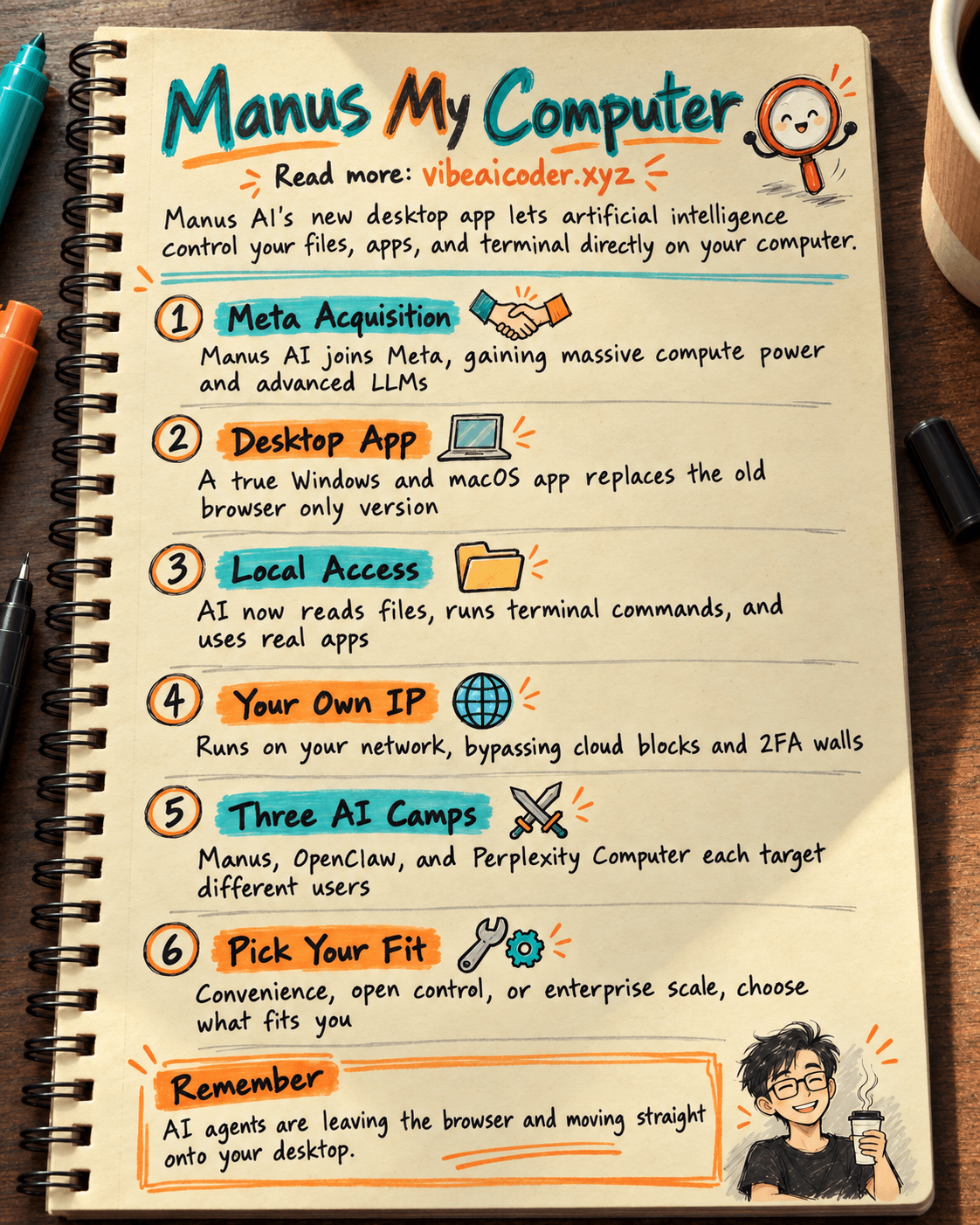
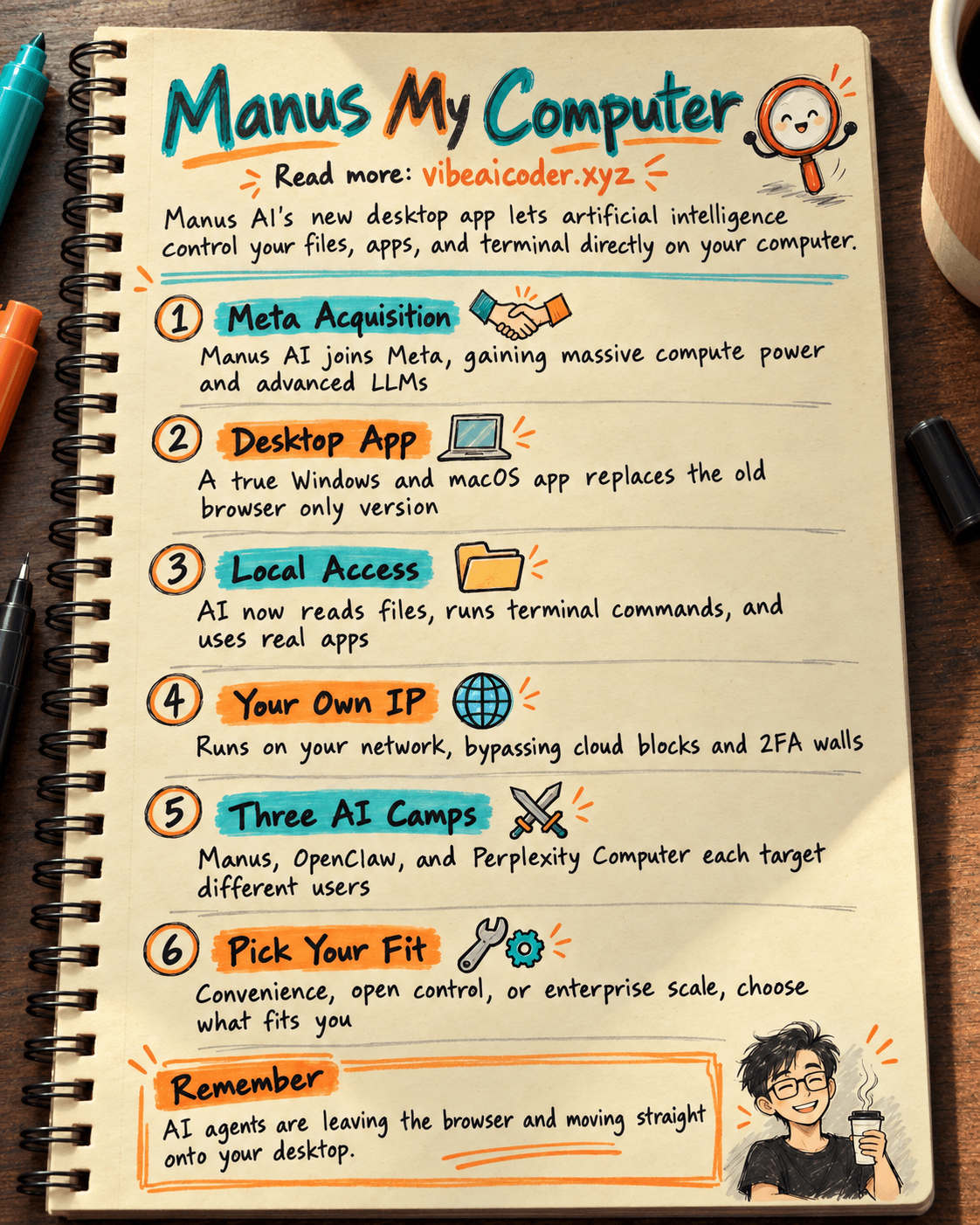
The biggest headline buried inside this update is that Manus AI has officially been acquired by Meta, the parent company of Facebook and Instagram. Joining Mark Zuckerberg's ecosystem does more than hand Manus AI a massive financial war chest, it also gives the company access to Meta's hardware infrastructure and some of the most advanced large language models (LLMs) available. That combination turns Manus from a promising startup into one of the most formidable contenders in the AI agent race, directly challenging the other major players in the market.
 My Computer: When AI Takes the Mouse and Keyboard
Unlike the earlier browser based version, "My Computer" is a true desktop application for Windows and macOS (Apple Silicon). The core idea behind this move is tearing down the "cloud sandbox" barrier. Manus can now access and manage local files, run commands in the terminal (CLI), and interact with other applications just like a real user would. It is no longer confined to a browser tab, it now has "hands" to work directly on your data.
 Automating the Most Complex Workflows
Ever been exhausted from sorting through thousands of photos, bulk renaming invoices, or checking hundreds of code files by hand? Manus AI can now handle all of it. With a single natural language command, it can open folders on its own, sort data, write and test scripts, and return the final result. Because it runs directly on your machine, Manus also uses your own IP address and network connection, which matters a lot, it lets the AI get past security layers, two factor authentication, and sites that block cloud IP addresses, something cloud only AI tools regularly struggle with.
 The AI Compute Race: Manus vs OpenClaw vs Perplexity
The AI agent landscape of 2026 has settled into three distinct camps:
-
Manus AI (the convenience camp): After joining Meta, Manus is leaning into an "AI that does it for you" experience built for the masses. It behaves like an assistant sitting right next to you, excellent at handling everyday practical tasks without requiring deep technical knowledge. Its smooth interface and high stability are its biggest strengths.
-
OpenClaw (the freedom camp): This is the territory of tech wizards and developers. OpenClaw is an open source platform that lets you plug in any model you like, from Claude to Gemini, and run it on your own server or personal machine. It offers total control, but it demands real skill in managing resources and API costs.
-
Perplexity Computer (the all out camp): Launched in late February 2026, this "Digital Worker" system targets large enterprises directly. At about $200 a month, it coordinates 19 different models at once to handle projects that run for months. Perplexity Computer does not just complete a single task, it operates like a full digital engineering department.
 Which One Is Right for You?
If you are a prosumer, freelancer, or office worker looking to boost your productivity, Manus AI is the top pick. Backing from Meta promises deeper integration into everyday workflows in the near future.
If you are a developer who wants to build a personalized agent system with deep integration into your DevOps pipeline or a massive codebase, OpenClaw gives you maximum flexibility.
And if you are running a business that needs a "digital employee" capable of long term planning, Perplexity Computer's Max plan is worth every dollar.
The world is changing faster than ever. Giving AI direct access to personal computers opens up huge opportunities, but it also comes with real privacy challenges. Still, with Meta's backing, Manus AI is showing it is serious about turning AI into a genuine collaborator rather than just a tool for looking things up.
More articles

AI Training vs Inference: What Is the Difference?

Gemini 4 Argon Reads a 500-Page Chemistry Patent in One Afternoon

Claude Opus 5.5 Codes a Real Money Trading Game in One Day

What Is a Token in AI? Why ChatGPT and Claude Charge by Tokens

What Is Chain of Thought? Why Asking AI to Think Step by Step Works Better

Claude Sonnet 5.5 vs GPT-6.1 Sol: Which AI Model Is Worth Using?