Google Gemma 4: Open Model for Reasoning and AI Agents
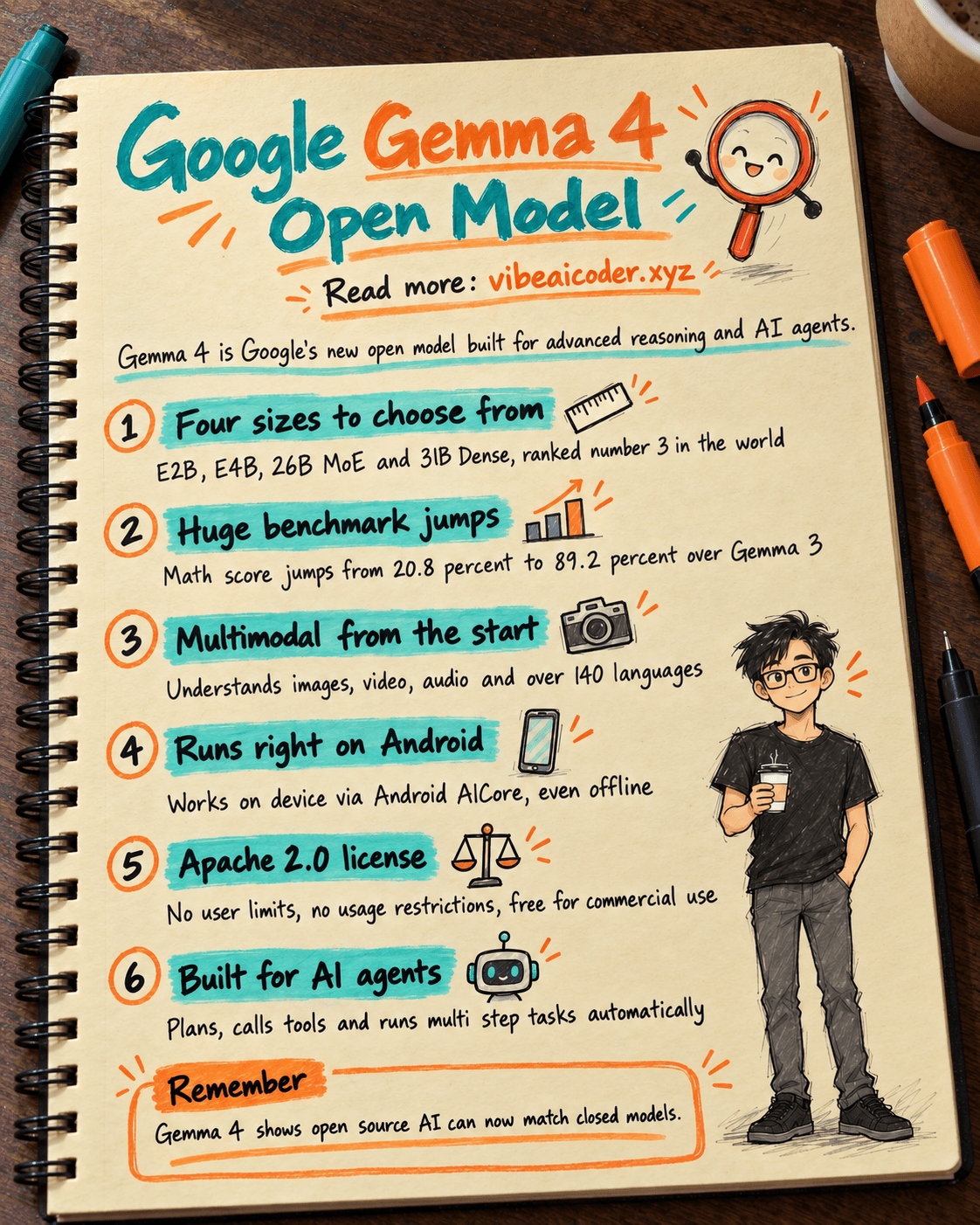
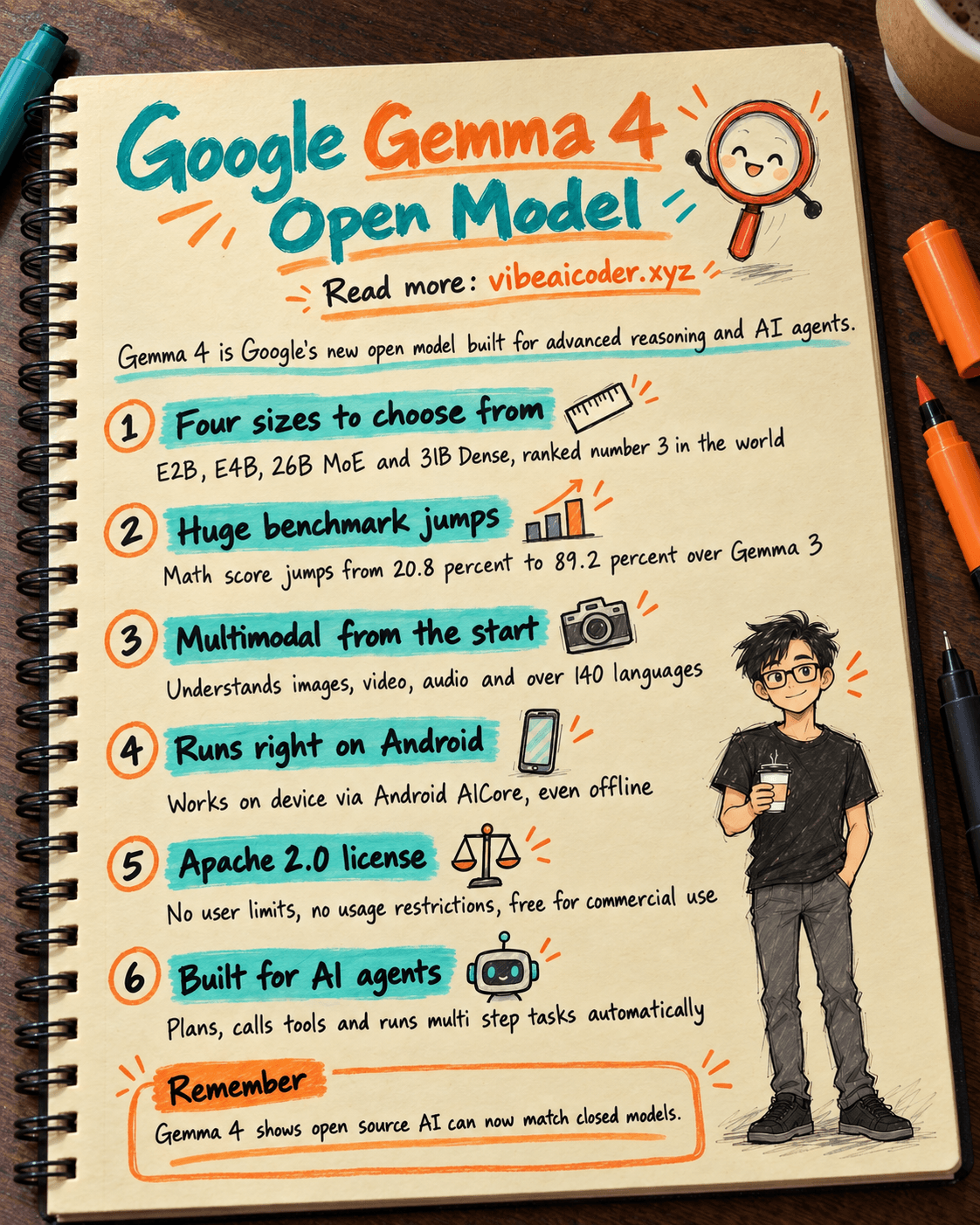
Google DeepMind launched Gemma 4 on April 2, 2026, a new open model line built specifically for advanced reasoning and agentic workflows. This is not just a routine upgrade. Gemma 4 marks a major leap in performance per parameter, currently ranking #3 in the world on the Arena AI leaderboard for open models.
 Four sizes for every need
Gemma 4 ships in four different sizes:
→ E2B (Effective 2B): 2.3 billion effective parameters, compact enough for mobile devices → E4B (Effective 4B): 4.5 billion parameters, a balance of performance and resource use → 26B MoE (Mixture of Experts): only 4 billion parameters active at once, saving on compute → 31B Dense: the largest model, the highest performer, ranked #3 in the world
 Impressive benchmarks
Compared with Gemma 3, the improvements are substantial:
→ AIME 2026 (math): from 20.8% to 89.2% (a 4.3x jump) → LiveCodeBench (coding): from 29.1% to 80.0% (a 2.7x jump) → GPQA (science): from 42.4% to 84.3% (nearly 2x)
These numbers show Gemma 4 is not just "a bit better." It genuinely jumps into a different tier.
 Multimodal from the ground up
The entire Gemma 4 line supports multimodal input natively:
→ Images: recognition across multiple aspect ratios and resolutions → Video: understands up to 60 seconds of video at 1 fps (26B and 31B models) → Audio: speech recognition and translation (E2B and E4B models) → Context window: 128K tokens for the smaller models, 256K for the larger ones → Support for more than 140 languages
 Runs directly on Android
Google has integrated Gemma 4 into the Android AICore Developer Preview, letting AI run directly on-device without a cloud connection. That opens the door to AI apps that work offline, protect user data better, and cut inference costs.
 Apache 2.0 license
The most attractive part for developers: Gemma 4 uses a fully Apache 2.0 license. No monthly active user (MAU) limits, no acceptable-use restrictions, 100% free for commercial use. That is a big advantage over many other open models that still carry restrictive terms.
 Built for AI agents
Gemma 4 was built specifically for agentic workflows. The model can:
→ Plan and work through complex logic → Call tools and execute tasks automatically → Handle multi-step action chains → Integrate with existing AI agent frameworks
According to Gartner, 40% of enterprise applications will use AI agents by 2026. With its open license and strong performance, Gemma 4 is a natural fit for that trend.
 Why Gemma 4 matters
Gemma 4 proves open-source AI no longer lags behind closed models. With benchmarks on par with GPT-5 and Claude on many tasks, a fully permissive license, and the ability to run on-device, this could be a turning point for developers who want to build AI products without depending on a third-party API.
More articles

AI Training vs Inference: What Is the Difference?

Gemini 4 Argon Reads a 500-Page Chemistry Patent in One Afternoon

Claude Opus 5.5 Codes a Real Money Trading Game in One Day

What Is a Token in AI? Why ChatGPT and Claude Charge by Tokens

What Is Chain of Thought? Why Asking AI to Think Step by Step Works Better

Claude Sonnet 5.5 vs GPT-6.1 Sol: Which AI Model Is Worth Using?