 Gemini 4 Argon Launches: 1 Million Tokens in One Answer, Ahead of GPT-6 Astra and Claude on Most Tests
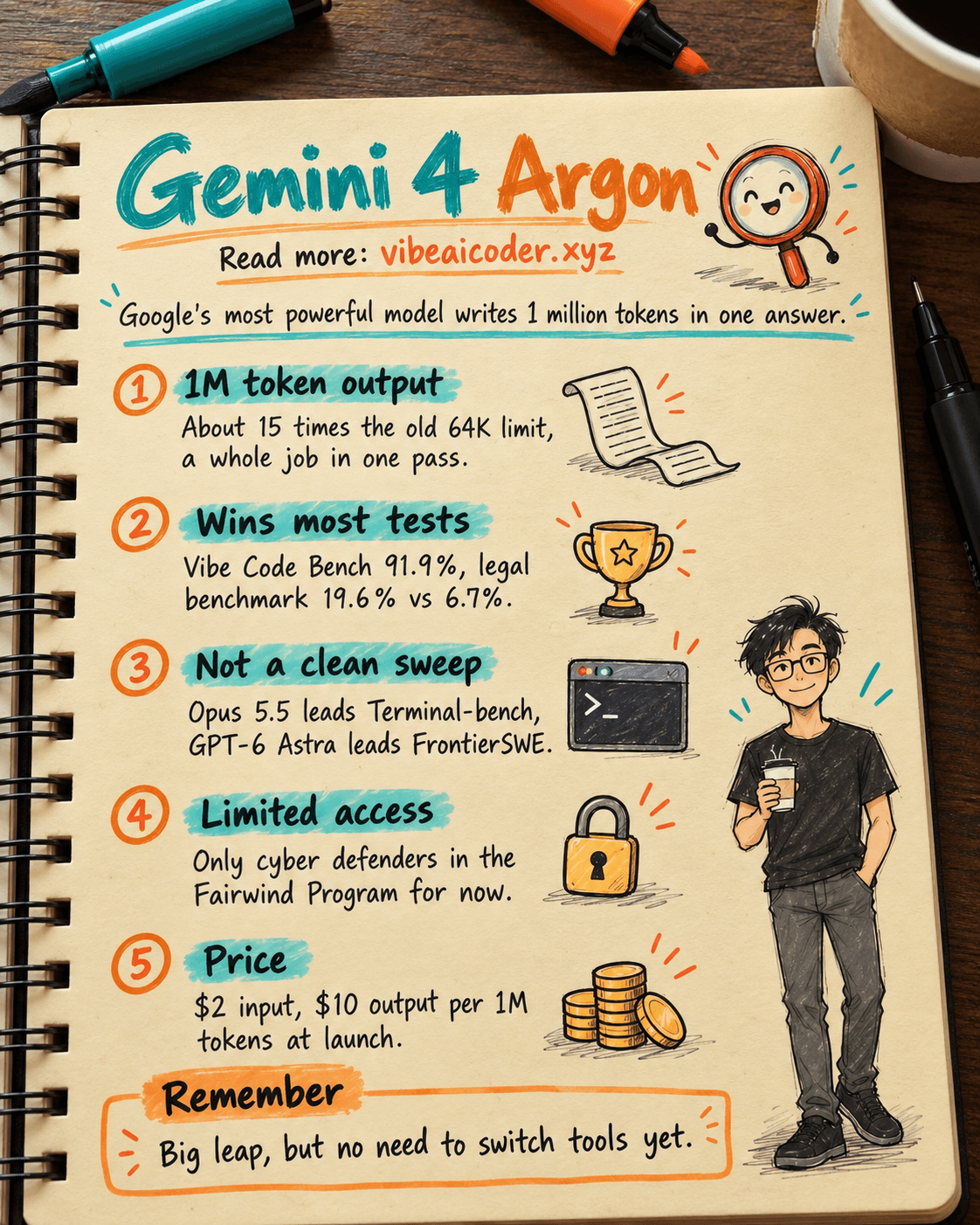
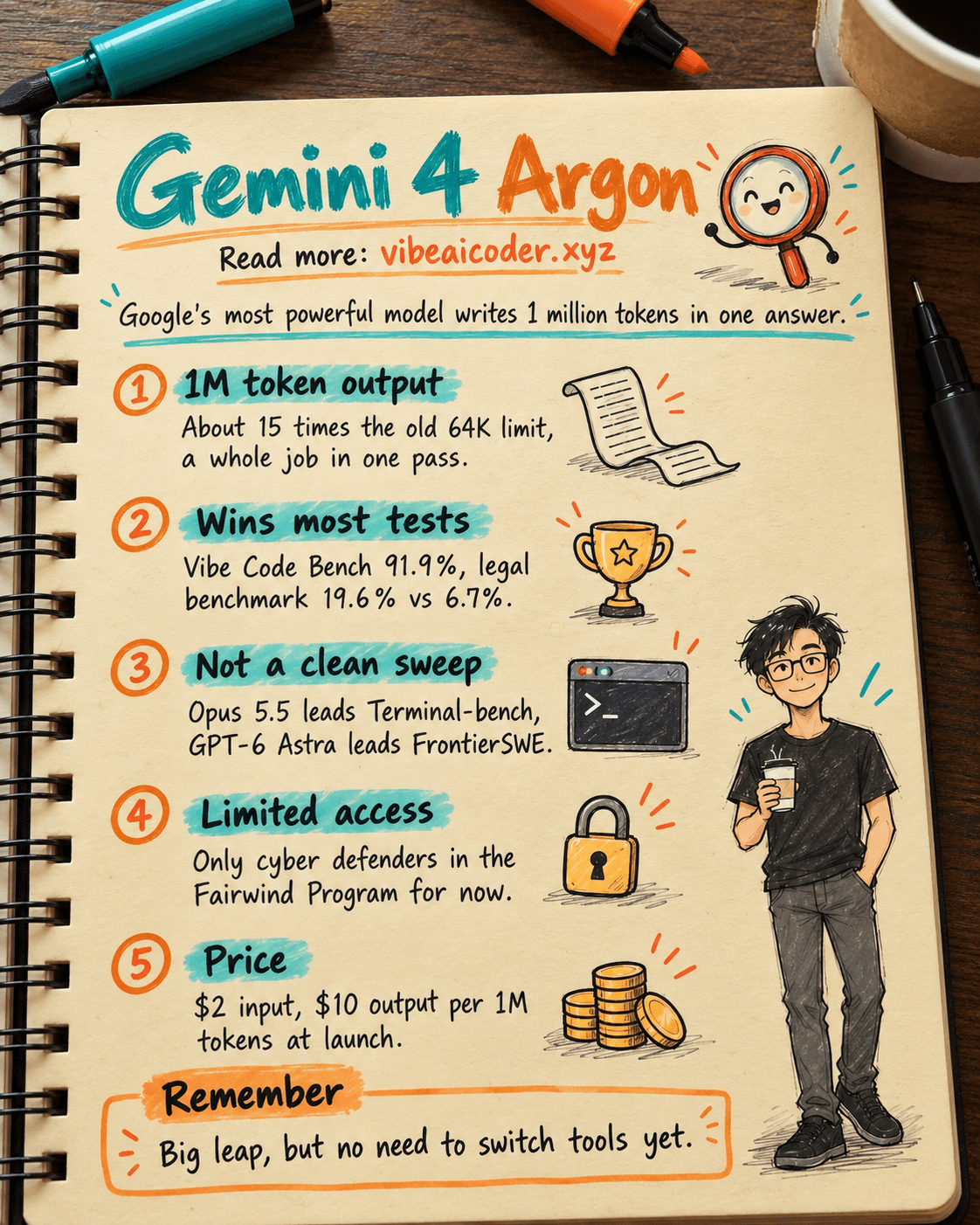
On September 30, 2026, Google DeepMind launched Gemini 4 Argon, the most powerful AI model Google has ever released. The headline feature: Argon can write up to 1 million tokens in a single response, about 15 times the previous 64K limit. On the comparison table Google published, Argon tops most of the tests, ahead of GPT-6 Astra, Claude Fable 5.1 and Claude Opus 5.5.
Before you go looking for a "try it" button, though: most of us can't use it yet. Here is where Argon is strong, where it is weak, and when regular users get access.
 What is Gemini 4 Argon?
Argon is Google's new "frontier" model (the group of AI models leading the field when they launch). It is built for three kinds of heavy work:
- Real software engineering, like fixing bugs and migrating entire large codebases.
- Deep knowledge work, such as legal, finance and research.
- Cybersecurity defense, finding and patching holes before attackers do.
New to AI? Our guide What is AI, explained simply covers the basics first.
 What does a 1 million token output mean?
Tokens are the small pieces of text an AI reads and writes (one English word is usually 1 to 2 tokens). Most AI models today can read a lot, but each answer can only write a limited amount. Go past that and the answer gets cut off.
With 1 million output tokens, Argon can finish a long, multi-step job in one pass, without splitting it up and stitching the pieces back together. Google's own examples:
- Migrating more than 800,000 lines of code from C/C++ to Rust.
- Optimizing a video decoder to run 2.7 times faster than the previous version.
- Freeing more than 300 TiB of memory in Google's data centers.
Put simply: older AI was like a writer who had to stop after every page. Argon is like someone who writes the whole book in one sitting.
 The scorecard: where Argon wins
According to Google's table, Argon leads in these areas:
- Knowledge work: Vals Index 68.9%, AutomationBench 51.3% (almost 9 points ahead of Opus 5.5), Vals Finance Agent v2 65.4%.
- Legal: Harvey's Legal Agent Benchmark at 19.6%, while rivals score only 3.8% to 6.7%. This is the biggest gap in the whole table.
- Coding: DeepSWE v1.1 at 77.9%, Vibe Code Bench at 91.9% (Claude Fable 5.1 and Opus 5.5 both at 90.3%).
- Science and math: LABBench 2 at 88.8%, RiemannBench at 76.0%.
- Very long documents: GraphWalks 99.7% up to 128K tokens, and 84.2% from 256K to 1M tokens (the best rival reaches only 71.8%).
- Video and charts: LVBench 91.7%, Chartography 71.6%.
 But Argon does not win everything
Look closely and there are places where Argon gets beaten:
- FrontierSWE v2 (hard coding): GPT-6 Astra 65.5%, Argon only 55.0%.
- Terminal-bench 4.0 (working in the command line): Claude Opus 5.5 leads with 66.4%, Argon 57.4%.
- PostTrainBench (ML engineering): Opus 5.5 leads with 49.3%.
- OSWorld-2.0 (controlling a computer): GPT-6 Astra 72.6%, Argon 69.2%.
- Cybersecurity, CWE-bench v1: Argon and GPT-6 Astra tie at 68%.
One thing to keep in mind: these are numbers published by Google itself. Benchmark scores can shift depending on how they are run, as our piece on whether AI benchmarks can be trusted explained. It is worth waiting for independent tests.
If you code with Claude every day, Opus 5.5 is still great value, especially for terminal work. See Claude Opus 5.5 launches: on par with Fable 5.1, 40% cheaper to compare.
 Who gets it first? The Fairwind Program
Argon is not open to everyone yet. Google is giving trusted cyber defenders early access through the Fairwind Program, which Google started on September 2, 2026 and which now has more than 650 partners worldwide.
A real example: security company Wiz used Argon in its free "Scan for Good" initiative and found a critical vulnerability exposing personal information in healthcare software used by hospitals around the world.
Google says it will expand to paid API developers and Google AI Ultra subscribers "as soon as possible", after finishing a voluntary pre-release safety process with governments. There is no date yet.
 How much does it cost?
- Introductory price: $2 per 1 million input tokens, $10 per 1 million output tokens.
- After the introductory period: $4 input, $20 output.
- Cached input (input saved for reuse) gets a 95% discount.
Note: writing a full 1 million output tokens in one go costs about $10 to $20, so this is a tool for big jobs, not small talk.
 What does this mean for you?
- The AI race is getting closer. Google, OpenAI and Anthropic take turns in the lead every month. Users win, because AI keeps getting smarter and cheaper.
- No need to switch tools yet. Argon is not widely available. If Claude or ChatGPT works for you, keep going. ChatGPT, Gemini or Claude: which should beginners pick is still a good guide.
- Long jobs and thick documents will get easier. Once Argon opens up, tasks like reading a full stack of contracts or rewriting an old app will fit into a single request to the AI.
Do you think Argon is strong enough to pull you away from Claude or ChatGPT? Let us know in the comments!
More articles

Gemini 4 Argon Reads a 500-Page Chemistry Patent in One Afternoon

Claude Opus 5.5 Codes a Real Money Trading Game in One Day

What Is a Token in AI? Why ChatGPT and Claude Charge by Tokens

What Is Chain of Thought? Why Asking AI to Think Step by Step Works Better

Claude Sonnet 5.5 vs GPT-6.1 Sol: Which AI Model Is Worth Using?

 Claude Opus 5.5 Launches: 30% Faster, 40% Cheaper, Blocks AI Brain Copying