Claude Sonnet 5.5: One Prompt Creates a Full Playable Game
Claude Sonnet 5.5: One Prompt Creates a Full Playable Game
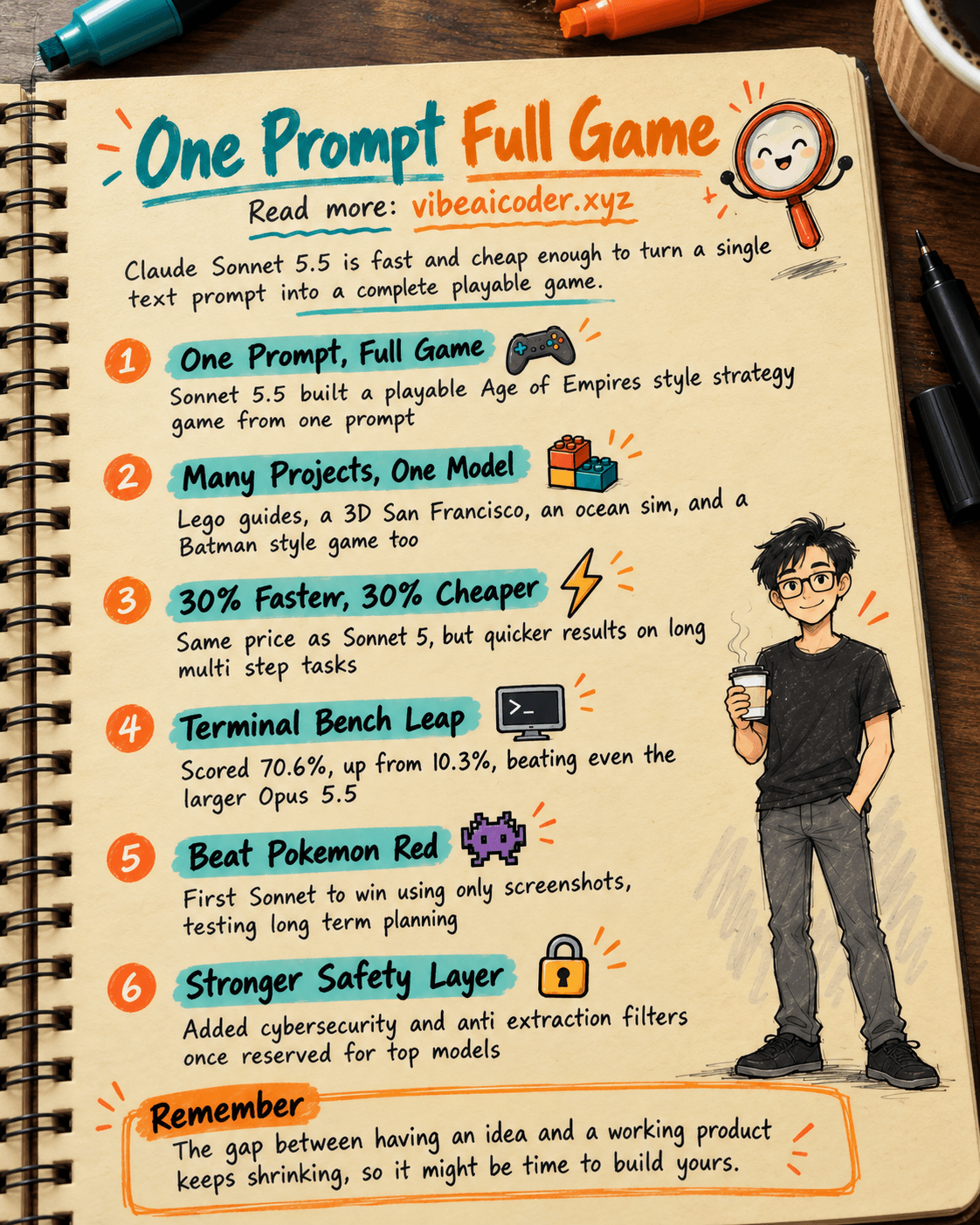
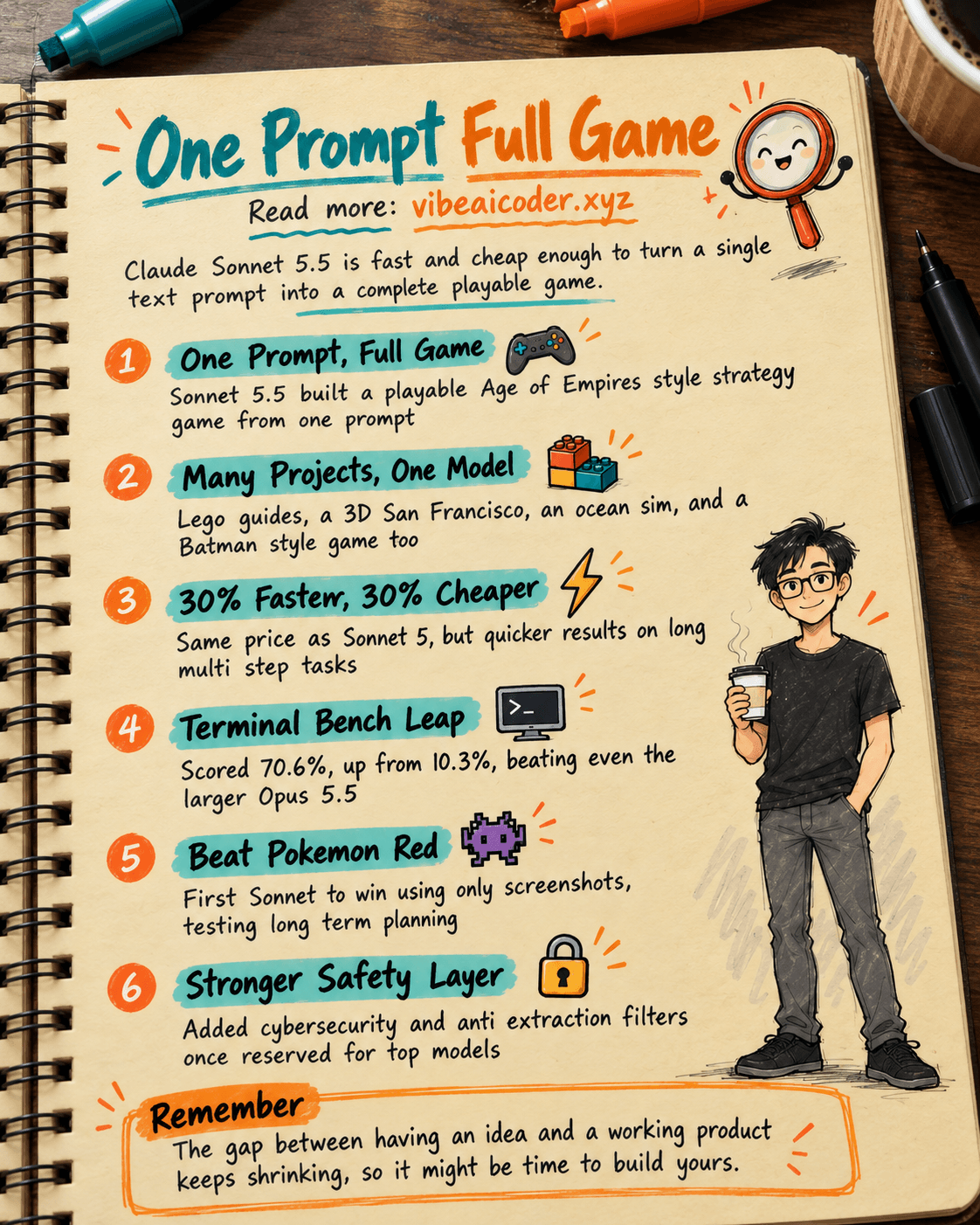
Would you believe an AI model could build an entire real time strategy game, in the style of Age of Empires, from nothing but a short text prompt? That is exactly what popular YouTuber Matthew Berman showed in his latest video after getting early access to Claude Sonnet 5.5, Anthropic's newest model, which launched on September 28, 2026.
From One Prompt to a Full Game
Berman's team put Sonnet 5.5 through a string of projects, not toy code snippets, but real, playable results: an Age of Empires style empire building strategy game that runs right in the browser, a Fall Guys style clone with 60 different levels, a Lego building tool complete with step by step assembly instructions, a detailed 3D model of San Francisco, an ocean simulator, and even a recreation in the style of Batman: Arkham City.
The striking part is that most of these came from just one initial description, with the AI handling everything else: writing the code, building the graphics, and working out the game rules. For non technical viewers, it is one of the clearest signs yet of how far "describe the idea, get the product" has come.
Why Sonnet 5.5 Can Pull This Off
Anthropic says Sonnet 5.5 is more than 30% faster than the previous Sonnet 5, while the cost per task dropped by as much as 30% too. In practical terms, the AI responds faster, can keep working through long multi step tasks without losing steam, and costs less for the same output.
On Terminal Bench, a benchmark that tests how well an AI can operate a command line on its own, the way a developer debugging code would, Sonnet 5.5 scored 70.6%, far above the older Sonnet 5's 10.3%, and even ahead of the larger Opus 5.5 (66.4%). It is also the first Sonnet model to beat Pokemon Red using only screenshots, a classic test of an AI's ability to remember context and plan over a long task rather than just answer a single question.
What Faster and Cheaper Means for Everyday Users
For anyone using AI to write code or build personal projects, speed and cost are not just numbers to brag about. A large project that once took tens of minutes of waiting for the AI to work through each step now finishes noticeably faster, while pricing stays the same as Sonnet 5: about $2 per million tokens the AI reads and about $10 per million tokens it writes. That means you can test more ideas and iterate more times within the same budget and timeframe.
It also explains why projects like games or 3D models, which require the AI to keep working through many small steps in a row (building the framework, adding game rules, fixing bugs, adding effects), are now realistic for a single hobbyist to pull off at home instead of needing to hire a whole development team.
Safer Behind the Scenes
Sonnet 5.5 is also the first Sonnet model to add an extra layer of cybersecurity protection and filters designed to stop people from trying to extract how the model reasons internally, measures Anthropic previously reserved for its most powerful models only. For everyday users this will not change daily use, but it shows Anthropic is treating Sonnet, its most widely used product line, with the same seriousness as its flagship models.
The Takeaway
Matthew Berman's demo is not really about showing off that AI can code well. It proves something more practical: the gap between "I have an idea" and "I have a working product" keeps shrinking month after month. You do not need to know how to program to get started, you just need to describe clearly what you want. If you have ever thought "this idea is good, but how would I even code it," this might be the moment to try again with the latest AI tools.
More articles

AI Training vs Inference: What Is the Difference?

Gemini 4 Argon Reads a 500-Page Chemistry Patent in One Afternoon

Claude Opus 5.5 Codes a Real Money Trading Game in One Day

What Is a Token in AI? Why ChatGPT and Claude Charge by Tokens

What Is Chain of Thought? Why Asking AI to Think Step by Step Works Better

Claude Sonnet 5.5 vs GPT-6.1 Sol: Which AI Model Is Worth Using?