 Claude Opus 4.7 Release: Anthropic's Most Powerful Opus Model Yet, Outperforms GPT-5.4 and Gemini 3.1 Pro
Anthropic just dropped a bombshell: Claude Opus 4.7, the strongest Opus model yet. If you're coding, doing research, or building agents, this one's for you.
Smarter, More Autonomous, Less Hand Holding
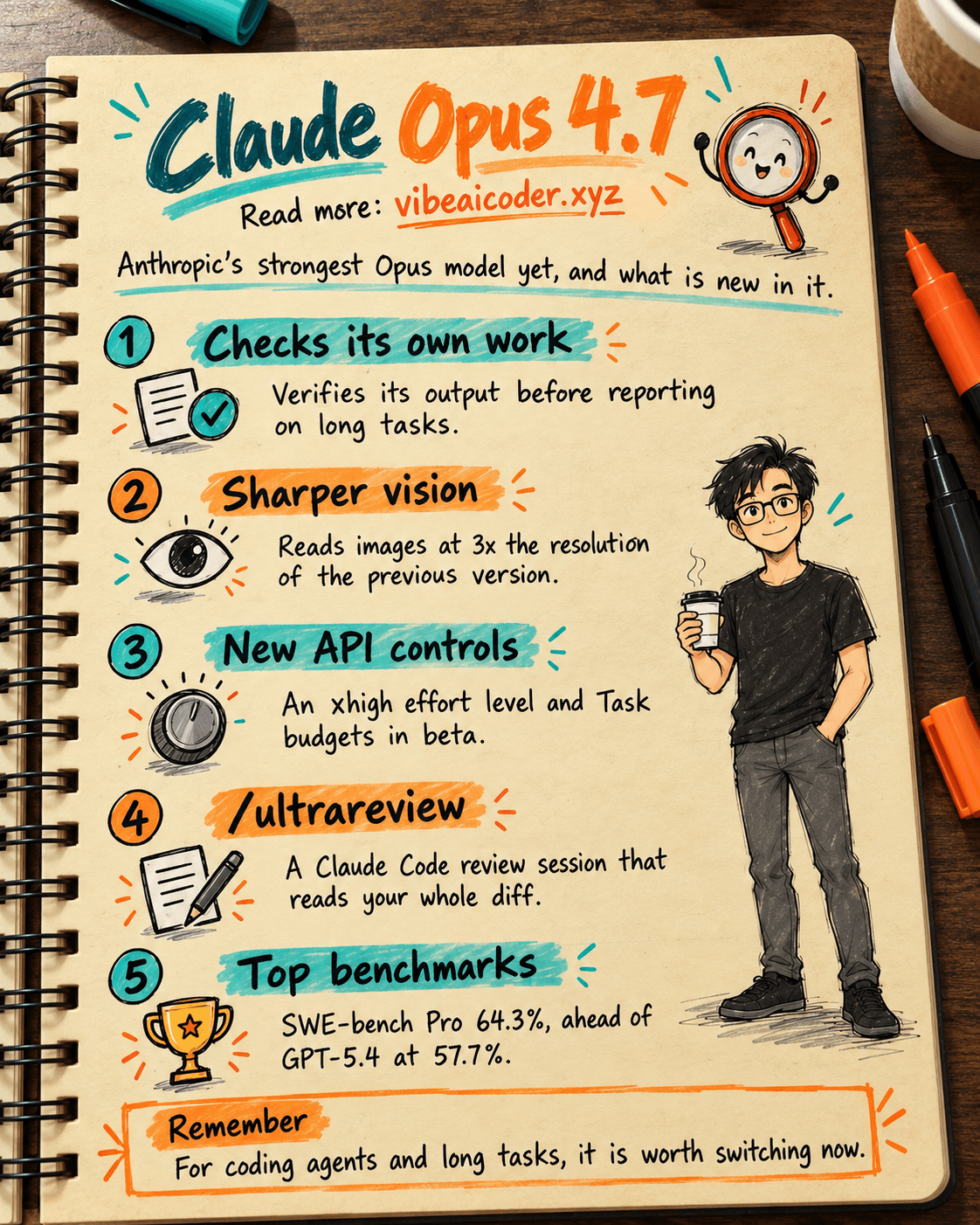
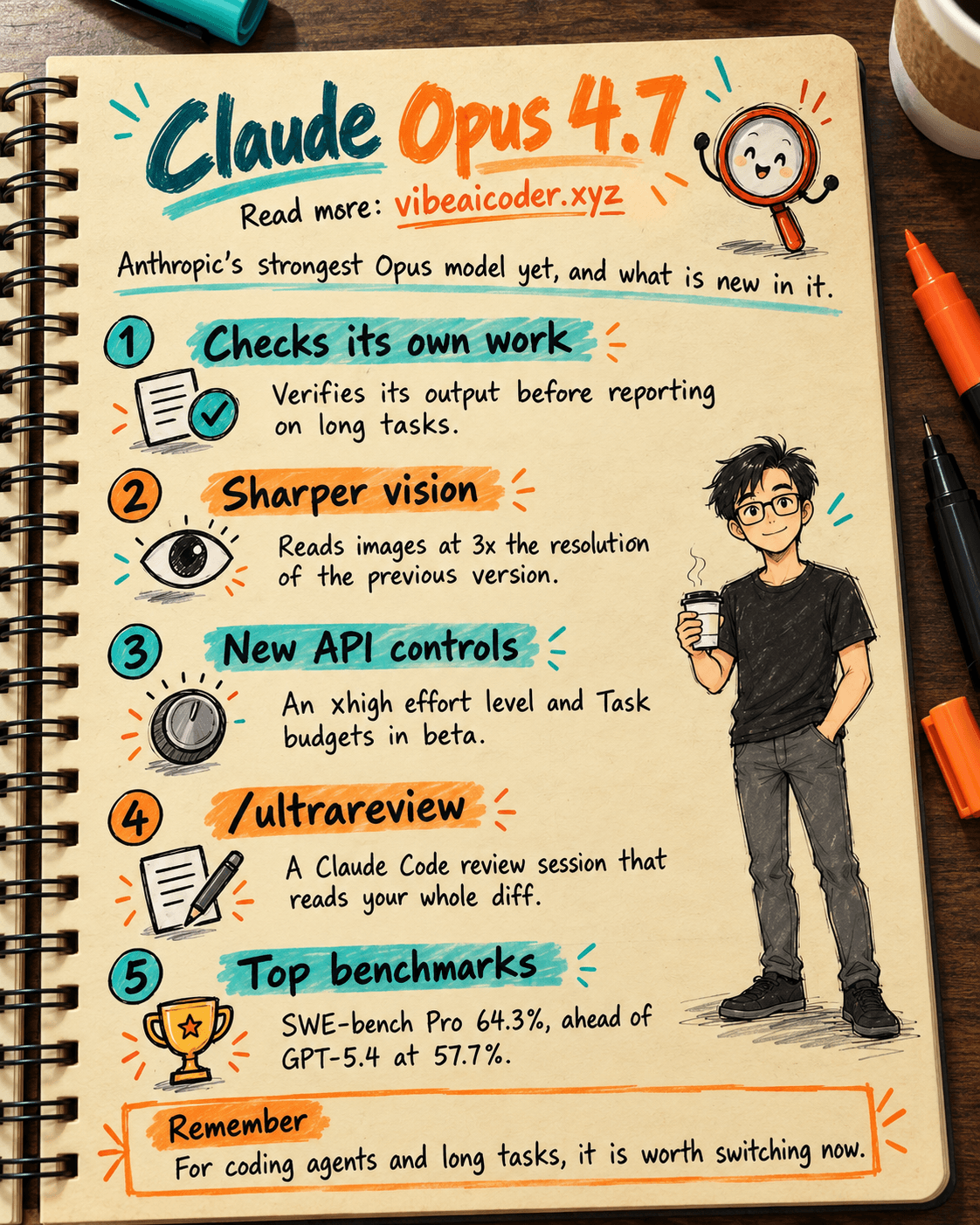
Opus 4.7 handles long horizon tasks far more rigorously, following instructions down to the smallest detail. The standout upgrade is that it now verifies its own output before reporting results, so you no longer have to double check every line yourself.
Supervision needs drop significantly, meaning you can hand off a task and go do something else while staying confident it'll get done right. It's a major leap in reliability, true "assign it and forget it" territory.
On the vision side, the model now reads images at 3x the resolution of the previous version. The payoff shows up when you ask it to generate interfaces, slides, and docs: the output is noticeably sharper and more polished.
New Firepower in the API
Anthropic added a new effort level called "xhigh", sitting between high and max. It's the sweet spot for tough problems, giving you finer control over reasoning and latency without having to push the model all the way to the costly max setting.
There's also Task budgets, now in beta. This feature lets Claude automatically prioritize work and manage costs across long runs. For anyone building agents or running big batch jobs, this feature alone is worth the upgrade.
In short, you now get two extra dials to tune the model to your needs, instead of just a simple on and off switch.
Claude Code Gets /ultrareview and a Smarter Auto Mode
Inside Claude Code, Anthropic shipped a new command called /ultrareview, and it's worth trying immediately. It's a dedicated review session where Claude reads through your entire diff and flags everything a sharp human reviewer would catch. Think of it as having a staff engineer review your PRs around the clock.
Auto mode has also been expanded for Max users. Long running tasks now need fewer interruptions, cutting down how often you have to step back in to confirm each step. The coding workflow feels noticeably smoother, especially during large refactors or framework migrations.
Both upgrades aim at the same goal: let developers move faster with fewer interruptions, without sacrificing quality.
Benchmarks That Crush the Competition
The numbers are the most exciting part. On SWE-bench Pro, Opus 4.7 scored 64.3%, compared to just 53.4% for Opus 4.6, 57.7% for GPT-5.4, and 54.2% for Gemini 3.1 Pro. Not even close.
SWE-bench Verified jumped to 87.6%, up from 80.8% on Opus 4.6. Terminal-Bench 2.0 hit 69.4%, showing serious strength in terminal based tasks.
On Humanity's Last Exam, Opus 4.7 scored 46.9% without tools and 54.7% with tools. MCP-Atlas reached 77.3%, leading the pack by a wide margin. OSWorld-Verified came in at 78.0%, and Finance Agent v1.1 hit 64.4%, also a category leader.
On academic knowledge benchmarks, GPQA Diamond scored 94.2%, CharXiv Reasoning hit 82.1% without tools and 91.0% with tools, and MMMLU reached 91.5%. Honestly, this model is rewriting the bar for the entire industry.
Is It Worth Switching Right Now?
If you're working on coding agents, automation, or long running tasks, the answer is yes, switch now. A 10 point gap on SWE-bench Pro is the difference between "usable" and "genuinely enjoyable to use."
For developers who vibe code, the /ultrareview command alone is reason enough to upgrade. You catch bugs before they ever get merged, saving yourself a lot of pain down the road.
So, have you tried Claude Opus 4.7 yet? Which benchmark impressed you the most?
More articles

AI Training vs Inference: What Is the Difference?

Gemini 4 Argon Reads a 500-Page Chemistry Patent in One Afternoon

Claude Opus 5.5 Codes a Real Money Trading Game in One Day

What Is a Token in AI? Why ChatGPT and Claude Charge by Tokens

What Is Chain of Thought? Why Asking AI to Think Step by Step Works Better

Claude Sonnet 5.5 vs GPT-6.1 Sol: Which AI Model Is Worth Using?