🤯 AI vs Traditional Programming: What CEOs and PMs Often Miss
You're rolling AI into your product, but you're still managing it like a regular software project. That is exactly why things keep going sideways and nobody can explain why.
Traditional programming: everything is predictable
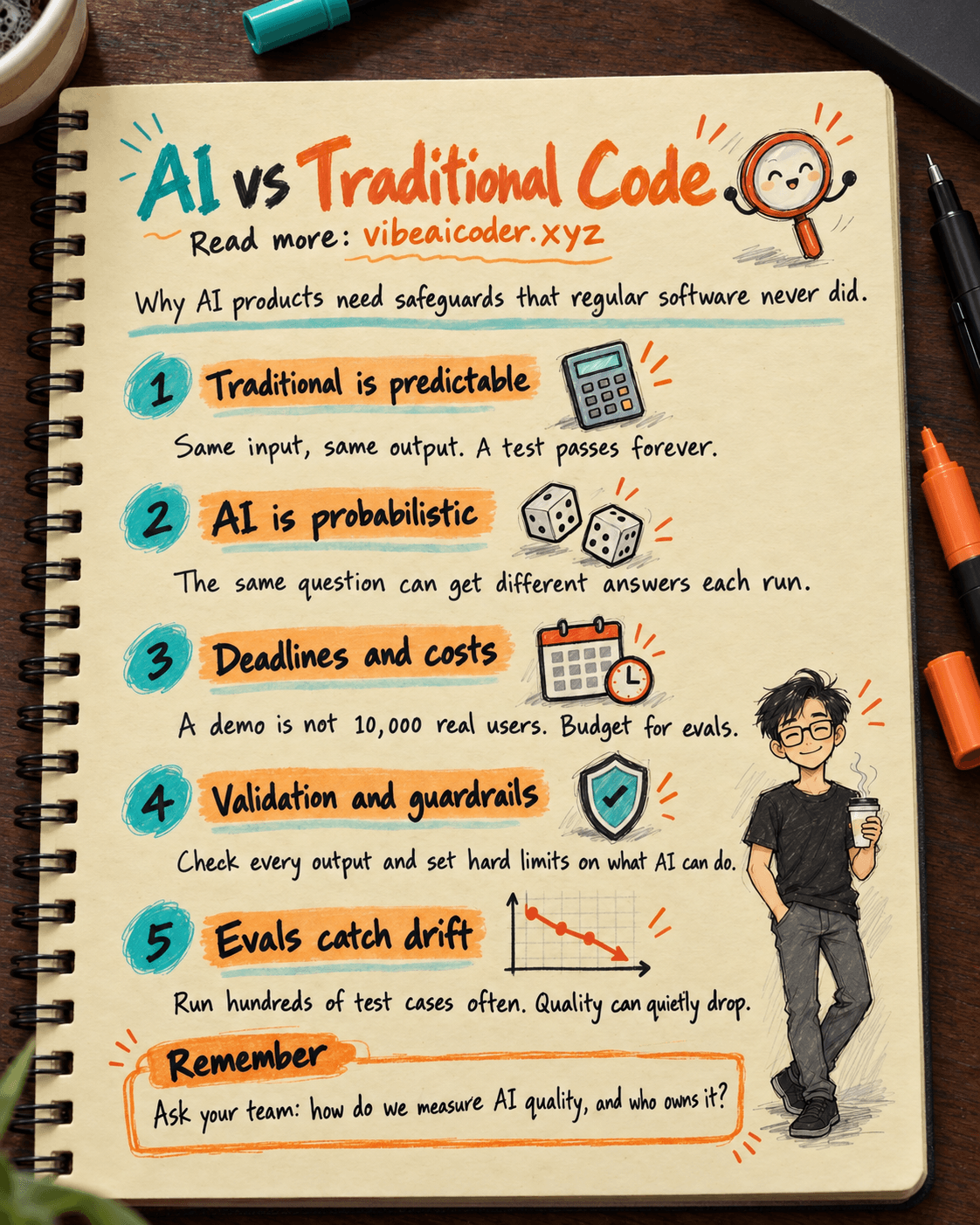
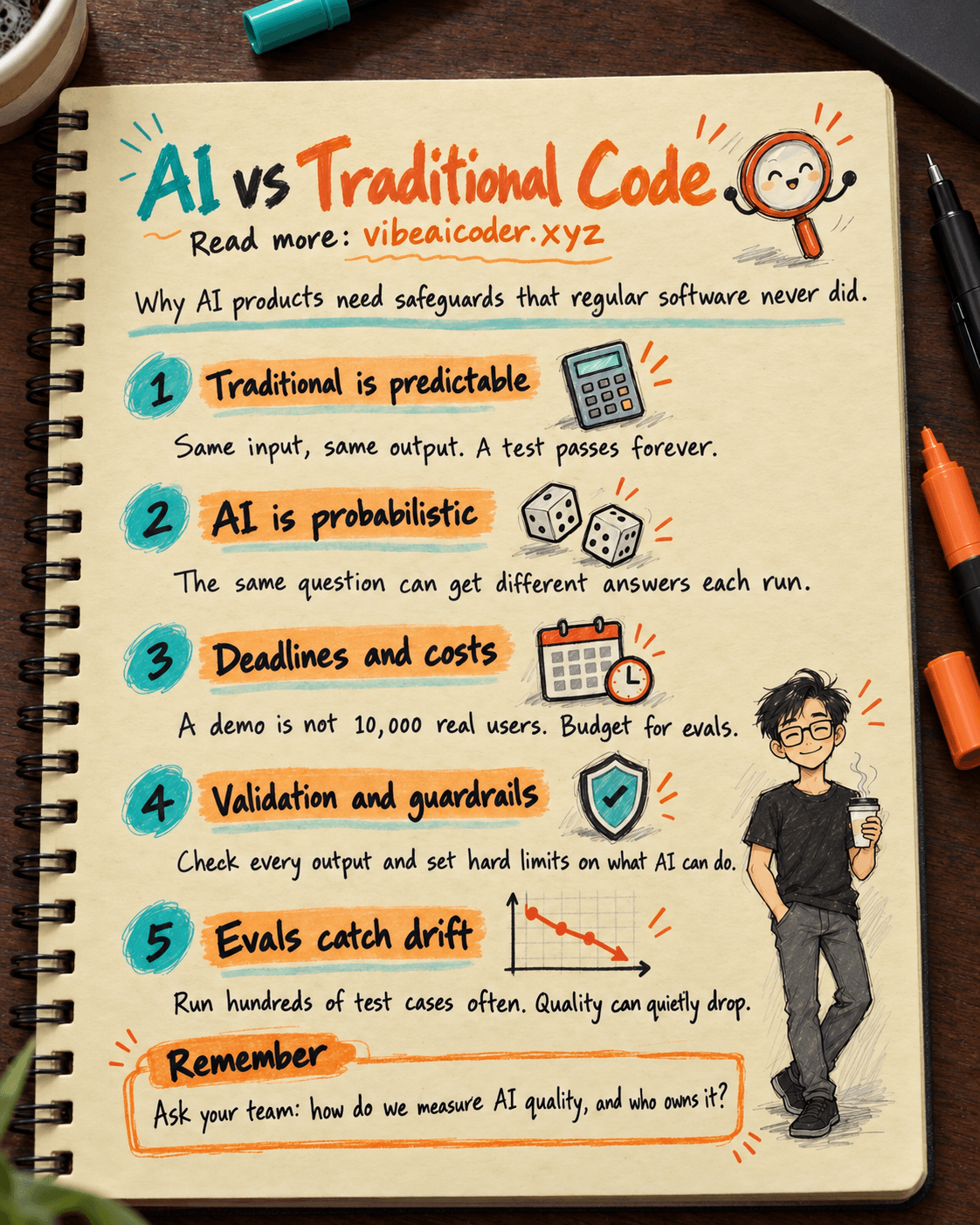
Traditional software runs on deterministic logic. The same input always produces the same output, no exceptions.
Click "Pay" with the correct details and the system always processes it correctly. Developers write a test once, and it keeps passing forever. When CEOs and PMs see a green dashboard, they feel completely at ease.
This is the world most tech leaders have lived in for years. It's also why they bring that same mindset to AI, and run into trouble.
AI works on a completely different mechanism
AI doesn't "look up" answers the way traditional software does. It uses probability to generate responses, which means the same question can get answered a dozen different ways across different runs.
Today the AI summarizes a contract with 98% accuracy. Tomorrow, with nothing changed, that number might drop to 91%. No warning. No error log. The system is still running, it's just running worse.
This is called non-determinism, and it's something most CEOs and PMs don't fully grasp before deciding to put AI into their product.
The most common bad decisions
Without understanding this, mistakes show up early in the project.
Deadlines get miscalculated. "The AI can do it, so let's ship it" ignores the gap between "works in a demo" and "stable with 10,000 real users and hundreds of edge cases." That gap is usually far wider with AI than with traditional software.
Costs get underestimated. Beyond building the feature, the team also needs infrastructure to continuously monitor AI output quality: an eval pipeline, monitoring, and human review at critical points. None of this exists in a traditional project, and it's often left out of the budget entirely.
Risk gets underrated. A wrong number in a financial report caused by an AI hallucination, a wrong answer sent to a customer, a decision based on an unchecked output: the consequences can be far worse than a typical software bug, because there's no clear error message to flag it.
The safeguards an AI product must have
Because AI is non-deterministic, production AI systems need things traditional programming almost never requires.
Validation checks every AI output before it reaches the user. Not whether the server is running, but whether the content the AI just generated is accurate, safe, and appropriate.
Guardrails are hard limits on what the AI is allowed to do or say. Like a new hire, no matter how talented, who still needs an approval process, AI can't be left to decide everything on its own in high stakes situations.
An evaluation pipeline runs hundreds of test cases regularly to measure output quality over time. Not a one time test, but continuous testing, because a model can "drift" (quietly get worse for no obvious reason) at any time.
The question CEOs and PMs should ask their team today
If your product already has AI in it, ask directly: "How are we measuring the quality of our AI output, and who's responsible when it drops?"
If the answer is silence, or "we just test it manually," that's a sign to fix things now, before it becomes a problem for real customers.
Understanding the technology you're using isn't just a developer's job. It's a leadership edge in the AI era.
More articles

AI Training vs Inference: What Is the Difference?

Gemini 4 Argon Reads a 500-Page Chemistry Patent in One Afternoon

Claude Opus 5.5 Codes a Real Money Trading Game in One Day

What Is a Token in AI? Why ChatGPT and Claude Charge by Tokens

What Is Chain of Thought? Why Asking AI to Think Step by Step Works Better

Claude Sonnet 5.5 vs GPT-6.1 Sol: Which AI Model Is Worth Using?