🧑💻 What Claude Code Learned From OpenClaw
Have you ever wondered how a personal side project could push an AI giant like Anthropic to rework its entire product roadmap? The story of OpenClaw is one of the clearest examples of how much power a community can have.
A small spark that lit a global craze
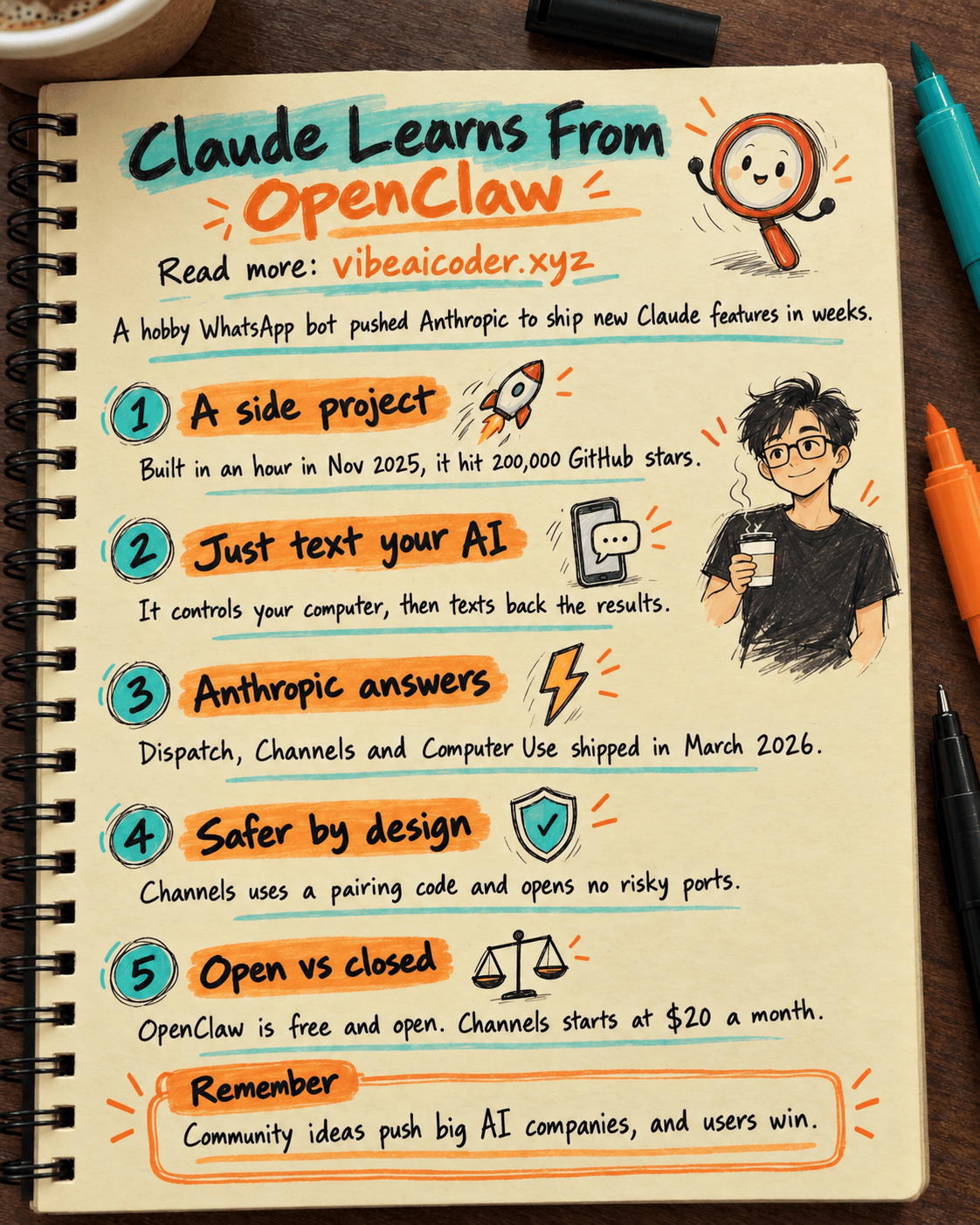
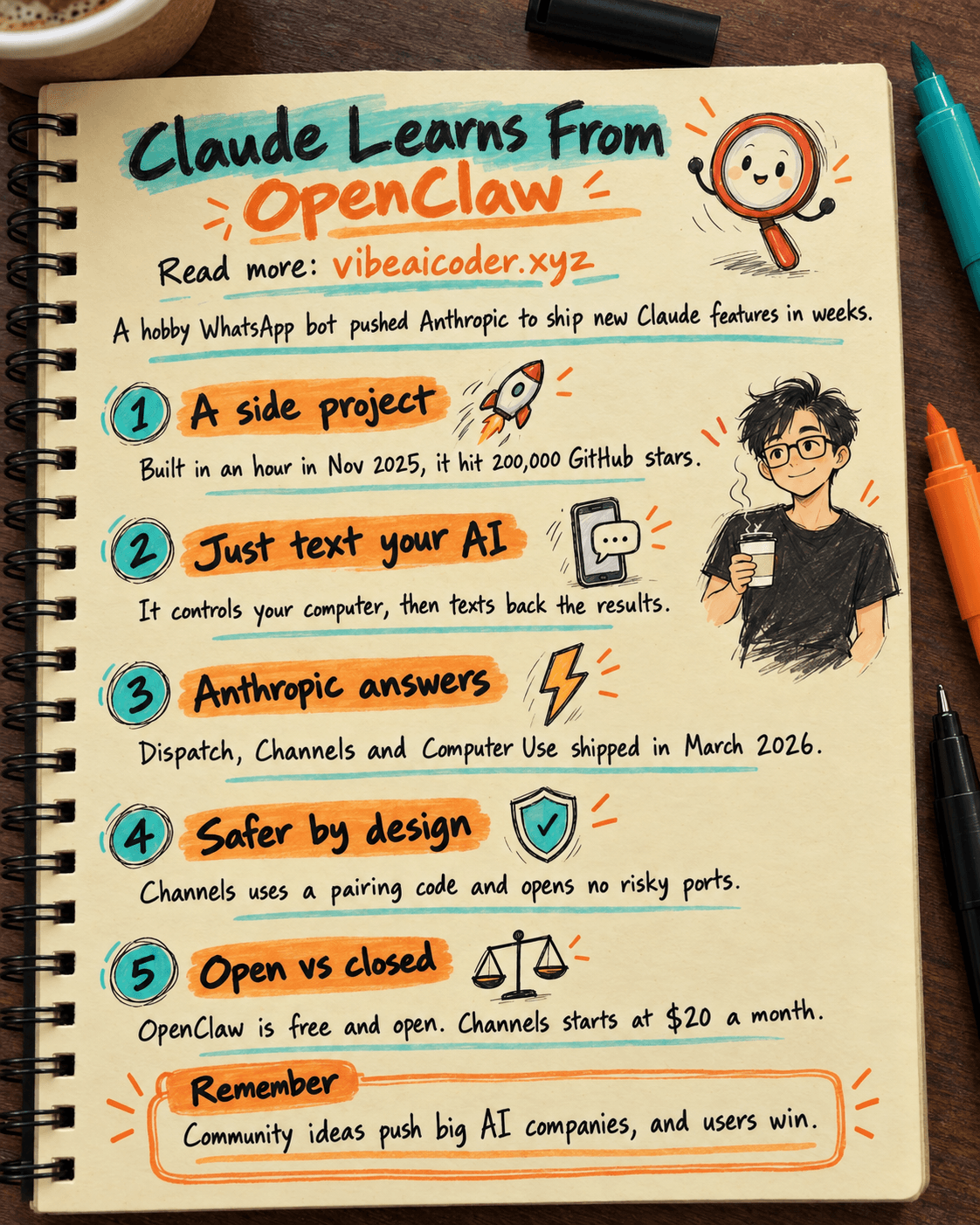
It all started in November 2025. Peter Steinberger, an Austrian developer, did something that sounded almost trivial. In just about an hour, he wired WhatsApp up to Claude Code. He originally named the project Clawd, as a nod to the AI model running underneath it. Anthropic quickly sent a cease and desist letter over the trademark, so the project was renamed OpenClaw. Instead of being killed off by the legal pushback, it exploded even harder. Within a few months it hit 200,000 GitHub stars. The craze got so big that Mac Minis sold out across the United States, as developers rushed to buy hardware just to keep an AI agent running around the clock.
Why "texting" might be the future of productivity
OpenClaw's appeal comes down to one very simple, very practical idea. You text your AI through WhatsApp, iMessage, Telegram, or Discord. It then actually takes control of your mouse and keyboard to get work done on your computer. Once it's finished, it texts you back with the results. No need to sit and watch a screen. No need for a complicated interface. This is the leap from an AI that answers questions to an autonomous AI collaborator, turning a chatbot into something closer to a real employee. The wave was big enough to spawn a string of forks, including Nvidia's NemoClaw, plus KiloClaw and NanoClaw. Even Chinese giants like Tencent, Alibaba, and Baidu started folding the idea into their own products.
Anthropic's lightning fast counterattack
Anthropic was never going to sit back and watch its own model get repackaged by the community. In January 2026, it quietly launched Claude Cowork for direct file management. On March 17, it shipped Claude Dispatch to fill the remote control gap, exactly the feature that had made OpenClaw so successful. Just three days later, on March 20, Claude Code Channels officially launched with Telegram and Discord integration, all running on MCP (Model Context Protocol), the open standard Anthropic itself created and later donated to the Linux Foundation to make it a shared language across the AI industry. The high point came on March 23 with Computer Use, letting Claude open apps, click, and navigate a browser fully on its own, with no clunky setup required.
A costly lesson in system security
Even while learning from the community, Anthropic was smart enough to fix OpenClaw's biggest weak spot: security. OpenClaw was notorious for its risky, overly broad file system access. Claude Channels takes a different approach. It authenticates through a pairing code that locks the bot to a specific user account, it doesn't open any risky connection ports, and it ships with real documentation on defending against prompt injection attacks. That gap is exactly what separates a scrappy personal tool from a solution safe enough for large companies to actually trust. Anthropic took a wild, community-born idea and turned it into a professional, reliable product.
Open source versus a closed ecosystem
Still, OpenClaw is far from dead. The project supports more platforms, including Signal, Slack, and Microsoft Teams. It's completely free and open source, so you can run it with any AI model you like, even fully offline for maximum privacy. Claude Channels, on the other hand, requires a subscription starting at $20 a month, and it locks you into Anthropic's own infrastructure. It's a genuinely interesting race: one side is a community chasing real, practical needs, and the other is a big company learning fast to raise the bar. In the end, it's users who benefit the most from this kind of intense competition. A future where AI just handles the work for you is already here.
Would you pick OpenClaw's freedom, or the polish of going all in on Claude?
More articles

Gemini 4 Argon Reads a 500-Page Chemistry Patent in One Afternoon

Claude Opus 5.5 Codes a Real Money Trading Game in One Day

What Is a Token in AI? Why ChatGPT and Claude Charge by Tokens

What Is Chain of Thought? Why Asking AI to Think Step by Step Works Better

Claude Sonnet 5.5 vs GPT-6.1 Sol: Which AI Model Is Worth Using?

 Claude Opus 5.5 Launches: 30% Faster, 40% Cheaper, Blocks AI Brain Copying