 How a Procurement Manager Used Claude Code to Compare 5 Vendor Quotes in 30 Minutes
You are staring at 5 PDF quotes from 5 different vendors. Each one uses a different format, a different pricing structure, and pages of dense legal terms. Your boss asks "which vendor should we pick?" and you already know you are about to lose two days reading line by line, retyping everything into Excel, and still worrying you missed some trap clause buried in the fine print.
As of April 2026, procurement teams have found a faster and more reliable way to do this, one that takes about 30 minutes instead of two days.
😫 The procurement manager's daily pain
Comparing 5 vendor quotes by hand is a familiar nightmare. Vendor A prices per unit, Vendor B prices by package, and Vendor C hides a setup fee in an appendix on page 12. You end up retyping everything into a spreadsheet, then still have to carefully read each vendor's payment terms, SLA, warranty, and penalty clauses.
On average, a procurement manager spends 1.5 to 2 days on a single full comparison. Worse, after hours of reading PDFs your brain gets tired, and the chance of missing a hidden fee or an auto-renewal clause goes up fast. Vendors know this, and some deliberately write confusing terms to take advantage of it.
 Claude Code reads vendor quotes with Vision OCR
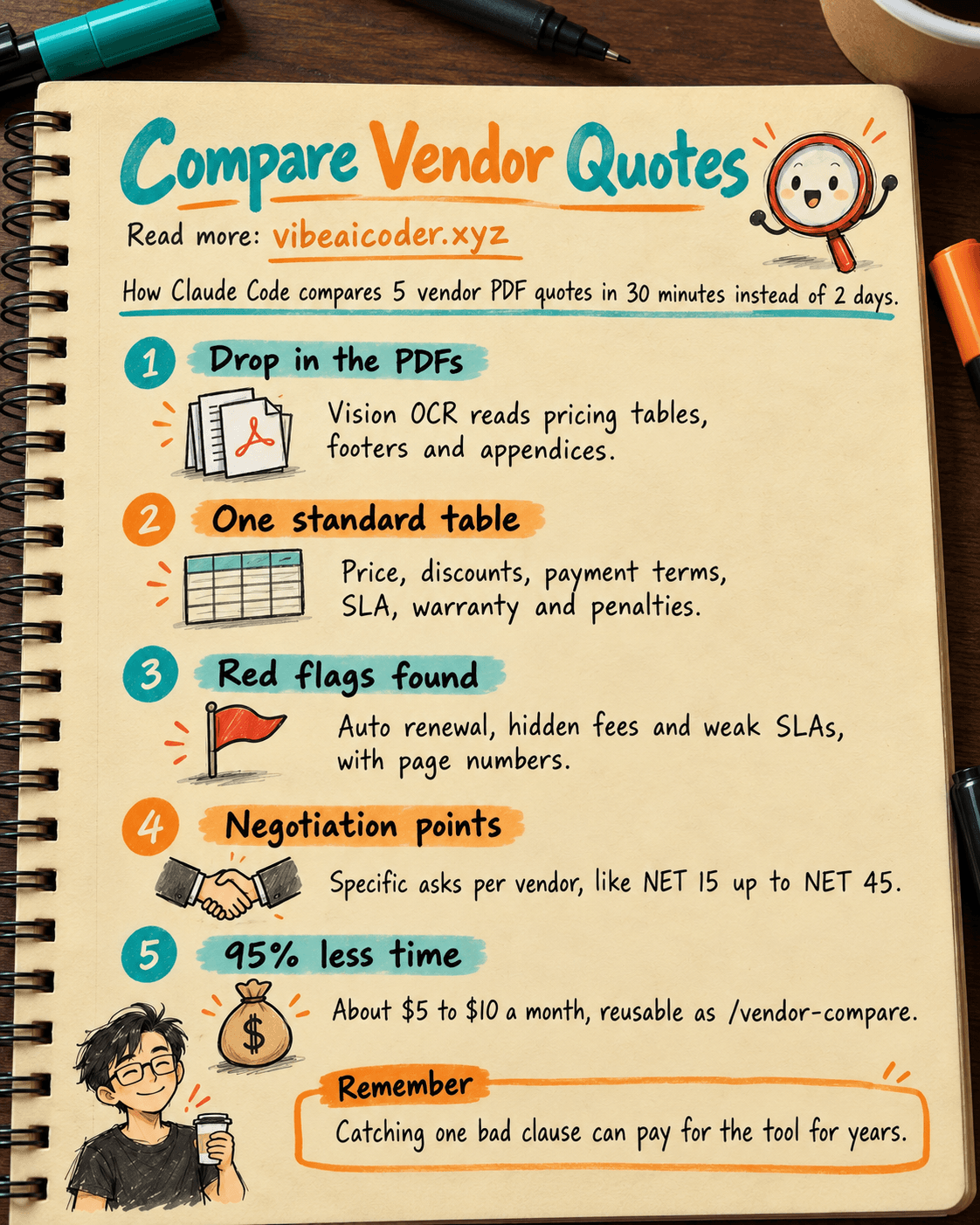
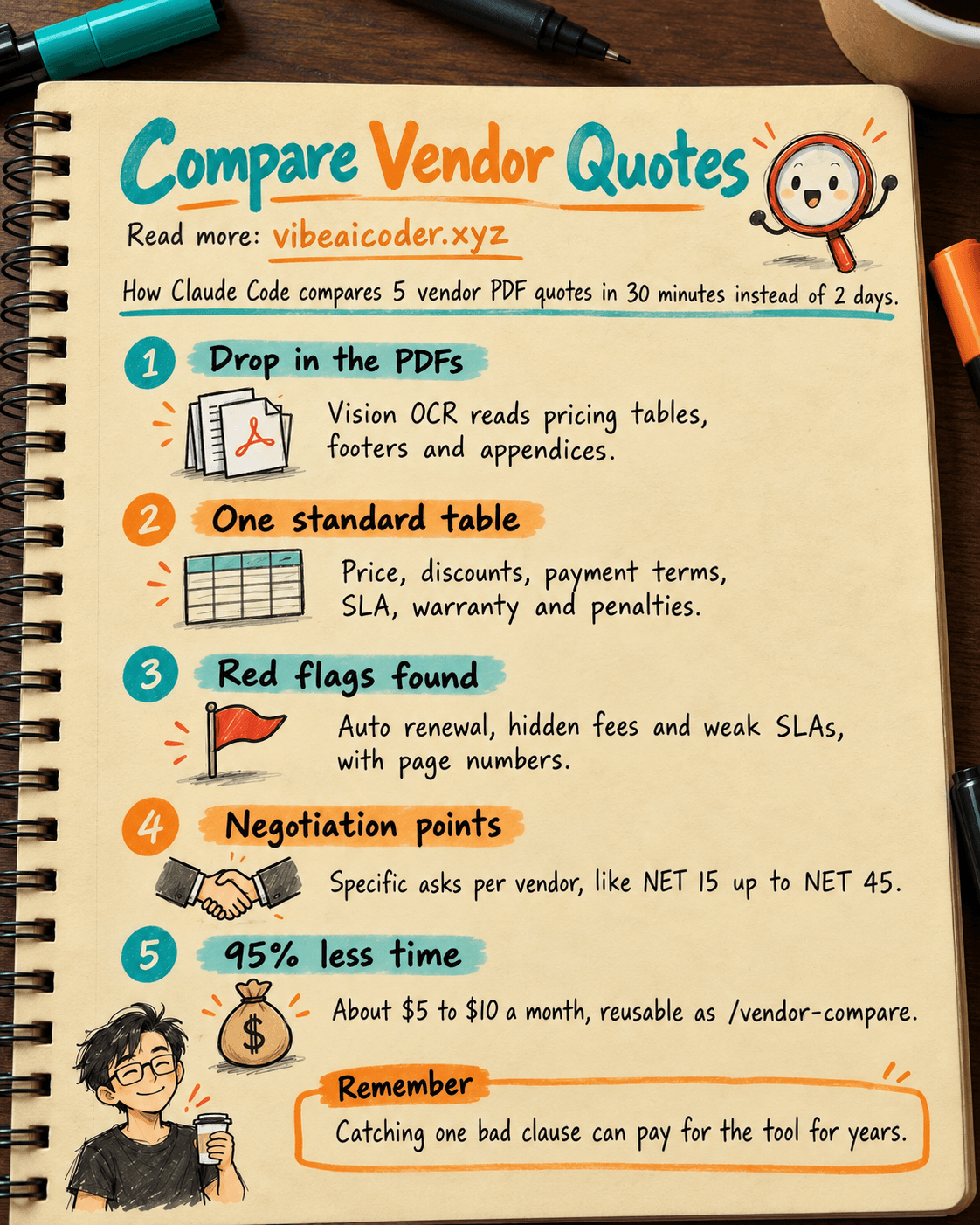
This is where the real time savings happen. Just drag and drop 3 to 5 vendor PDF quotes into Claude Code, no converting, no reformatting needed. Claude's Vision OCR can read complex pricing tables, tiny footer text, and clauses tucked away in appendices.
Claude understands business context, not just raw text. It can tell the difference between list price, discounted price after a volume tier, and extra fees added on top. This used to be something only a trained human could do reliably, and now AI handles it in seconds per file.
An automatic, standardized comparison table
Once the data is extracted, Claude builds a standardized comparison table with all the columns that matter: price per unit, volume discount tiers, payment terms (NET 30, NET 60, prepaid), delivery time, warranty period, SLA response time, and penalty clauses for vendor breaches.
The key is that every vendor gets converted to the same unit of measurement. No more Vendor A pricing by month, Vendor B by year, and Vendor C by number of users. One glance and you can see who is more expensive, who is cheaper, who is flexible, and who is rigid.
🚩 Red flags get exposed automatically
This is where Claude really shines. It automatically flags red flags that are easy for a human eye to miss: an auto-renewal clause that kicks in after 12 months without notice, hidden fees buried under "ancillary services," a weak SLA response time (48 hours when the industry standard is 4), or a one-sided penalty clause that only punishes the buyer.
Claude also points to the exact paragraph in the PDF where the trap sits, and which page, so you can double check it yourself. No more signing a contract and discovering three months later that you are locked into a three-year commitment.
 Negotiation points for each vendor
After the analysis, Claude generates specific negotiation points for every vendor. For example: "Vendor A has the best price, but NET 15 payment terms are too tight, consider negotiating up to NET 45." Or: "Vendor C's warranty is only 6 months while the market standard is 12, push for an extension."
You walk into the negotiation with full data in hand, knowing exactly which vendor has room to lower price, which one is strong on service, and which one is eager to close the deal. Claude also highlights the best overall deal based on the weights you define, whether you prioritize price, SLA, or delivery time.
 ROI and running cost
You can turn this into a reusable skill called /vendor-compare that runs right in the terminal, ready for every future bidding round. Claude Code typically costs only about $5 to $10 a month if you run a few comparisons per week.
The ROI is clear: a 95% reduction in time spent comparing quotes (from 2 days down to 30 minutes), better deals thanks to a full 7 dimensional analysis instead of just looking at price, and most importantly, avoiding trap contracts that could cost hundreds of millions in damages. Catching just one bad clause can pay for the tool for years.
Have you ever signed a vendor contract only to discover a trap clause later? If you had Claude Code from the start, how different would that outcome have been?
More articles

Gemini 4 Argon Reads a 500-Page Chemistry Patent in One Afternoon

Claude Opus 5.5 Codes a Real Money Trading Game in One Day

What Is a Token in AI? Why ChatGPT and Claude Charge by Tokens

What Is Chain of Thought? Why Asking AI to Think Step by Step Works Better

Claude Sonnet 5.5 vs GPT-6.1 Sol: Which AI Model Is Worth Using?

 Claude Opus 5.5 Launches: 30% Faster, 40% Cheaper, Blocks AI Brain Copying