 OpenAI Launches GPT-5.4 Mini and Nano: Cheaper, Faster AI Agents
Would you believe that for just a few cents, you could own an AI assistant capable of controlling a computer on its own, clicking and typing almost as smoothly as a human?
The Rise of the "Tiny Giants"
On the morning of March 21, 2026, OpenAI shook up the tech world by unveiling two new models, GPT-5.4 Mini and GPT-5.4 Nano. These aren't just stripped-down, memory-saving versions of the flagship model. They represent a real leap forward in AI agents, built with one goal in mind: near-zero latency when executing tasks and directly operating a computer interface (what OpenAI calls "Computer Use").
Lightning Speed, Heavyweight Specs
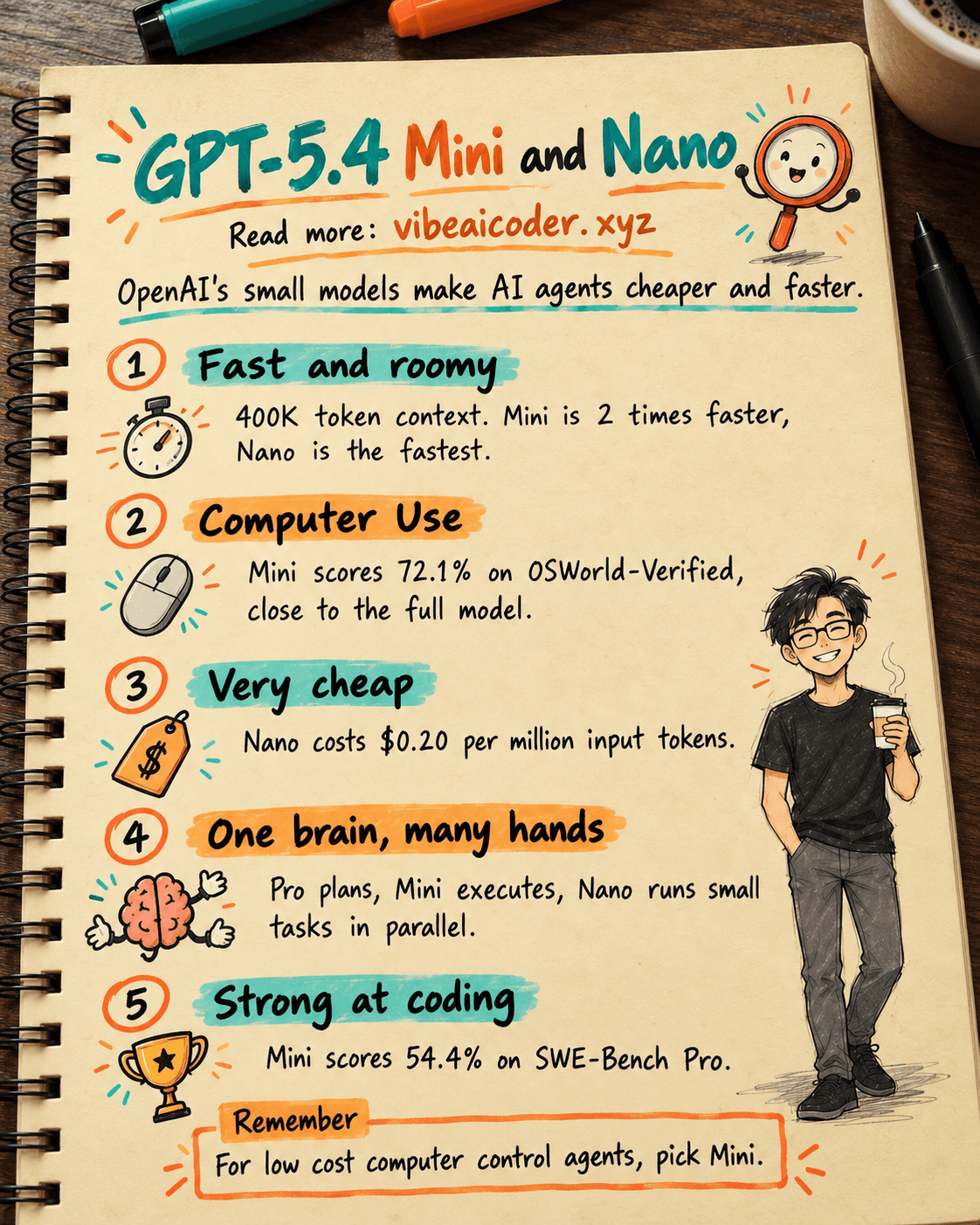
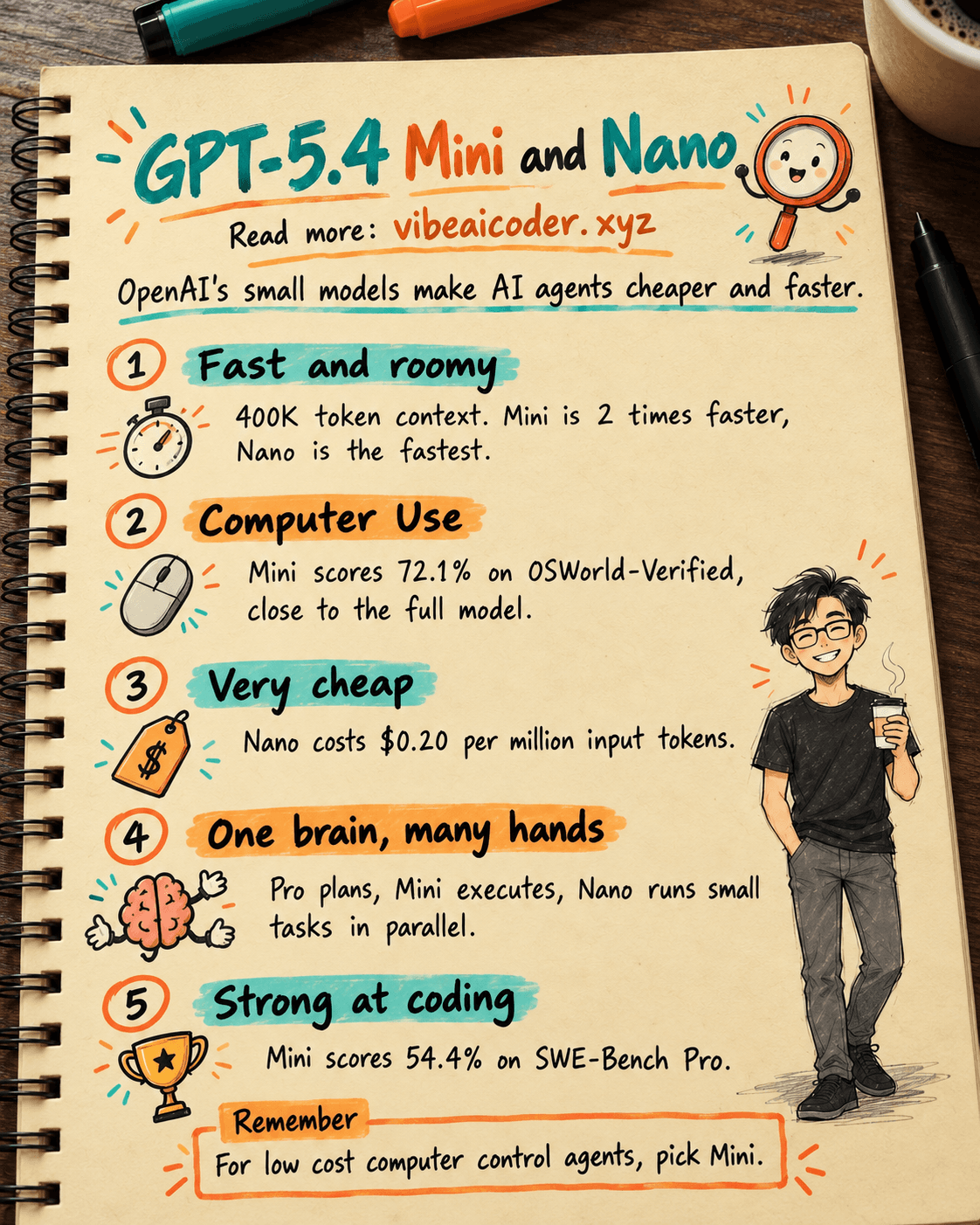
Despite being labeled Mini and Nano, the specs on this pair are enough to make rivals sweat. Both models come with a context window of up to 400,000 tokens, large enough to feed in an entire novel or dozens of dense code files and still have the AI understand everything in depth. GPT-5.4 Mini responds twice as fast as its predecessor, while the Nano version is now the fastest model in OpenAI's entire lineup, ideal for tasks that need an instant response.
Computer Control: A Turning Point for 2026
The real game changer is Computer Use. AI used to just answer questions, but now GPT-5.4 Mini scores 72.1% on the OSWorld-Verified benchmark, only 3 percentage points behind the full-size model. In other words, the Mini version delivers 96% of the flagship's power when it comes to understanding and operating a user interface. You can tell it to open Excel, pull together figures, send emails, or even book a flight on a website, all without lifting a finger.
Undercutting the Global AI Market
OpenAI seems intent on squeezing its competitors with aggressive pricing. GPT-5.4 Nano costs just $0.20 per million input tokens. To put that in perspective, using AI to describe and tag 76,000 high quality images now costs around $52, roughly ten times cheaper than it did a year ago. That's a huge win for developers and businesses looking to weave AI into their workflows without blowing the budget.
Strategy: One Big Brain, Many Small Hands
OpenAI is reshaping how we use AI through a multi-agent architecture. GPT-5.4 Pro/Full acts as the "chief architect," handling complex planning. GPT-5.4 Mini becomes the "executor," writing code and browsing the web. Finally, GPT-5.4 Nano serves as the "support layer," running dozens of small tasks in parallel, such as summarizing documents or classifying data in real time. It's a smoothly coordinated and remarkably smart system.
How It Stacks Up Against the Competition
On March 2026's leaderboard, GPT-5.4 Mini holds a clear lead in coding ability, scoring 54.4% on SWE-Bench Pro, ahead of both Claude 4.5 Haiku and Gemini 3.1 Flash. Gemini still leads on context length, handling up to 2 million tokens, but when it comes to UI interaction smarts and running costs, OpenAI currently holds the crown.
Which Model Should You Pick for Your Project?
If video and massive context windows are your priority, go with Gemini 3.1 Flash. If you need nuance, safety, and natural language polish, Claude 4.5 Haiku is still a strong contender. But if your goal is building next generation AI agents for automation (RPA) that can control a computer impressively well at the lowest cost, GPT-5.4 Mini is the top choice right now.
The AI world is changing by the day. Are you ready to put these "small hands" to work?
More articles

Gemini 4 Argon Reads a 500-Page Chemistry Patent in One Afternoon

Claude Opus 5.5 Codes a Real Money Trading Game in One Day

What Is a Token in AI? Why ChatGPT and Claude Charge by Tokens

What Is Chain of Thought? Why Asking AI to Think Step by Step Works Better

Claude Sonnet 5.5 vs GPT-6.1 Sol: Which AI Model Is Worth Using?

 Claude Opus 5.5 Launches: 30% Faster, 40% Cheaper, Blocks AI Brain Copying