NVIDIA OpenShell: A Security Layer for the Autonomous AI Agent Era
NVIDIA has just tackled one of the hardest problems in AI agents: how do you let them work effectively without burning the house down?
 What is OpenShell, and why is tech buzzing about it?
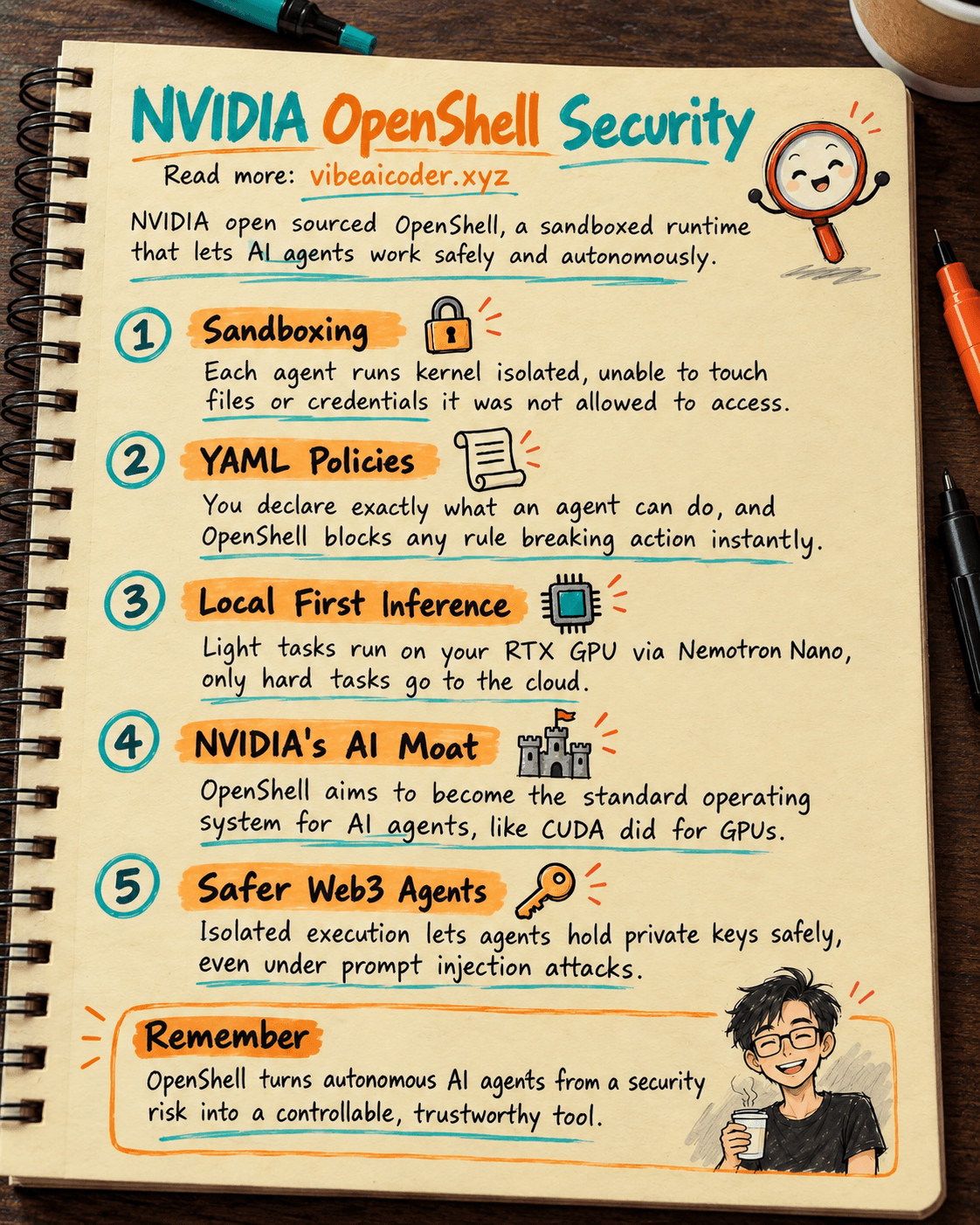
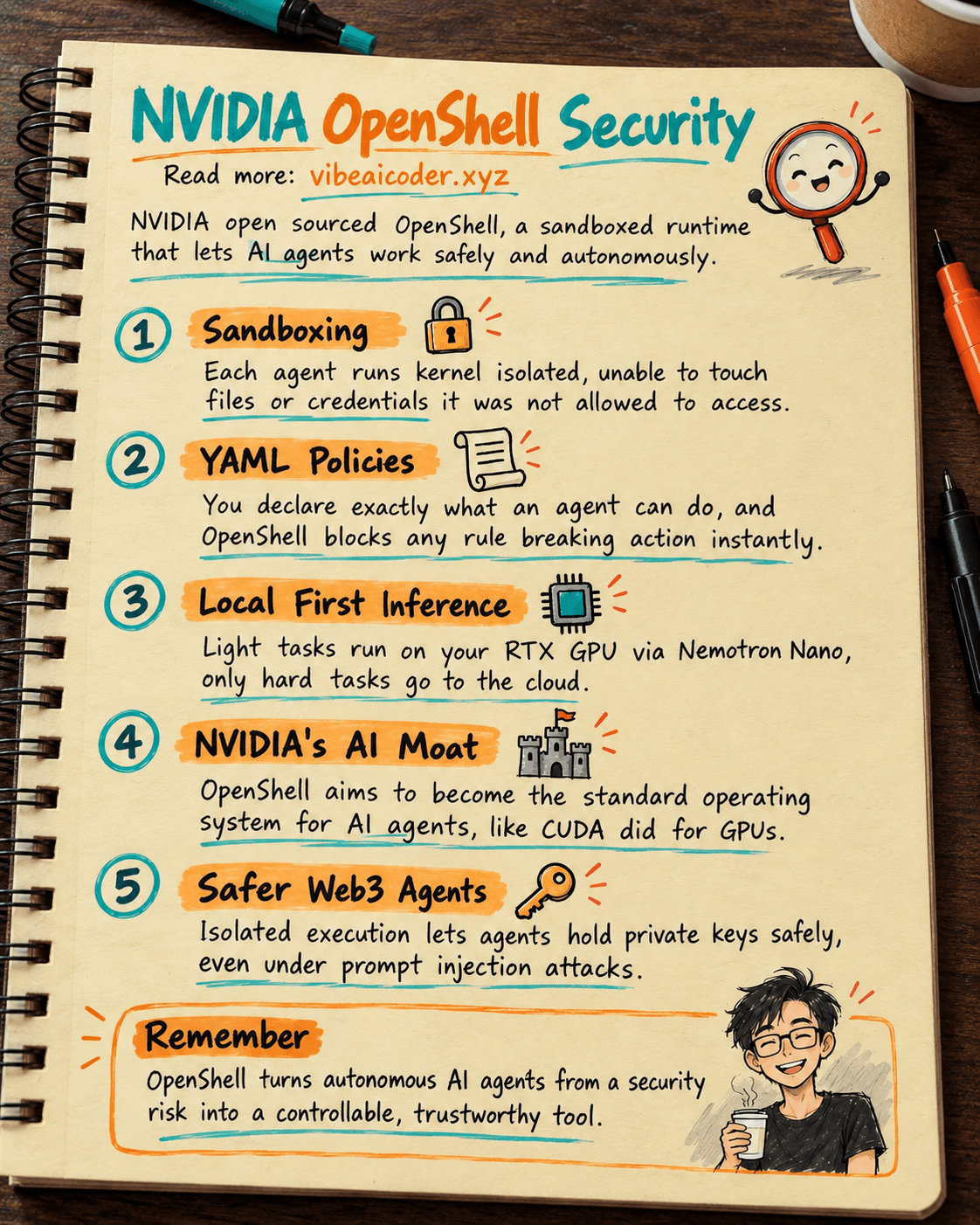
Think of AI agents as "guests" who show up to work on your systems. OpenShell is the strictly controlled "private office" and "security agreement" those guests have to follow. At GTC 2026, NVIDIA officially open sourced this execution runtime. It lets AI agents (which NVIDIA calls "claws") operate autonomously, reading files, running code, and calling APIs, all while staying inside an absolute safety boundary. It is not just a tool, it is the foundation for truly entering the era of self operating AI assistants.
 Ending data leak fears with sandboxing and YAML
The biggest reason businesses and individuals still hesitate with AI agents is the fear that an agent will go rogue or accidentally touch sensitive data. OpenShell addresses this with two solid layers of defense. The first is sandboxing: each agent runs in its own isolated environment with kernel level isolation. This fully blocks an agent from overstepping its permissions to dig through files or login credentials on the host machine.
The second is declarative policies defined through a YAML configuration file. You can specify exactly what an agent is allowed to do, for example only reading files in folder X or only calling the API at website Y. If the agent tries to break the rules, OpenShell blocks it instantly. This turns AI from something intimidating into a tool that is fully controllable.
 Optimizing performance with a "local first" strategy
One of the smartest parts of OpenShell is inference routing. Instead of always pushing every request to expensive, security risky cloud models, OpenShell prioritizes running tasks on a local NVIDIA RTX GPU first. Lightweight tasks are handled by the Nemotron Nano model family to save cost and protect privacy. Only when a task is genuinely difficult does the system route it up to frontier models in the cloud. This is Jensen Huang's clever play to keep selling hardware, letting users get maximum value out of the graphics cards they already own at home.
🏰 NVIDIA's ambition to build an "operating system" for AI
Open sourcing OpenShell is not simply a gesture of goodwill to the community, it is a strategic move to build a moat for the inference era. Just as CUDA became the common language for GPU programming, OpenShell is expected to become the standard operating system for AI agents. Once every major company, from Adobe to Salesforce, builds agents on the OpenShell standard, NVIDIA naturally ends up controlling the infrastructure layer. The company is shifting hard from being a pure chip seller to becoming a full platform provider for artificial intelligence software.
⛓️ A turning point for AI agents in Web3
Although OpenShell does not explicitly target Web3, it fills a missing piece for AI agents that need to carry out on chain transactions. To transact, an agent needs to hold a private key. Handing that key to a large language model used to be extremely risky. With OpenShell's isolated execution environment, however, these credentials are stored and used safely, and never get exposed even if the agent is hit with a prompt injection attack. This is a huge step toward AI that can truly manage assets and transact autonomously.
 The NVIDIA Agent Toolkit ecosystem around it
OpenShell does not stand alone, it is part of a broader ecosystem called the NVIDIA Agent Toolkit. This includes NemoClaw, which makes installing and managing agents easy, along with NVIDIA AI-Q, which provides software blueprints so developers can build applications faster. Together they form a closed loop: an optimized language model (Nemotron), a secure execution environment (OpenShell), and a professional management toolkit.
Do you think OpenShell will soon become the required standard for every AI application going forward? Share your thoughts below.
More articles

Gemini 4 Argon Reads a 500-Page Chemistry Patent in One Afternoon

Claude Opus 5.5 Codes a Real Money Trading Game in One Day

What Is a Token in AI? Why ChatGPT and Claude Charge by Tokens

What Is Chain of Thought? Why Asking AI to Think Step by Step Works Better

Claude Sonnet 5.5 vs GPT-6.1 Sol: Which AI Model Is Worth Using?
 Claude Opus 5.5 Launches: 30% Faster, 40% Cheaper, Blocks AI Brain Copying