Model, App, API: What Is the Difference? Claude Model vs Claude App vs Claude API
Model, App, API: What Is the Difference? Claude Model vs Claude App vs Claude API
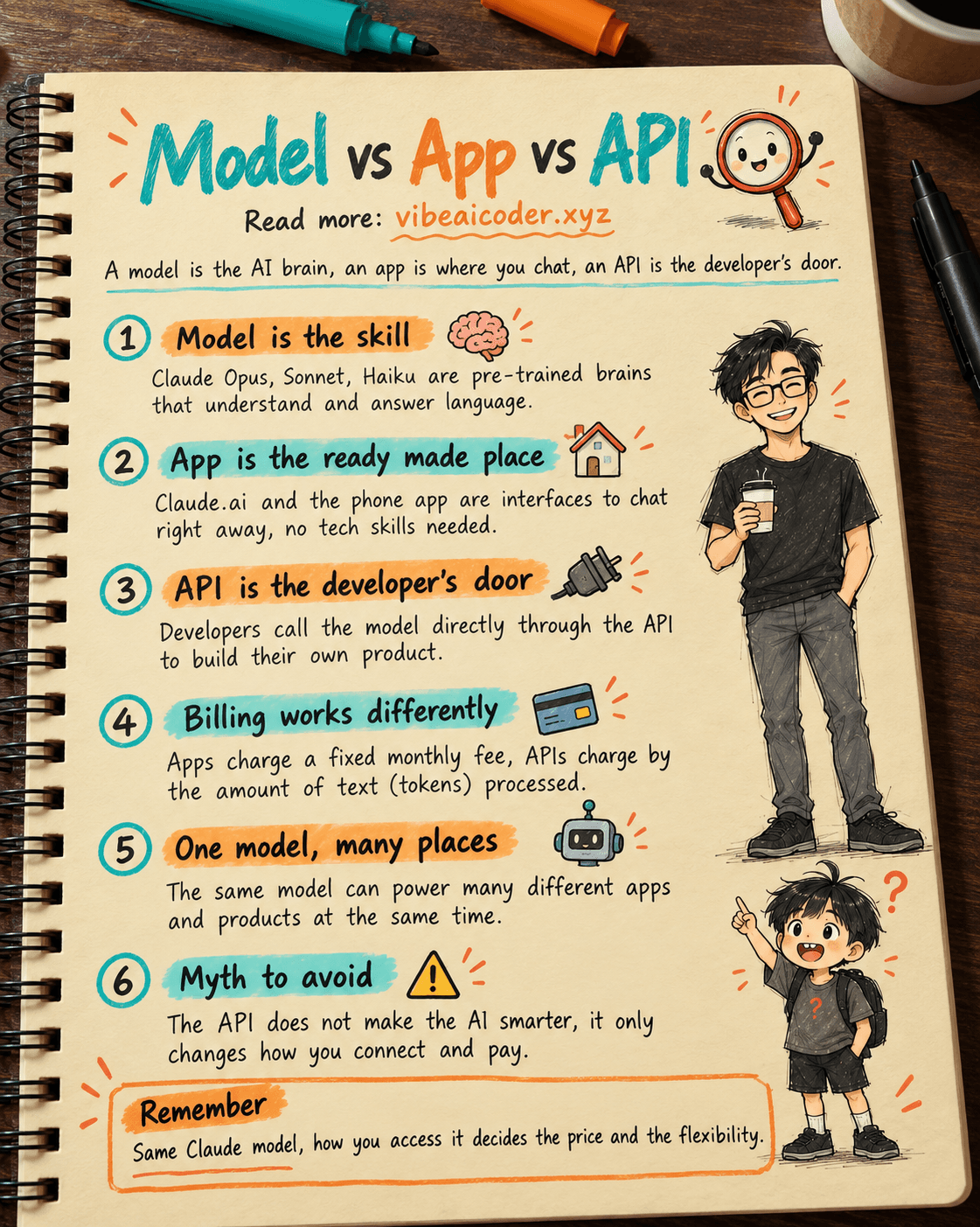
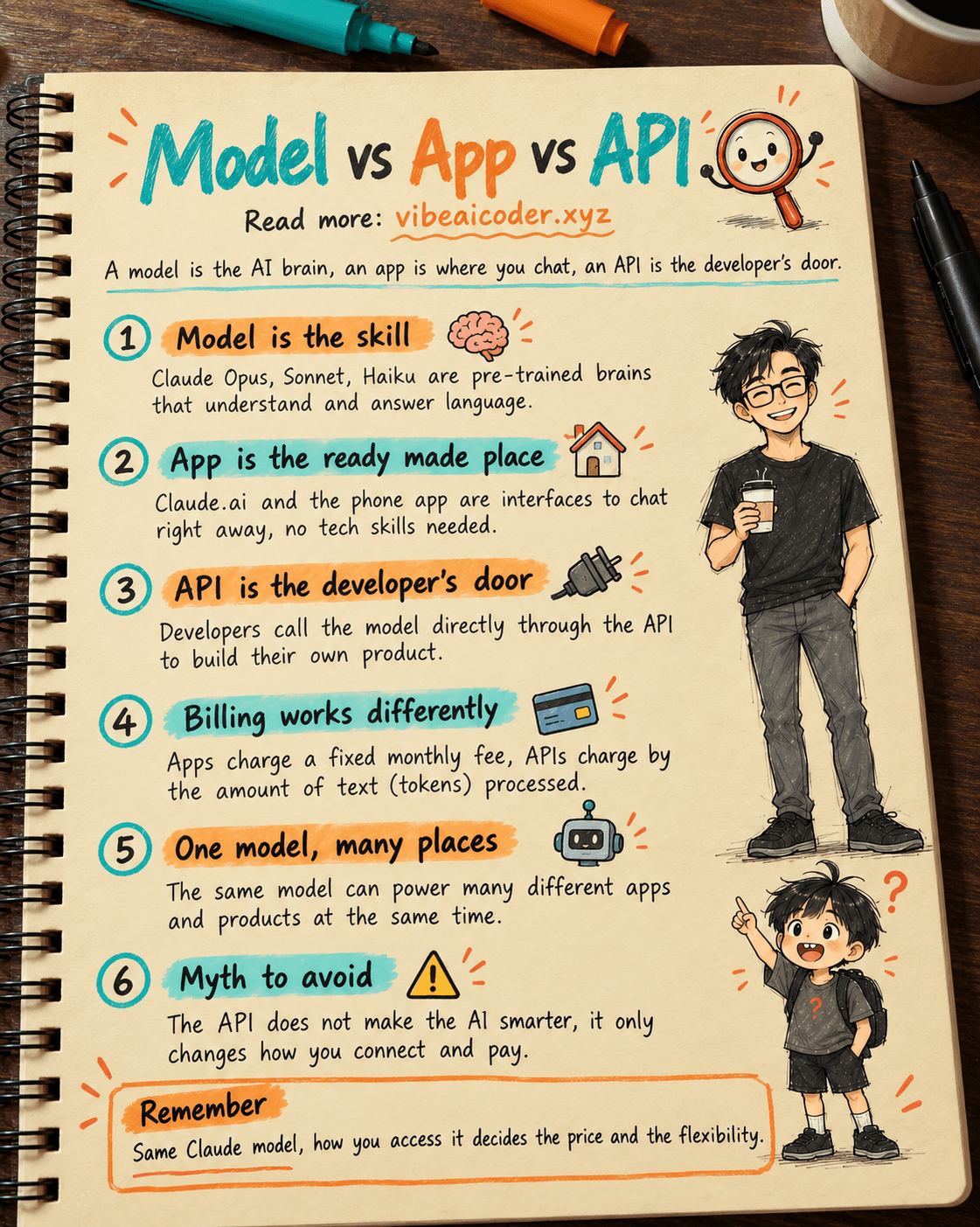
A model is the AI "brain" trained to understand and respond to language, an app is the interface that lets you talk to that brain, and an API is a separate door that lets developers plug that same brain into their own software. People often lump all three together under one name like "Claude" or "ChatGPT", but understanding the difference helps you pick the right tool for the right job, and stops you from being confused when you see different prices or version names in different places.
Understanding it with an everyday example
Think of Claude like a talented chef.
- The model is the chef's skill and knowledge, built up over years of training and practice. In AI terms, this is Claude Opus, Claude Sonnet or Claude Haiku, each version being a "chef" with a different skill level and speed.
- The app is like the restaurant where that chef works. You walk in, there are tables, a menu, a server bringing you food. This is Claude.ai on the web, the phone app, or Claude Code on your computer: you just open it and use it, no technical knowledge required.
- The API is like hiring that same chef privately to cook for your own restaurant or shop. You no longer go to their restaurant, you plug their skill directly into your own product: your own chatbot app, an internal tool, a website with a built in AI assistant. A developer writes a bit of code to "call" that chef whenever they need them.
It is the same underlying skill (the model), but how you access it (through an existing restaurant, or by hiring the chef yourself) changes the cost, the flexibility, and who it is suited for.
How it actually works
- The model is the pre-trained core. Companies like Anthropic (which makes Claude) and OpenAI (which makes GPT) train models on enormous amounts of text, using huge amounts of computing power and time. A model has no interface on its own, it is simply a system that takes text in and produces text out.
- The app is the interface layer built on top of that model. Claude.ai, ChatGPT, or the phone app are pieces of software that let you type questions, see your chat history, and upload files, all through friendly buttons and screens. Apps usually have a free tier and a paid monthly plan (like Claude Pro) for individual users.
- The API is the technical door that leads straight into the model, bypassing the app. A developer sends a piece of code (called a "request") containing the question, the model answers right away with data, and the developer decides how and where to display that answer.
- The API is billed by the amount of text processed (tokens), not by the month. Every API call is charged based on how many tokens go in and how many come out, so cost depends on how much you actually use it, unlike an app's fixed monthly fee that covers unlimited reasonable use.
- The same model can sit behind many different apps. For example, Claude (the model) does not only run inside Claude.ai, many other companies also use it through the API to build sales chatbots, writing assistants, or features inside their own accounting software, as long as they pay for API usage.
What this means for you
- If you just need to chat, write, or ask questions day to day: the app is enough, you do not need to think about the API at all. Open Claude.ai or the phone app, subscribe to a paid plan if you need more usage, and that is it.
- If you run a shop and want a chatbot that automatically answers customers on your Facebook Page: this is when you need the API, because you need to connect AI to your own system (like Messenger), which a regular app like Claude.ai cannot do by itself. This usually requires a developer or a service that builds it for you.
- Whether you access a model through the app or through the API, pay attention to the version name (for example, Claude Opus for hard tasks that need deep reasoning, Claude Haiku for simple tasks that need fast, cheap answers). The model name is the same whether you go through the app or the API, because the underlying "skill" is one and the same.
- If you see two different prices quoted for "the same AI", it is likely that one is the app's monthly price and the other is the API's pay per use price. Read carefully to understand what you are actually paying for before comparing.
Common misunderstandings
- "Using the API makes the AI smarter than the app." Not true. The model is the same, and the answers are essentially the same if you pick the same model version. The API only differs in how you connect and how you are billed, it does not make the AI "better".
- "The app and the API are two different AIs." Not true. The app is just the interface wrapped around the model, and the API is a direct path into that same model. In fact, the app is also "calling" the model through a similar kind of connection behind the scenes, you just never see that code.
- "You need to know how to code to use AI through the API." It is true that building software that calls the API requires programming knowledge, but the end user of that product (for example, a customer chatting with a bot on a Facebook Page) does not need to know anything, they just see an ordinary chat window.
FAQ
Are Claude Opus, Sonnet, and Haiku different models or different apps? This is a difference at the model level. All three can be accessed through the same app (Claude.ai) or the same API, you simply choose the model version that fits the task.
If I use the Claude.ai app, am I "using the API"? Technically, Anthropic's own app also connects to the model through an internal system similar to an API, but you do not need to worry about that. "Using the API" in this article specifically means a developer calling the model directly to build their own product, not you opening an app to chat.
Why do companies sell the app and the API separately instead of one combined price? Because they serve two different kinds of customers: individual users who want a fixed monthly price to chat freely, and businesses building their own products who need to pay exactly for what they use, whether that is very little or a lot.
Can I use both the app and the API at the same time? Yes. The two are completely independent, you can pay for Claude Pro to chat daily for yourself, while your company (or you) separately pays for API usage to run a different automated chatbot, with no effect on each other.
If I am not a developer, do I need to learn how to use the API? No, unless you want to build your own AI powered product or business tool. For most users, understanding the app and choosing the right model version to chat with is enough.
Understanding these three layers makes it much easier to read anything about AI: whenever someone says "Claude", ask yourself whether they mean the model, the app, or the API, and the answer will usually become clear right away.
More articles

Gemini 4 Argon Reads a 500-Page Chemistry Patent in One Afternoon

Claude Opus 5.5 Codes a Real Money Trading Game in One Day

What Is a Token in AI? Why ChatGPT and Claude Charge by Tokens

What Is Chain of Thought? Why Asking AI to Think Step by Step Works Better

Claude Sonnet 5.5 vs GPT-6.1 Sol: Which AI Model Is Worth Using?

 Claude Opus 5.5 Launches: 30% Faster, 40% Cheaper, Blocks AI Brain Copying