📒 MiroFish's Prediction Methodology Explained
📒 Have you ever wondered how society would actually react if a shocking event happened tomorrow? Instead of guessing or relying on old charts, the tech world is buzzing about a tool called MiroFish, which builds an entire "virtual society" so you can test drive future scenarios before they happen.
A 37,000 Star Sensation on GitHub
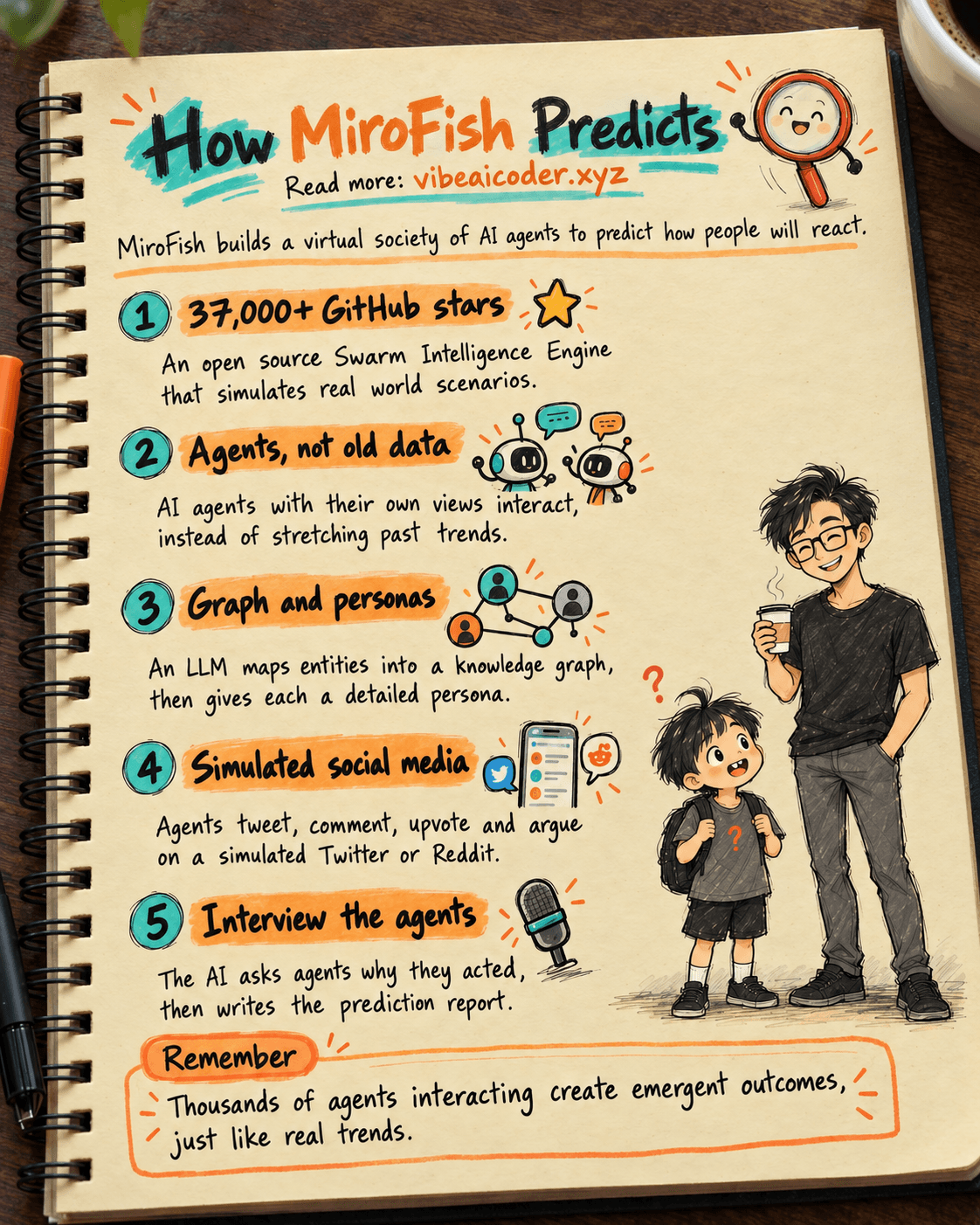
MiroFish is not just another AI tool. It is an open source Swarm Intelligence Engine project that has taken off with more than 37,000 stars on GitHub. Its appeal comes from how accurately it can simulate and predict real world scenarios. Instead of looking backward at the past, MiroFish looks at how people (or rather, their AI versions) interact with each other to figure out what happens next.
A Different Kind of Prediction: No Historical Data Required
Most forecasting tools today rely on extrapolation, taking past data and stretching the trend line into the future. MiroFish takes a different approach. The project uses agent based simulation. It creates AI agents with their own personalities and opinions, then lets them live and argue with each other inside a simulated environment. The final result does not come from a statistical formula, it comes from the natural social behavior of these agents.
How MiroFish Builds a "Virtual Society"
To predict an outcome, MiroFish runs through six carefully designed steps:
- Ontology generation. An LLM reads your source material and extracts the entities and the complex relationships between them.
- Graph building. MiroFish uses Zep Cloud to build a knowledge graph that connects all the pieces of information together.
- Agent profile generation. This is the most impressive part. Every entity gets an extremely detailed persona, covering everything from MBTI type, age, and occupation to political views and personal memories.
- Simulation execution. The agents are placed into a simulated social media "battlefield" (Twitter or Reddit), where they tweet, comment, upvote, and argue just like real people.
- Report generation. MiroFish uses a ReACT model (Reasoning plus Acting) to analyze how events unfold. The AI reasons through the data, queries information, and even "interviews" the running agents directly to understand why they acted the way they did.
- Final report. The system outputs a prediction report along with an interactive world you can explore yourself.
Why Would Robot Behavior Predict Human Behavior Correctly?
It sounds far fetched, but the logic is compelling. MiroFish's agents are built from real data. If a document describes a 30 year old engineer worried about inflation, the agent carries that same mindset into the simulation. When thousands of agents with different ideologies, preferences, and biases interact, the result is what is known as an emergent outcome. This is exactly how real world phenomena like viral social trends, media crises, and consumer trends actually form.
The "Detectives" Behind Every Report
To produce a high quality prediction, MiroFish relies on four powerful tools:
- InsightForge, which breaks down your question and searches the knowledge graph from multiple angles.
- PanoramaSearch, which gives a full picture of the situation, including older data that might otherwise get missed.
- QuickSearch, which quickly verifies new information as it comes up.
- InterviewAgents, the most unique feature of all. The AI directly asks agents inside the simulation questions like "why did you retweet that post?" which helps uncover the deeper motives behind every action.
In simple terms, MiroFish creates a "social laboratory" where you can test any scenario and learn from the mistakes without any real world consequences. What do you think about letting AI predict our own behavior?
More articles

Gemini 4 Argon Reads a 500-Page Chemistry Patent in One Afternoon

Claude Opus 5.5 Codes a Real Money Trading Game in One Day

What Is a Token in AI? Why ChatGPT and Claude Charge by Tokens

What Is Chain of Thought? Why Asking AI to Think Step by Step Works Better

Claude Sonnet 5.5 vs GPT-6.1 Sol: Which AI Model Is Worth Using?

 Claude Opus 5.5 Launches: 30% Faster, 40% Cheaper, Blocks AI Brain Copying