 Loop Engineering: How to Design an AI Coding Agent That Actually Works
Have you ever built an AI coding agent only to be disappointed that it just "answers once and stops"? The problem usually is not the AI model you picked, it is how you designed the loop.
 What Is Loop Engineering?
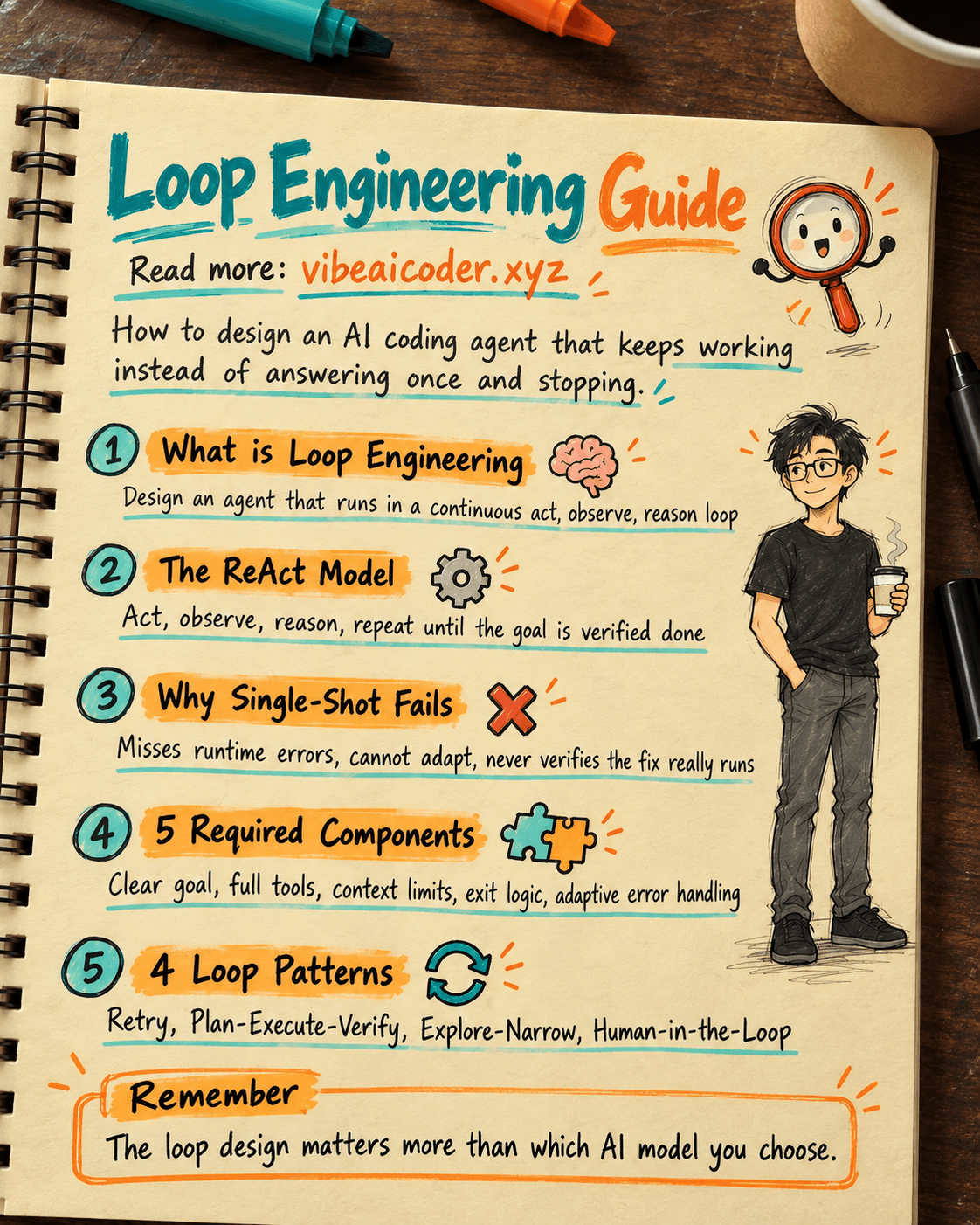
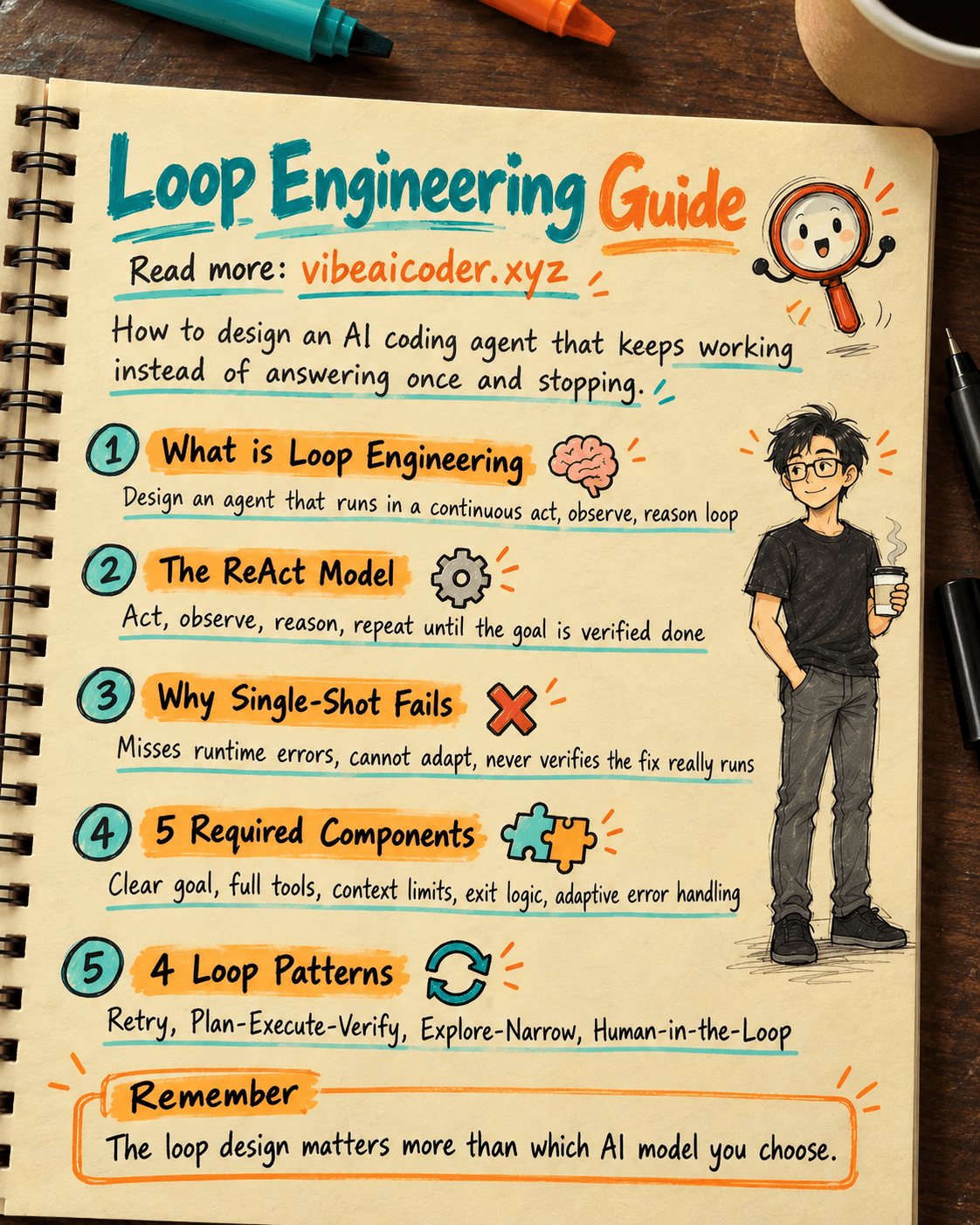
Loop Engineering is the practice of designing an AI coding agent to run in a continuous loop instead of responding once and stopping. This article draws on ideas from MindStudio, one of the most in depth sources on real agent architecture.
It sounds simple, but this is exactly the line between an agent that is "a nice demo" and one that "actually works in production." Most developers who are new to AI agents skip this part and then wonder why their agent keeps failing in real world situations.
 The Theoretical Foundation: The ReAct Model
It all starts with the ReAct (Reason + Act) model. Instead of just generating a block of code and handing it to the user to run, a ReAct style agent will:
- Take an action (run code, read a file, call an API)
- Observe the result coming back from the real environment
- Reason about the next step based on what just happened
- Repeat until the goal is reached
A standard coding loop looks like this: understand the goal, write code, run the code, observe the output or the error, reason about the cause, fix it, and try again. Sounds familiar? That is exactly how a skilled programmer works.
❌ Why Single-Shot Prompting Is Not Enough
Single-shot prompting, asking once and getting one answer back, has three serious problems that many people overlook.
First, it cannot catch runtime errors. Code can look syntactically correct but fail when it runs because of a specific environment, a dependency version, or real data that differs from the original assumptions.
Second, it cannot adapt to a specific environment. The same task can have a different path on one machine and different permissions on another server. The agent needs to observe and adjust, not guess blindly from the start.
Third, there is no way to verify that the solution actually runs. You get back a piece of code, trust that it is correct, and only discover it does not run once you deploy it.
 5 Required Components Of A Good Loop
To build a loop that genuinely works, you need all five of these components.
A clear, checkable goal: the agent needs to know what "done" looks like. Not "write a sort function" but "write a sort function, run these test cases, and finish once they all pass."
Complete tooling: the agent must be able to run code, access files, use the terminal, and call a test runner. Missing any one of these breaks the loop.
Context management: the token window is limited. A long running loop needs a strategy for summarizing or dropping old context so it does not overflow partway through.
Clear termination logic: both success and failure conditions. Without this, an agent can loop forever or stop too early.
Genuinely adaptive error handling: not just retrying the exact same thing again. The agent needs to analyze the error, change its approach, and try something different.
 4 Common Loop Patterns
Depending on the type of task, you will use a different pattern.
Retry Loop fits tasks with a simple pass or fail outcome. Run, fail, analyze the error, fix it, run again.
Plan-Execute-Verify is for multi step tasks that must happen in order. The agent plans ahead, executes each step, and verifies the result of each step before moving on.
Explore-Narrow is ideal for debugging or exploring a new API. The agent starts broad, tries several directions, then gradually narrows in on the direction that works.
Human-in-the-Loop is required for production changes that need approval. The agent works up to a certain point, then stops and asks the user before continuing.
 Conclusion: The Loop Matters More Than The Model
Here is the most important insight: the quality of an AI coding agent depends far more on how its loop is designed than on which underlying AI model you choose. Whether you use GPT-4o or Claude Sonnet matters less than whether you designed the loop correctly.
Loop Engineering is a skill that any vibe coder who wants to build an agent that truly works needs to learn. It is not prompt engineering, and it is not picking a better model, it is understanding how the loop works and designing it correctly from the start.
Where are you getting stuck when building your own AI coding agent's loop? Share it so we can debug it together.
FAQ
Is Loop Engineering the same thing as prompt engineering? No. Prompt engineering focuses on how you phrase a single request. Loop Engineering focuses on how the agent acts, observes, reasons, and repeats across many steps until the goal is verified as done.
Does a better model remove the need for loop design? No. A stronger model can reason better at each step, but without a well designed loop, clear termination logic, and proper tooling, it will still fail on real world tasks the same way a weaker model would.
Which loop pattern should I start with? Start with a Retry Loop for simple pass or fail tasks, then move to Plan-Execute-Verify once your task has multiple ordered steps that each need their own verification.
Why is Human-in-the-Loop still necessary if the agent works well? Because some actions, like changes to a production system, carry real risk. Pausing for human approval at the right point prevents a confident but wrong agent action from causing damage.
More articles

Gemini 4 Argon Reads a 500-Page Chemistry Patent in One Afternoon

Claude Opus 5.5 Codes a Real Money Trading Game in One Day

What Is a Token in AI? Why ChatGPT and Claude Charge by Tokens

What Is Chain of Thought? Why Asking AI to Think Step by Step Works Better

Claude Sonnet 5.5 vs GPT-6.1 Sol: Which AI Model Is Worth Using?

 Claude Opus 5.5 Launches: 30% Faster, 40% Cheaper, Blocks AI Brain Copying