💪 Install Superpowers for Claude Code: A New AI Development Workflow
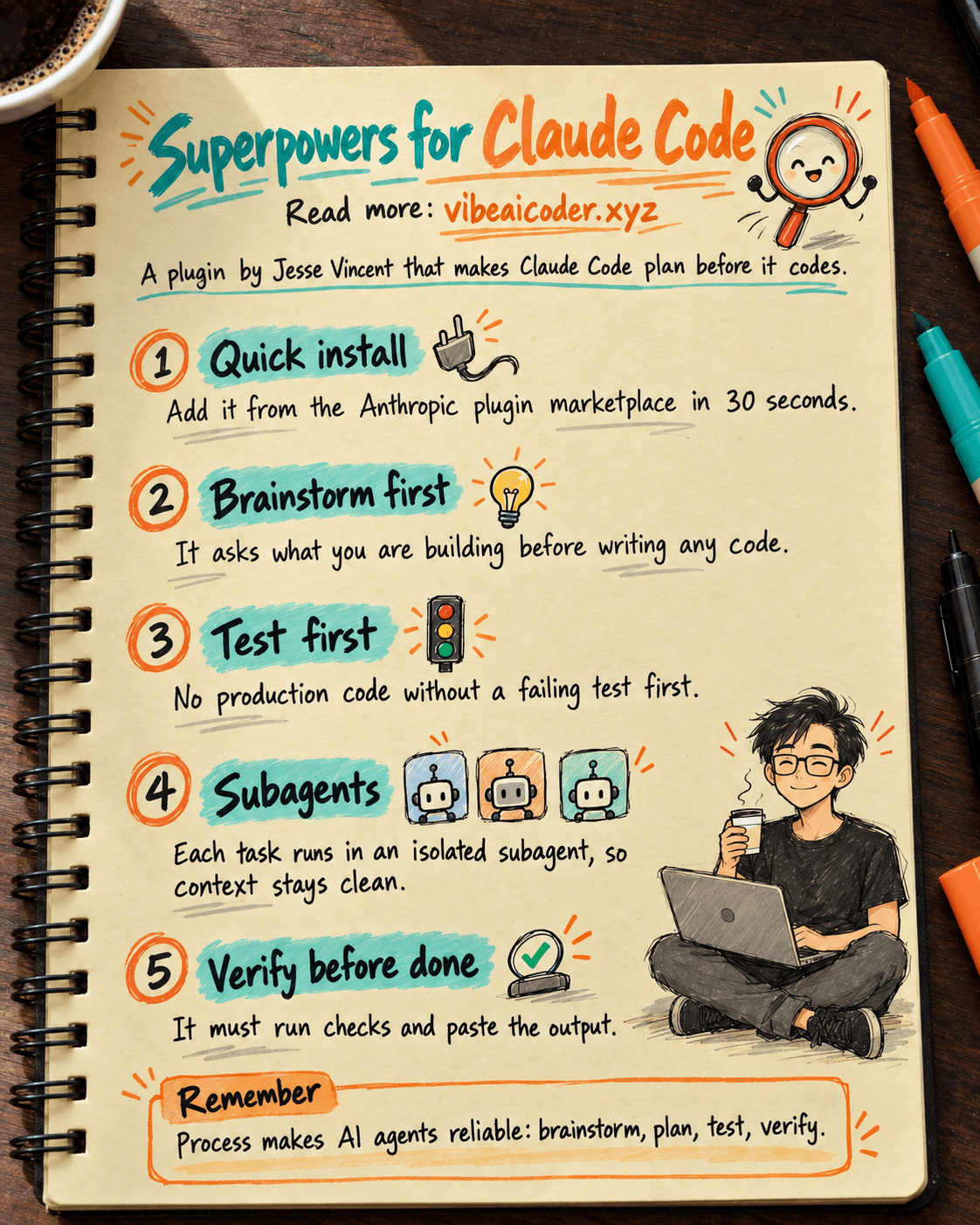
Ever notice how Claude Code defaults to being a "yes man"? You type "write function X" and it dives straight into code, no questions about context, no tests, no verification. Superpowers, a plugin by Jesse Vincent (@obra) that just landed on the Anthropic marketplace, flips that behavior on its head.
What Superpowers Is
Superpowers is a full software development methodology that standardizes the workflow for Claude Code, Codex, Gemini CLI, Cursor, OpenCode, and Factory Droid. Jesse's philosophy: "The moment an agent sees you're building something, it shouldn't jump into code. It should pause and ask what you're actually trying to do."
Instead of "vibe coding" that produces slop, Superpowers forces a strict sequence: brainstorm, plan, TDD, subagent execution, verify, finish. The repo has zero third party dependencies, is MIT licensed, and is now officially on the Anthropic marketplace.
Installing It in 30 Seconds
# Option 1: Anthropic official marketplace
/plugin install superpowers@claude-plugins-official

# Option 2: Superpowers marketplace (includes related plugins)
/plugin marketplace add obra/superpowers-marketplace
/plugin install superpowers@superpowers-marketplace
For Codex CLI, run /plugins and search for "superpowers." For Factory Droid, use droid plugin marketplace add followed by droid plugin install. Install it once, and it's available across every project.
14 Core Skills
Superpowers installs 14 skills, each a SKILL.md file with frontmatter that defines when it auto triggers. The most important ones:
- using-superpowers: bootstraps every conversation, with a
SessionStarthook that runs on startup, clear, and compact. - brainstorming: runs BEFORE any creative task, forcing the agent to clarify requirements.
- test-driven-development: runs BEFORE writing a single line of code.
- subagent-driven-development: spawns isolated subagents so context doesn't bleed into the main session.
- systematic-debugging: triggers on a bug or failing test, no guessing allowed.
- verification-before-completion: runs BEFORE claiming something is "done," requiring a verification run with pasted output.
- using-git-worktrees and finishing-a-development-branch: automatic worktrees, with prompts for merge, PR, or cleanup.
- requesting-code-review and receiving-code-review: real discipline, no performative rubber stamping.
The core rule: "If there's even a 1% chance a skill applies, you absolutely must invoke it."
The Iron Law of TDD
NO PRODUCTION CODE WITHOUT A FAILING TEST FIRST. "If you haven't seen the test fail, you don't know it's testing the right thing."
Wrote code before the test by mistake? Delete it and start over. There's no "just this once" exception.
Vanilla vs. Superpowers
| Vanilla Claude Code | With Superpowers |
|---|---|
| Generates code the moment you ask | Starts with a brainstorm |
| May or may not include tests | Failing test, then passing code, then refactor (TDD) |
| One main agent, long context, drift | Isolated subagent per atomic task |
| Can say "done" incorrectly | Must verify and paste output |
| No review process | Standardized review skill |
| Manual worktrees | Automatic git worktrees |
The result: Claude works autonomously for hours without drifting from the plan, fewer regression bugs, and teams of 5 to 10 developers can hand off big agent tasks and actually sleep at night.
Applying This for Teams in Vietnam
Three things worth keeping in mind:
- Spend one day getting familiar with the slash commands and skills before handing over an important project. Read
using-superpowersto understand how triggering works. - User instructions always take top priority. If you say "don't use TDD for this task," the agent will listen. Skills only override the default system prompt.
- It's fully customizable. You can write your own domain specific skill (say, "deploying-to-our-k8s") following the
writing-skillsskill, and package it as your own plugin.
One interesting detail: the author admits the repo has a 94% PR rejection rate because agents keep submitting slop. That shows agents still need to be taught to read the contributor guide. But that's the core idea: agents genuinely can read a spec on their own, as long as the process forces them to.
Have you tried installing Superpowers yet? Which skill has been most useful, brainstorming for asking the right questions, or verification-before-completion for shutting down false "done" claims?
Repo: github.com/obra/superpowers. Author: Jesse Vincent (@obra).
More articles

Gemini 4 Argon Reads a 500-Page Chemistry Patent in One Afternoon

Claude Opus 5.5 Codes a Real Money Trading Game in One Day

What Is a Token in AI? Why ChatGPT and Claude Charge by Tokens

What Is Chain of Thought? Why Asking AI to Think Step by Step Works Better

Claude Sonnet 5.5 vs GPT-6.1 Sol: Which AI Model Is Worth Using?

 Claude Opus 5.5 Launches: 30% Faster, 40% Cheaper, Blocks AI Brain Copying