 Harness Engineering: Vibe Coding Is Dead, a New Era Begins
Are you still "vibe coding" and praying the code just works? It's 2026 now, and that approach is no longer enough.
What Is Harness Engineering?
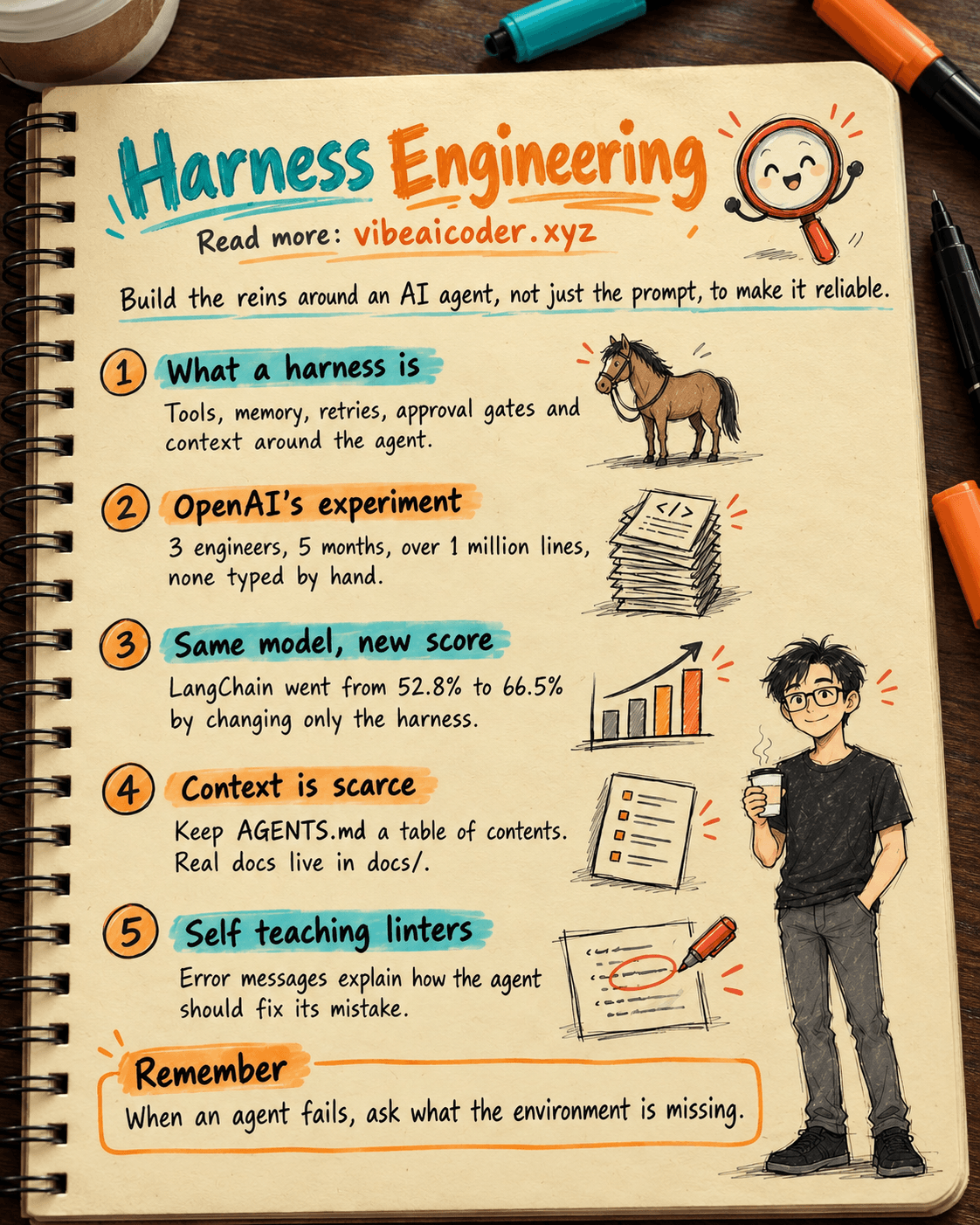
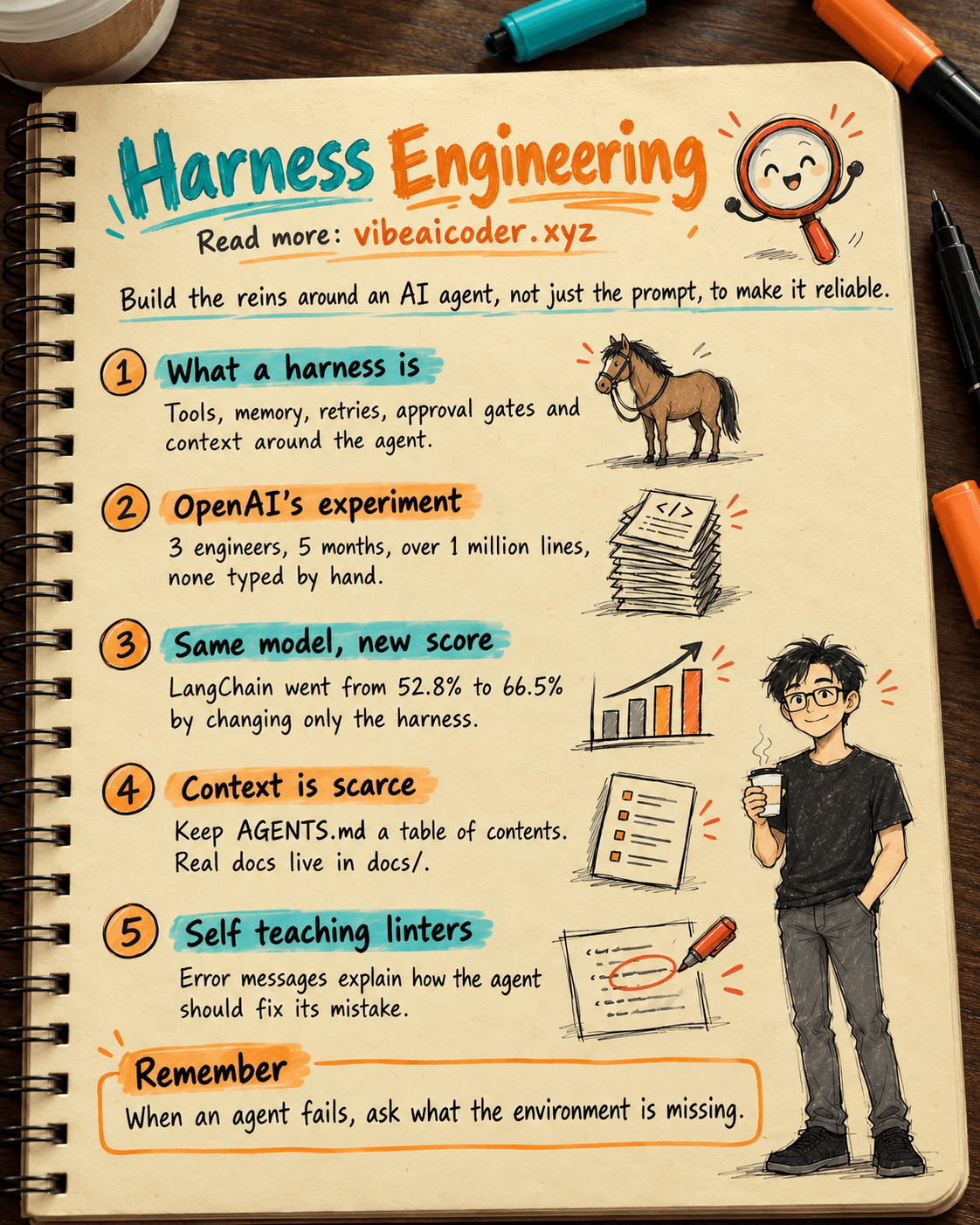
Picture an incredibly powerful but wild horse. You don't need a different horse, you need a better set of reins. That's harness engineering. It's the discipline of designing the constraints, feedback loops, and control mechanisms around an AI agent so it can operate reliably in real production environments. The harness isn't the agent itself, it's everything around it: tools, memory, retries, human approval gates, context engineering, and sub agents.
 An Unbelievable Number From OpenAI
OpenAI ran a wild experiment. A team of 3 engineers started from an empty repo and, after 5 months, produced more than 1 million lines of production code. Not a single line was hand written. It took only 10% of the time a traditional approach would need. The secret? They didn't write code, they built a harness. The real work was breaking a big goal into small building blocks, prompting an agent to build each block, then using those blocks to unlock increasingly complex tasks.
 Same Model, Completely Different Results
LangChain proves this point best. Their coding agent jumped from 52.8% to 66.5% on Terminal Bench 2.0, climbing from the Top 30 to the Top 5. They didn't change the model. They didn't change the prompt. They only changed the harness around it. Same AI, but a different operating environment produces results that are worlds apart.
 4 Core Principles
First, context is a scarce resource. A giant instructions file crowds out the actual task and code. When everything is "important," nothing is. Second, AGENTS.md is a table of contents, not an encyclopedia. The real knowledge base lives in a clearly structured docs/ folder. Third, the repository has to be easy for an agent to read, because anything the agent can't access within its context effectively doesn't exist. Fourth, custom linters with self teaching error messages help agents learn to fix their own mistakes. When an agent crosses a boundary, the error message should explain what the boundary is, why it exists, and how to fix the violation.
 Which Tools Are Leading the Pack?
Claude Code with its Agent SDK is currently a top choice, offering a built in permission model, a hooks system, and support for multi session agents. CrewAI focuses on orchestrating multiple agents with its Flows feature. Cursor builds harness capabilities directly into the IDE through rules files and loop detection. Each tool has its own strength, but they all share the same underlying harness philosophy.
 The Engineer's Role Has Changed
2025 proved that AI can write code. 2026 is showing that the hard part was never the model, it's the harness. Engineers no longer sit around writing code line by line. They design systems, define intent, and build feedback loops. When an agent produces a weak result, the answer isn't "try harder," it's "what is the environment missing?" That is the real moat of 2026.
More articles

Gemini 4 Argon Reads a 500-Page Chemistry Patent in One Afternoon

Claude Opus 5.5 Codes a Real Money Trading Game in One Day

What Is a Token in AI? Why ChatGPT and Claude Charge by Tokens

What Is Chain of Thought? Why Asking AI to Think Step by Step Works Better

Claude Sonnet 5.5 vs GPT-6.1 Sol: Which AI Model Is Worth Using?

 Claude Opus 5.5 Launches: 30% Faster, 40% Cheaper, Blocks AI Brain Copying