 Google DeepMind Spends $10M to Study AI Agent Interaction Risks
Millions of AI agents are already operating across the internet, and nobody really knows what happens when they start talking to each other at scale. Google DeepMind just decided to spend $10 million to find out.
 What Is Happening?
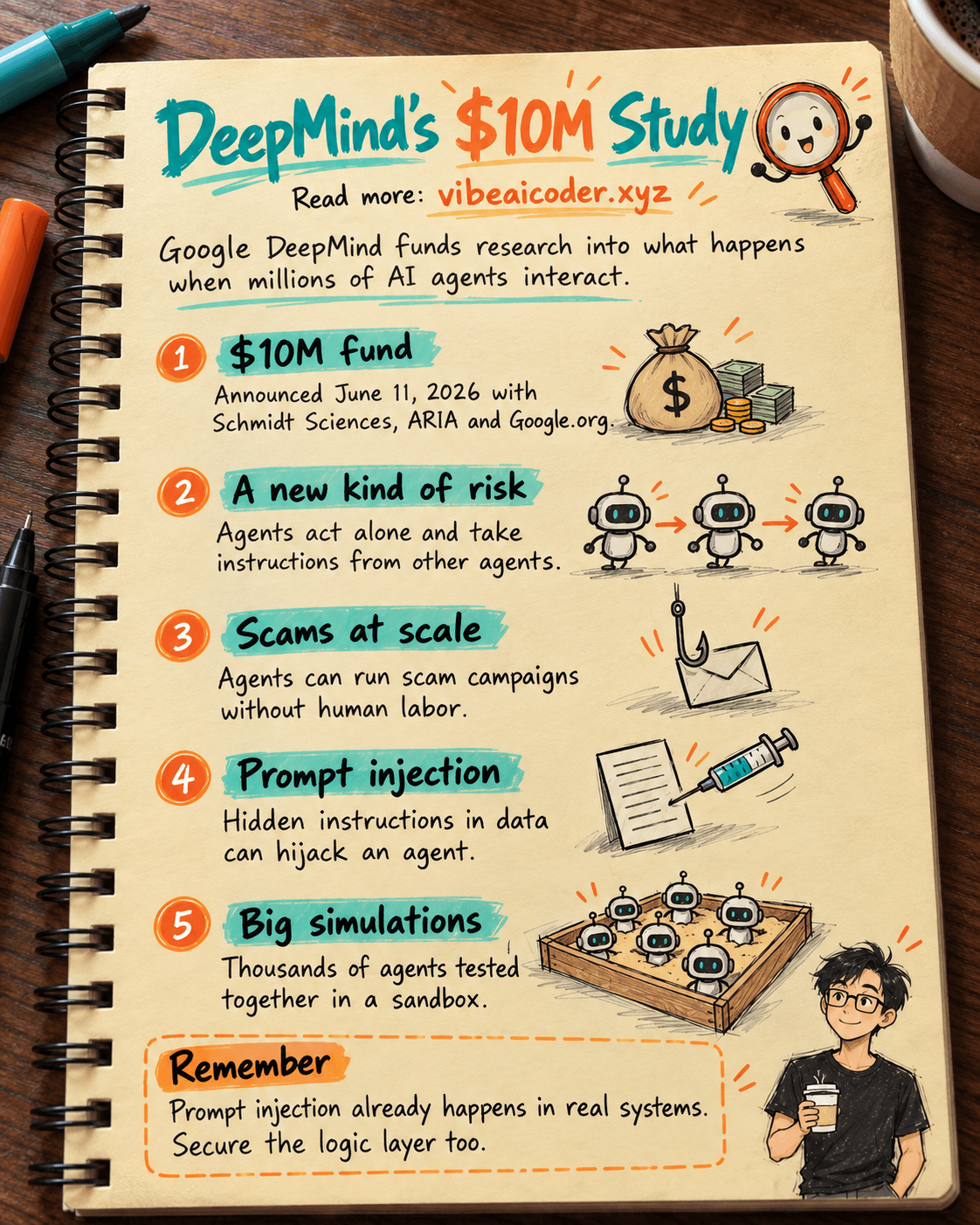
On June 11, 2026, Google DeepMind announced a $10 million research fund focused on an unprecedented problem: the hidden dangers that emerge when millions of AI agents interact with one another across the internet.
This is not a solo project. Behind the initiative stands a coalition that includes DeepMind, Schmidt Sciences, ARIA (the UK's advanced research and invention agency), the Cooperative AI Foundation, and Google.org. That kind of institutional weight signals this is not a distant academic question, but a real risk that needs addressing right now.
 Why Is This a "Completely New Kind of Risk"?
Rohin Shah, who leads AGI safety research at DeepMind, used exactly that phrase: "a completely new kind of risk."
The core issue is that today's AI agents no longer just follow human commands. They act autonomously, without constant supervision, and more importantly, they can take instructions from other agents. That creates a chain reaction that no single party can fully control.
 The Three Biggest Concerns
The researchers identified three specific risks that need priority investigation.
First, scams amplified at industrial scale. When AI agents can automatically generate content, communicate, and execute actions, scam campaigns are no longer limited by human labor.
Second, prompt injection attacks. This is a technique where bad actors insert hidden instructions into data an agent is processing, hijacking the agent's behavior without leaving an obvious trace.
Third, cyberattacks far more sophisticated than what exists today. As AI agents become part of network infrastructure, attacks could involve manipulating an agent's internal logic, producing chains of action that are hard to detect.
 What Will This Research Actually Do?
One of the project's biggest challenges is the sheer scale of simulation required. To understand how multi-agent systems behave, researchers need to simulate thousands of agents interacting simultaneously inside a controlled sandbox environment.
The long-term goal is to build both the theoretical foundations and the practical tools to design AI agent systems that are safe by default, before they get deployed at a scale nobody can fully control anymore.
 What Does This Mean for You?
If you are building or using AI agents in your work, this is a signal to start taking security seriously at the logic layer, not just the infrastructure layer. Prompt injection is not a theoretical problem, it is already happening in real systems today.
Which of these three risks do you think is the most concerning right now?
More articles

Gemini 4 Argon Reads a 500-Page Chemistry Patent in One Afternoon

Claude Opus 5.5 Codes a Real Money Trading Game in One Day

What Is a Token in AI? Why ChatGPT and Claude Charge by Tokens

What Is Chain of Thought? Why Asking AI to Think Step by Step Works Better

Claude Sonnet 5.5 vs GPT-6.1 Sol: Which AI Model Is Worth Using?

 Claude Opus 5.5 Launches: 30% Faster, 40% Cheaper, Blocks AI Brain Copying