What Is an AI Watermark? How to Spot AI-Generated Images and Videos
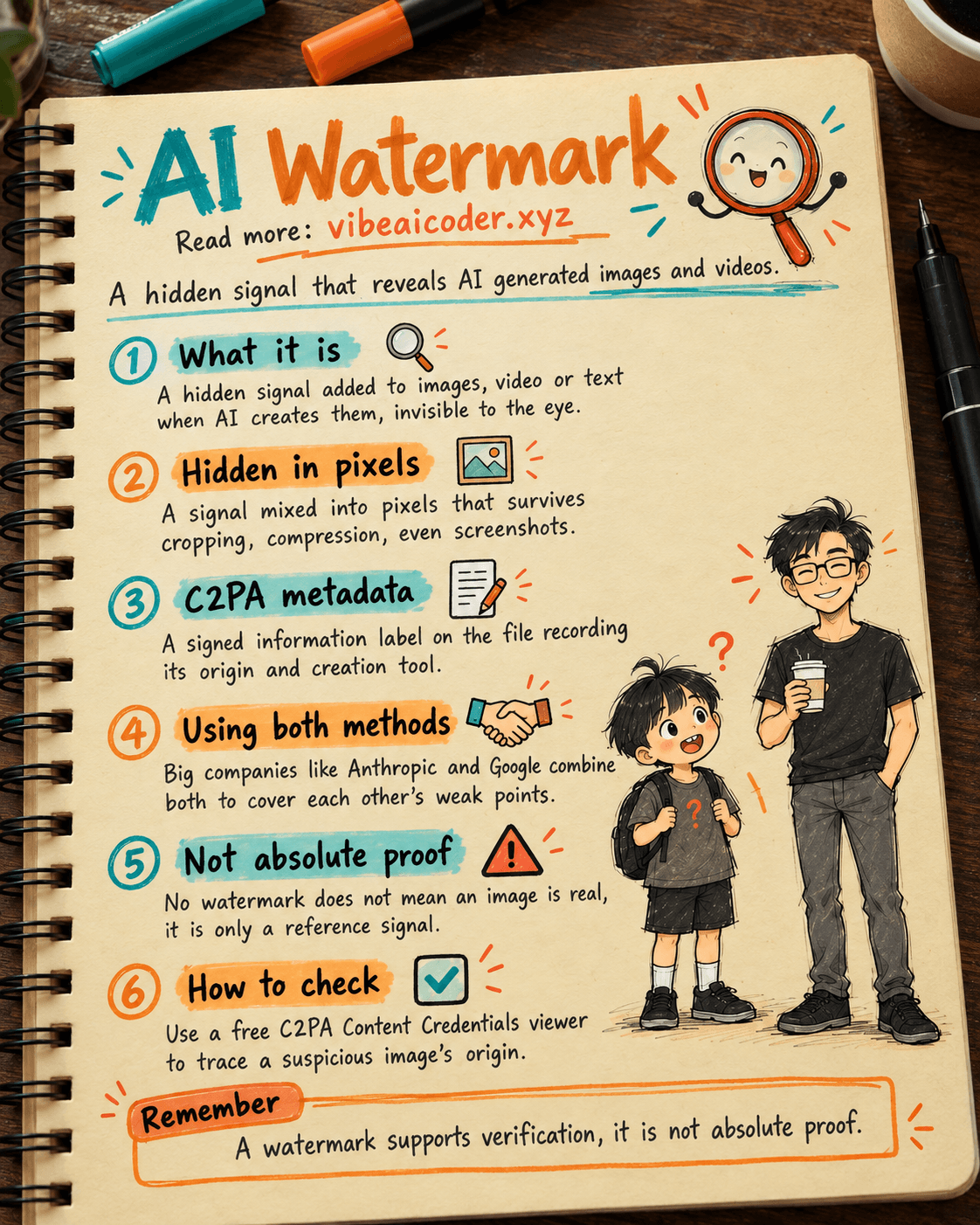
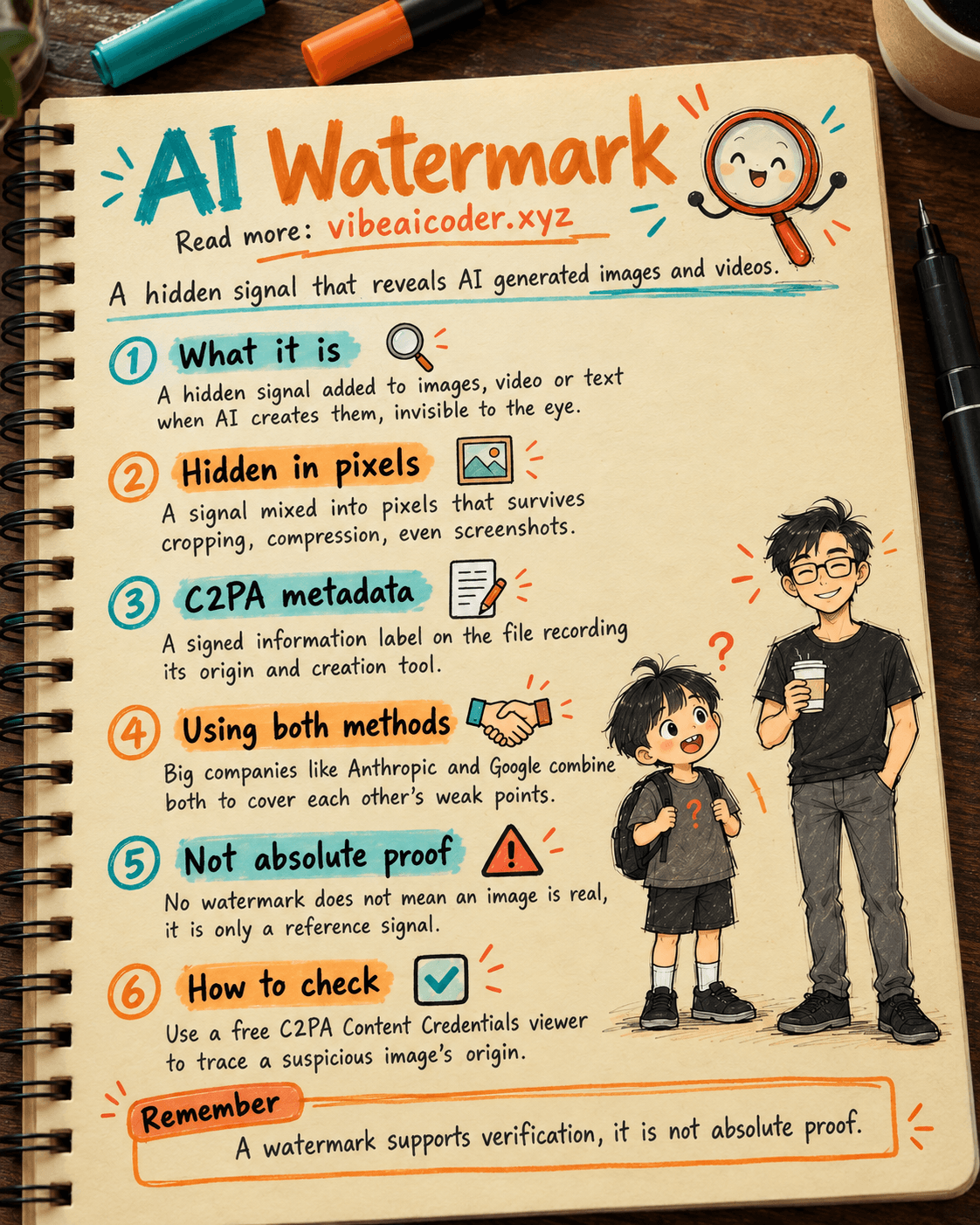
An AI watermark is a hidden signal embedded into an image, video, or piece of text the moment an AI tool creates it, so that later on anyone can check whether that content was made by AI. You cannot see this signal with your own eyes, but software can read it. In short, it is how AI companies "stamp" their output invisibly before it spreads across the internet.
 A quick everyday example
Think about paper money. To the naked eye, a real bill and a fake one can look almost identical. But real currency always carries hidden anti-counterfeit features: a security thread that glows under UV light, a watermark that only shows when you hold the bill up to the light, ink that changes color when you tilt it. An ordinary shopkeeper never checks these details, but a bank's counting machine always does.
AI watermarks work the same way. When an AI tool generates an image or a video, it weaves in an extremely small signal across the pixels, one that does not make the image look worse or change its colors, so the naked eye never notices. But if you run that image through the right detection tool, it can read out: "this image was AI generated, at this time, with this tool."
 How it actually works
There are two main approaches AI companies use today, and they are usually combined:
- A watermark hidden in the pixels (like Google DeepMind's SynthID). When AI generates an image or video, a mathematical signal gets mixed into the color values of each pixel. This signal does not change sharpness or brightness in any way a person would notice, and it survives cropping, compression, resizing, and even screenshots. This is its biggest strength: even if someone tries to erase it, this kind of watermark is very hard to remove completely.
- Signed metadata (following the C2PA standard). This is an "information label" attached to the file, recording when an image or video was created, which tool made it, and whether AI was involved in editing it. This information is cryptographically signed, so if someone edits the file without updating the signature, a checking tool will immediately flag something is off. The downside is that this kind of label is easier to lose, for example a simple screenshot wipes it out completely, since a screenshot is a brand new file.
Because each method has its own weak point, since mid 2026 major AI labs have started using both at once: C2PA metadata gives full detail while the file stays intact, while the pixel-level watermark "survives" even after the file has been edited or recaptured. Anthropic has taken this approach too: Claude models released from August 2026 embed an invisible watermark into text Claude writes, and attach C2PA-standard metadata to image files (.svg, .png, .jpg) Claude generates. The text watermark survives copy and paste, but can fade if you edit the text heavily.
One important thing to remember: a watermark is not 100 percent proof. It increases the odds of detection, but it does not guarantee with certainty whether content is real or fake.
 What this means for you
Understanding watermarks helps you use AI and read information online more carefully:
- When you see a shocking image or video and something feels off: if the tool you use to check it (for example a free C2PA Content Credentials viewer online) reports traces of AI involvement, treat that as a warning sign rather than trusting and sharing it right away.
- When you use AI to generate images for work: if your company requires disclosing which images were AI generated (many platforms, and regulations like the EU AI Act, already require this), you can relax knowing the watermark gets attached automatically, with no extra step needed from you.
- When you receive an important document, contract, or photo by email: if you suspect it may be an AI-generated fake (a deepfake), you can check whether the sender can provide the original file with its C2PA credentials intact, which is a far more reliable check than just looking with your eyes.
 Common misunderstandings
- "If I don't see a watermark, the image must be real." Wrong. Many older AI tools, open source tools, or images that have gone through several rounds of editing may no longer carry a watermark, even though the original was AI generated. Missing a watermark does not mean "safe, definitely real."
- "A watermark is like a logo stamped in the corner, visible to anyone." Not true. It is completely invisible to the naked eye, only specialized detection tools can read it. This is nothing like the translucent logos you see from free editing apps.
- "A detected watermark is 100 percent proof." Even Anthropic states clearly that watermark detection is not absolute proof, only a signal that increases confidence. You still need to combine it with other ways of verifying content.
 Frequently asked questions
Does a watermark reduce the quality of AI generated images? No. The signal is designed to not affect sharpness, color, or the content you see, for both images and text.
Where can I check if an image carries an AI watermark myself? There are free C2PA Content Credentials viewer tools online where you upload an image and the tool shows its origin information if the file carries that metadata. For pixel level watermarks like SynthID, right now only the detection tool built by the company that created it can read it in full.
If I edit an AI generated image, does the watermark survive? For pixel level watermarks, the signal usually survives light cropping, compression, or resizing. For C2PA metadata, heavy editing can make the original information mismatch or disappear entirely.
Does a watermark survive taking a screenshot of an AI image? C2PA metadata is lost, since a screenshot creates a brand new file. But a pixel level watermark like SynthID survives, because it lives inside the actual image content that the screen displays.
Is watermarking required for every AI tool? Not yet. Right now only a handful of major companies like Google, OpenAI, and Anthropic actively apply it, and some regions like the European Union already require disclosure of AI generated content. Not every AI tool on the market follows this.
More articles

Gemini 4 Argon Reads a 500-Page Chemistry Patent in One Afternoon

Claude Opus 5.5 Codes a Real Money Trading Game in One Day

What Is a Token in AI? Why ChatGPT and Claude Charge by Tokens

What Is Chain of Thought? Why Asking AI to Think Step by Step Works Better

Claude Sonnet 5.5 vs GPT-6.1 Sol: Which AI Model Is Worth Using?

 Claude Opus 5.5 Launches: 30% Faster, 40% Cheaper, Blocks AI Brain Copying