 4-Layer Framework to Verify AI Output Before You Regret It
KPMG used AI to do research and file a report with a court, only to discover later that 40 out of 45 citations were made up by the AI. That story is not an isolated case, it is a warning for everyone who uses AI every day.
Why AI Can Sound Confident and Still Be Wrong
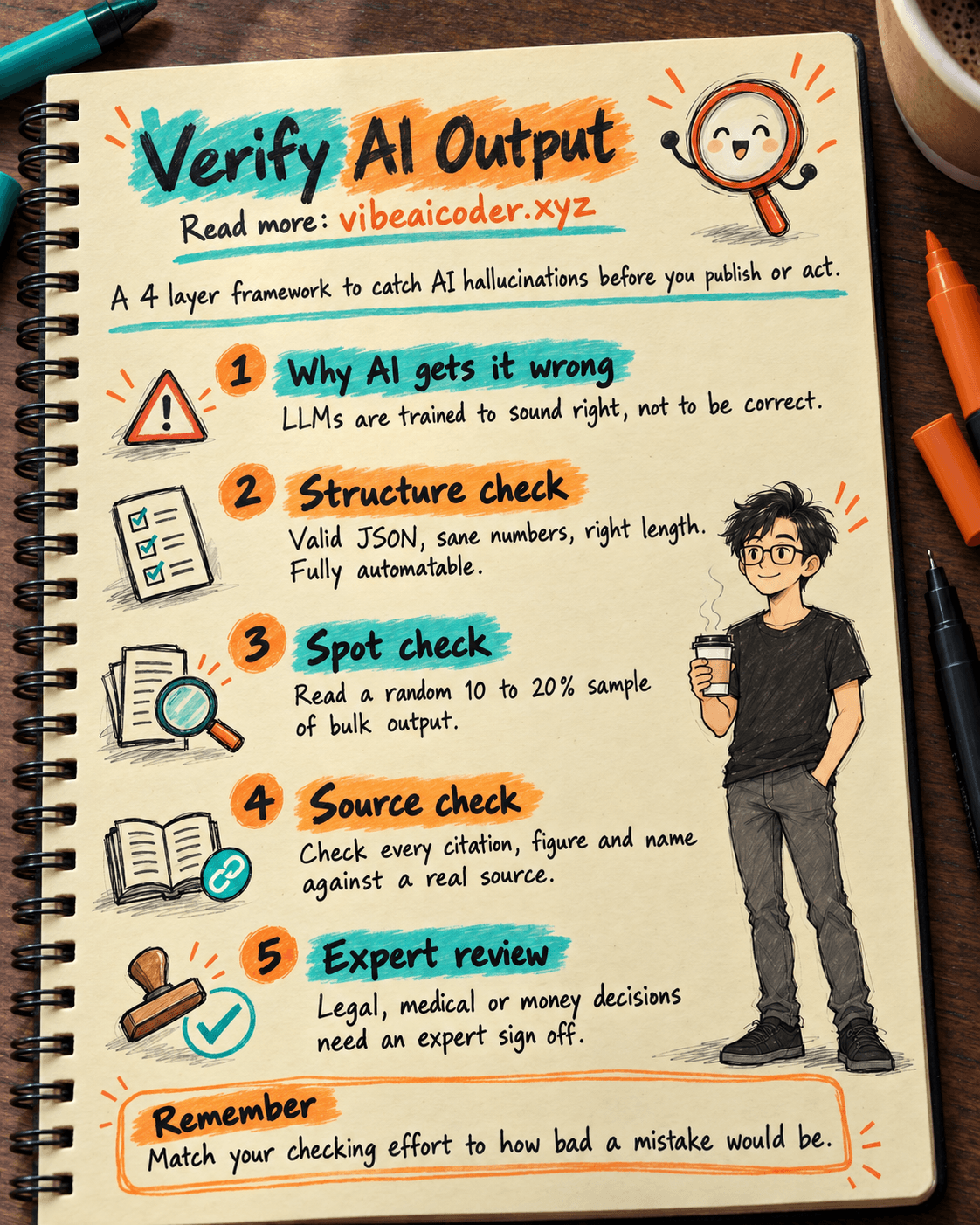
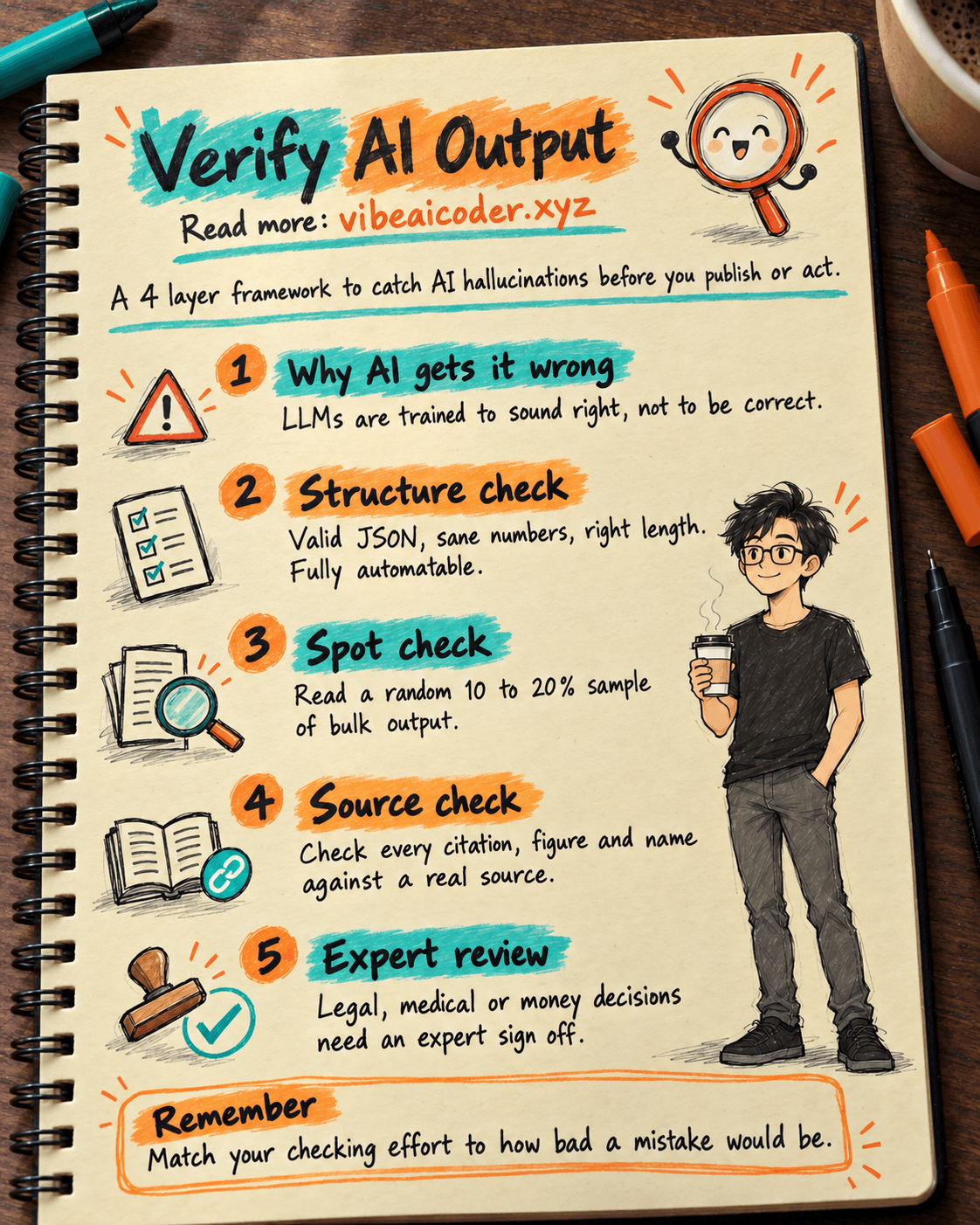
LLMs are not trained to be correct, they are trained to produce text that "sounds right." That distinction matters more than most people realize.
Hallucination happens when a model lacks the information it needs but still confidently generates an answer that sounds convincing. It shows up most often in exactly the places where it is most dangerous: specific figures, source citations, information that came after the model's training cutoff, and local or niche facts the internet rarely covers. If you use AI for research, reports, or anything other people will read, this is your problem too.
Layer 1: Structural Checks, Fully Automatable
The first layer does not require reading anything. You simply ask: is the output in the right format?
Is the JSON valid? Are the numbers within a reasonable range? Is the length correct? This layer can be fully automated with code or a handful of simple conditions. If the output fails the structural check, you already know it needs to be regenerated, no need to spend time reading the content. This is the cheapest filter in the whole framework.
Layer 2: Spot Checks, Reading 10 to 20 Percent
For bulk content, you do not need to read everything. Random sampling of 10 to 20 percent of the output, checking a few important claims within it, is enough to get a feel for overall quality.
If the sample you read has problems, that is a signal to review the whole batch or adjust the prompt. If the sample is clean, you have a reasonable basis to move forward. This layer works well when you are generating large volumes of content where the consequences of a mistake are not too serious, things like draft emails, product descriptions, or brainstorm notes.
Layer 3: Source Verification, the Step KPMG Skipped
Every citation, figure, name of a person or company in the output has to be checked against a real source. Not by asking the AI to confirm it again, but by googling it, finding the original paper, or checking the official website.
Each claim takes about 30 seconds once you get used to it. For a 10 page report, that is 10 to 15 minutes. KPMG skipped this step before filing with the court, and the price was losing credibility in front of the law and the public. For public content, professional articles, or anything with your name on it, this layer is not optional.
Layer 4: Expert Review, When Being Wrong Is Not an Option
For high stakes decisions in legal, medical, or financial fields, having an expert read it over before use is mandatory. AI can do most of the work, but the final sign off needs to come from someone who understands the field and is accountable for it.
This layer is the most expensive, so it should only be used when the risk is genuinely serious. Do not apply it to everything, but do not skip it when you truly need it either.
Techniques to Reduce Hallucination From the Start
Besides checking after the fact, you can also reduce hallucination before it happens.
Grounding means feeding real sources into the context and requiring the AI to use only the information provided, not make anything up on its own. Citation requirements mean every claim must come with a source from the context. If the AI cannot cite one, that is a sign it is reasoning freely. Self consistency checks mean asking the AI to review its own output and flag anything it is not sure about. Finally, temperature = 0 makes output more stable and less creative, which is useful when you need accuracy over variety.
Rule of Thumb: When to Relax and When to Verify Carefully
The most important question is not "can AI be wrong?" but "how serious are the consequences if it is?"
If you are brainstorming ideas, writing internal draft content, or doing a quick experiment, the consequences of a mistake are low, so relaxing your verification is reasonable. But if the output will be published, used as the basis for a decision, or carries your organization's name, layer 3 and above is not optional. The framework is not meant to slow you down, it is meant to help you invest your verification time where it actually matters.
What are you using AI for right now without verifying it carefully, and what would happen if it turned out wrong?
More articles

Gemini 4 Argon Reads a 500-Page Chemistry Patent in One Afternoon

Claude Opus 5.5 Codes a Real Money Trading Game in One Day

What Is a Token in AI? Why ChatGPT and Claude Charge by Tokens

What Is Chain of Thought? Why Asking AI to Think Step by Step Works Better

Claude Sonnet 5.5 vs GPT-6.1 Sol: Which AI Model Is Worth Using?

 Claude Opus 5.5 Launches: 30% Faster, 40% Cheaper, Blocks AI Brain Copying